Ancala roofing, thirty years in.
Concrete tile, flat sections and the underlayment that holds it all, on the lower McDowell slopes above Shea — one family-owned, licensed roofer.
Ancala was built well enough in the 1990s that its roofs still look new from the fairway, which is exactly the problem.
Ancala climbs the lower slope of the McDowells north of Shea Boulevard and east of the Loop 101, a guard-gated country club community laid out around its course in the early 1990s and built out, lot by custom lot, over the decade that followed. The roofs are concrete tile almost without exception: S-tile and flat profiles in the sand and terracotta blends the design committee approved, over felt underlayment, on rooflines with more hips, valleys and roof-to-wall transitions than a production house. Thirty summers later the tile has barely changed. The felt beneath it has been through 114 excessive-heat reports since 2010 in the NWS record for this area, and it has changed completely.
We have worked the custom lots along Via Linda and up the slope toward the Preserve, the fairway homes on both sides of the course, and the townhomes and semi-custom streets on the community's lower edge, as well as the 1990s subdivisions outside the gates along Mountain View Road and the Shea corridor. The jobs repeat: an underlayment replacement on a roof that has reached its date, a valley or a transition redone in metal after a leak, a run of eave tile reset after an August outflow. The company is family owned and operated, licensed, bonded and insured.
This page lays out what the National Weather Service has recorded around Ancala since 2010, including the hail that still gets talked about, what the City of Scottsdale asks of a re-roof, which systems make sense on these slopes, and the questions owners here ask us. Then book the free inspection and we will lift tile in the places that tell the truth.
Four things that break Ancala roofs, in the order they do it.
Ancala gets the Valley's heat, the McDowells' outflow wind, and, once in a long while, the kind of hail that reroofs a neighborhood. On thirty-year-old custom rooflines the damage shows up in a predictable sequence.
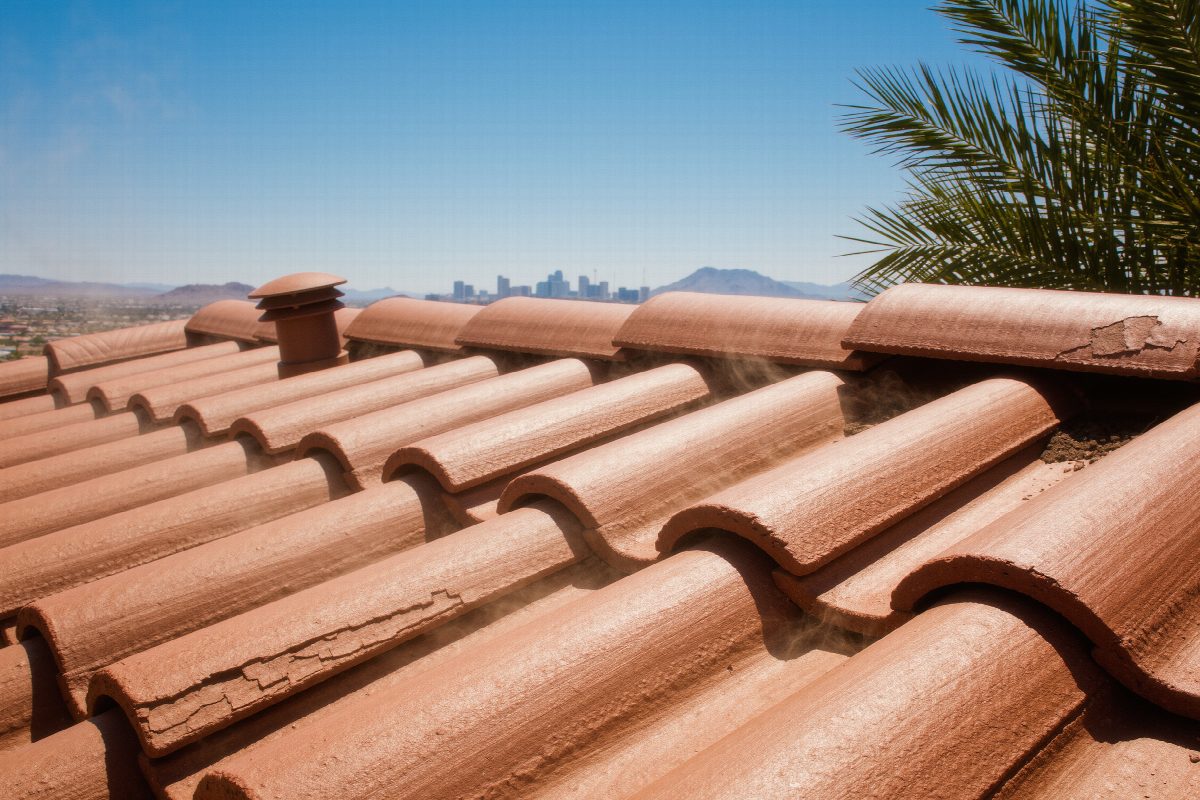
Underlayment that has reached its date
The 1990s builders here laid concrete tile over asphalt felt, and the lifespan table below gives that felt twenty to twenty-five years. Ancala's earliest roofs are past the top of that range. The felt goes brittle on the south and west slopes first, cracks at the laps, and the first sign is a ceiling stain after a sideways rain rather than anything you can see from the street. A tile underlayment replacement lifts and stacks your tile, replaces the sheet with a high-temperature synthetic, redoes every flashing in metal and relays the tile you own.
Valleys and transitions on custom rooflines
A custom house has valleys where a tract house has none, and lower roofs running into upper walls wherever the plan stepped. The 1990s detail at those spots was often a strip of felt and a bead of mastic, which held for a decade. Water that moves fast down a long valley then finds the lap. We reflash valleys with a wide metal pan and step and counterflash every wall, which is the part of an underlayment job that actually stops the leaks.
Outflow wind off the slope
The record shows 70-mile-an-hour gusts in August 2018 that the NWS placed near Shea Boulevard east of the Loop 101, which is Ancala's address, and again in August 2024 along Mountain View Road, where the wind uprooted trees on a school campus. Wind takes the eave course and the hip and ridge caps, then drives rain under the tile it did not lift. Wind repair is a small job in the first week and a large one by October.
Hail, rarely and memorably
On October 5, 2010 a storm tracked from south of Chandler to far north Scottsdale and dropped hail to 2.5 inches across this part of the city, damaging hundreds of roofs and dozens of aircraft at the airport, and a generation of Ancala tile was replaced on insurance afterward. Since then the record holds 1.5-inch hail in August 2022 and 1-inch stones in 2019 and 2025. Hail claims turn on photographs taken soon after; we take them.
What the weather has actually done around Ancala since 2010.
The National Weather Service logs every storm report it can verify. These are the ones within 4 miles of Ancala: 114 excessive heat reports, 54 dust storm reports, 24 heat reports, 10 strong wind reports. The tennis-ball hail of October 2010 is the event everyone in Ancala remembers, and the one that reroofed the neighborhood; since then it is the 70-mile-an-hour outflow gusts of August 2018 near Shea and the 101 and August 2024 on Mountain View Road that have kept us on these roofs, with the 1.5-inch hail of August 2022 as the thing to check tile for.

| Date | Event | Recorded | Where | What it does to roofs | |
|---|---|---|---|---|---|
| Sep 26, 2025 | Hail | 1" hailReport of 1 inch diameter hail near 92nd Place and East Laurel Lane in Scottsdale. No injuries or damage reported. | Scottsdale Municipal Airport | Bruised shingles, cracked tile, dented soft metals; foam coatings chip. | NOAA #1293451 |
| Aug 6, 2024 | Thunderstorm WindProperty damage logged: $3,000 | 70 mph est. gustMultiple large uprooted trees inside the Cochise Elementary School campus located along East Mountain View Road in Scottsdale. Wind gusts were estimated upwards of 70 mp… | Scottsdale Municipal Airport | Lifted tile, torn shingles, flashing peeled at the edges; wind-borne debris punctures flat roofs. | NOAA #1205960 |
| Aug 12, 2022 | Hail | 1.5" hailPing-pong sized hail reported along Loop 101 and East Cactus Road in Scottsdale. No damages or injuries were reported. | Scottsdale Municipal Airport | Bruised shingles, cracked tile, dented soft metals; foam coatings chip. | NOAA #1053466 |
| Sep 23, 2019 | Hail | 1" hailScattered to numerous showers and thunderstorms developed across the northeast portion of the greater Phoenix area during late afternoon and early evening hours on Septe… | Scottsdale Municipal Airport | Bruised shingles, cracked tile, dented soft metals; foam coatings chip. | NOAA #850060 |
| Aug 12, 2018 | Thunderstorm WindProperty damage logged: $40,000 | 70 mph est. gustThunderstorms with strong, gusty and damaging outflow winds moved across the northeast portion of the greater Phoenix area during the late afternoon hours on August 12th… | Scottsdale Municipal Airport | Lifted tile, torn shingles, flashing peeled at the edges; wind-borne debris punctures flat roofs. | NOAA #771102 |
| Aug 2, 2016 | Thunderstorm WindProperty damage logged: $30,000 | 70 mph est. gustThunderstorms moved across the greater Phoenix area, including the community of Fountain Hills, during the afternoon hours on July 2nd. Some of the stronger storms gener… | Fountain Hills | Lifted tile, torn shingles, flashing peeled at the edges; wind-borne debris punctures flat roofs. | NOAA #646596 |
| Oct 5, 2010 | HailProperty damage logged: $110,000,000 | 2.5" hailThis storm moved from south of Chandler to far north Scottsdale. As the storm moved through Scottsdale, the storm dropped up to tennis ball sized hail. The hail damaged … | Scottsdale | Bruised shingles, cracked tile, dented soft metals; foam coatings chip. | NOAA #266217 |
| May 2, 2010 | High WindProperty damage logged: $50,000 | 58 mph est. gustSeveral homes in Chandler, near Kyrene and Ray, had roof tiles blown off. Tree limbs were also blown down. One woman described the wind sounding like a roaring train. | Greater Phoenix Area | Ridge caps and edge metal lift first; wind-driven rain gets under tile. | NOAA #221406 |
Source: NOAA NCEI Storm Events Database, events from 2010 through 2026 with a reported location within 4 miles of Ancala, or an NWS zone warning covering it. Wind speeds marked "est." are NWS estimates from damage; "measured" gusts came from an instrument. Dollar figures are the property damage NWS logged for the whole event, not one roof.
Excessive-heat warning days covering Ancala, by year
Each bar is a day the NWS issued a heat warning or advisory for the forecast zone Ancala sits in. Heat is the slow storm: it is what ages underlayment, shingles and coatings between the loud ones.
Had one of these go over your roof? A free inspection with photos tells you what it did, in writing, before the next one. Storm damage is cheapest fixed the week it happens.
Every roof. Every property type.
One trusted, family-owned roofer for Ancala — homes, businesses, and multifamily communities alike.
Residential Roofing
Tile, shingle, foam, metal, and flat roofs for Ancala homes — installs, repairs, and replacements.
Commercial Roofing
TPO, PVC, EPDM, foam, and metal systems engineered for Ancala's toughest buildings.
Multifamily Roofing
Apartment, condo, and HOA roofing across Ancala — phased, documented, and warrantied.
An honest number takes four facts, not a city name.
We do not publish a Ancala price list, because there is no such thing as a Ancala roof. There is your roof: its square footage, its pitch, what is on it now, and how many layers and penetrations are hiding underneath. Our instant estimator asks exactly those questions and prices them from our real job costs, in about a minute, with no phone call.

Size and pitch
Priced by the roofing square (100 sq ft). Steep slopes and two-story walls add labor and safety setup; a flat roof adds drainage work.
The system
Tile is the most expensive to install and the cheapest to keep; shingles the reverse. Foam is a recoat every decade, not a tear-off.
What is underneath
Most Ancala tile roofs do not need new tile; they need new underlayment. Rotten decking, extra layers and old skylights are the surprises, and we price them before we start, not after. What a full replacement involves.
Permit and disposal
Where Scottsdale requires a permit, the fee and the inspections are part of the quote. So is the dumpster. Financing is available on every job.
What the City of Scottsdale requires before the first tile moves.
Read from the official pages, linked below, and worth reading yourself: a permit pulled in your name by a licensed contractor is the paper trail that protects your warranty, your insurance claim, and your sale price. We pull the permit and schedule the inspections on every job that needs one. The authority is Planning and Development Services - Permit Services / One Stop Shop, Permit Services 480-312-2500; One Stop Shop 480-312-7725; Inspection Services 480-312-5750.

Like-for-like re-roof is exempt. Listed under 'Work that does not require a permit': "Re-roofing when the same roofing material is used". A change of material is not addressed by name; the same page lists "Alteration of building exterior" under work that requires a Building Permit.
Roof repair is not named. General statement: "home improvement projects that are cosmetic, do not involve structural changes, and do not require skilled trades ... do not require a permit" (same page).
Not stated for roofs. Page says projects that require "construction, structural improvements, demolition" require a permit.
No roof-specific inspection published; same-material re-roof needs no permit. Permitted projects: "Inspections are requested and completed in phases."
2021 IBC, IEBC, IPC, IMC, IFGC, IFC, ISPSC and 2020 NEC with city amendments effective Jan. 1, 2023; 2021 IRC and 2021 IECC amendments effective Jan. 7, 2023 (Ordinance No. 4575, Resolution No. 12499); 2021 IgCC mandatory July 1, 2023. and the 2021 IRC amendments PDF.
No re-roof figure published (re-roof is exempt). Fee schedule: "Work completed without a permit will be fined an amount equal to double the permit fee."
Exempt work "can be done by the homeowner, or their contracted professional"; no owner-builder rule for permitted roof work found.
Cool-roof rule: 2021 IRC amendments add Section N1102.6 (R402.6) requiring low-sloped roof surfaces (Climate Zones 0-3) to meet a 3-year-aged SRI of 64, or aged reflectance 0.55 and emittance 0.75, unless prohibited by the ESLO (Resolution No. 12499, p. 8).
Rules change and we are roofers, not the building department: confirm the current requirement with the City of Scottsdale before work starts. Rules above were read from the linked official pages on October 25, 2026.

What lasts here, and how long.
The design committee decided what Ancala roofs look like thirty years ago and has not changed its mind. These are the systems that fit that decision and how long each lasts here.
Concrete tile, the Ancala standard
Right for the architecture and durable for fifty years or more. The original profiles and blends are mostly still made. The underlayment is the roof; replace it at year twenty-five with a synthetic sheet and the tile goes back on for another lifetime.
Flat sections behind parapets
Many of the custom homes have low-slope areas over garages, patios and entry towers, finished in foam or a modified bitumen membrane. They leak before the tile does, because they hold water and the tile does not. Scuppers cleared in May and a recoat on a ten-to-fifteen-year cycle is the whole program. Foam is the usual choice for a replacement.
Standing-seam metal, as accents
Copper and painted steel appear on entry porticos and bay windows, and occasionally on a contemporary remodel. They outlast everything else on the house; the soldered seams and the flashing into stucco are what we check after wind.
Shingles, outside the gates
Some of the 1990s tracts along the Shea corridor carry architectural shingles, which the sun here ages faster than the label promises: eighteen to twenty-five years, with granule loss in the gutters as the early warning.
| Roof system | Expected life here | What decides it |
|---|---|---|
| Concrete tile | 50 years or more for the tile; 20 to 25 for the underlayment beneath it | The tile outlives the felt it sits on. Most "tile roof replacements" here are underlayment replacements with the tile relaid. |
| Asphalt shingles (architectural) | 18 to 25 years | The Valley sun ages shingles faster than the label says; granule loss is the tell. |
| Spray polyurethane foam with elastomeric coating | 25 years and up, with a recoat every 10 to 15 | Foam is a system you maintain, not replace; let the coating go and the foam goes with it. |
| Standing-seam metal | 40 to 60 years | Expansion and contraction loosen fasteners over decades; otherwise it shrugs off the heat. |
| Modified bitumen or single-ply (TPO, PVC) on flat roofs | 15 to 25 years | Reflective membranes last longest; ponding water takes years off any of them. |
Ranges reflect roofs in this climate region under normal maintenance; a warranty up to 30 years is available on qualifying systems we install. Compare systems on our residential roofing page.
Every part of Ancala was built in a different decade, and the roofs show it.
Ancala is small enough to walk, but the roofs still divide by where on the slope the lot sits and when it was built.

| Area | Housing and roofs | What we see on inspections |
|---|---|---|
| The upper custom lots | The 1990s and early 2000s estates highest on the slope toward the Preserve: large custom homes, concrete tile over multiple elevations, flat sections behind parapets, long valleys. | Original felt at the end of its life, valley and transition flashing that was never metal, and wind damage at the eaves on the exposed east and north faces. |
| The fairway and interior streets | The semi-custom homes along the course and the gated interior, mostly mid-1990s: S-tile and flat concrete tile on simpler rooflines. | Underlayment replacements by the street now that the whole phase has crossed twenty-five years; eave and hip tile loosened in the August outflows; design-committee color matching on replacement tile. |
| Townhomes and the lower edge | The attached and clustered homes near the entrance and the Via Linda frontage, association-managed. | Shared valleys and parapets where a leak starts on the neighbor's side; phased underlayment projects coordinated with the association. |
| Outside the gates: Via Linda, Mountain View and the Shea corridor | 1980s and 1990s tile and shingle tracts on the flatter ground below Ancala, including the streets the August 2024 outflow went through. | Felt past its date under tile, shingles at the end of their life, and ridge caps and eave tile displaced in wind. |
The services an Ancala roof actually needs.
Excellent 1990s tile over underlayment that has finished its job. A cheaper problem than it looks.
Get your free Ancala roofing estimate.
Tell us about your property and our team will follow up fast with an honest assessment and a clear plan — no pressure, no obligation.
- Superior ratings across Google, Yelp & Facebook.
- Industry-leading warranty up to 30 years.
- Family owned, licensed, bonded & insured. AZ ROC #325294.
Prefer to talk? Call (602) 314-4650. Prefer to pick a time? Book online.
Get Your Free Estimate
Free roof inspection · Response within 24 hrs
Thank you!
Your request has been received. Our team will contact you shortly.

A roof here has a calendar. Here is ours.
Ancala's calendar is the Valley's, with one addition: on a roof past twenty-five years, treat every monsoon storm as a reason to look at the ceilings the next morning.
- May
Clear every scupper, drain and gutter; cut back limbs over the roof; check that tile at the eaves and hips is seated.
Dust storms arrive before the rain. A blocked drain plus a monsoon cell is a ceiling leak. - Early June
Inspect foam and flat roofs for exposed foam, blisters or ponding marks; have coatings due this year done now.
Coatings need dry weather to cure, and July will not give it to you. - After every big monsoon storm
Walk the ground line for displaced or broken tile, lifted shingles and debris; check ceilings and the garage.
Wind damage is cheapest fixed the same week it happens. - Late September
Book a post-monsoon inspection with photos; reseal pipe boots, skylight curbs and parapet caps.
The summer cooked the sealants; the fall is when you find out which ones. - December through February
Watch flat roofs during winter rain; the slow, soaking storms find leaks the monsoon missed.
Winter rain sits on a roof for days instead of minutes.
Would rather not climb a ladder? Our free inspection covers every item on this list, with photos and a written report you keep. What a 21-point inspection looks at.
Asked in Ancala, answered plainly.
Do I need a City of Scottsdale permit to replace the underlayment on my Ancala roof?
Not when the same roofing material goes back on, which is what an underlayment replacement does: your concrete tile comes off, the sheet beneath it is replaced, and your tile is relaid. The City of Scottsdale lists re-roofing with the same material among the work that does not need a permit. A change of material, which is rare inside Ancala, would be treated as an exterior alteration, and that is permitted work. The permit section above is read from the City's own pages and links to them, and we confirm the current rule before we start. The design committee's approval is a separate matter and always applies.
My roof looks fine from the street. Why does the inspection say the underlayment is gone?
Because the tile is not the roof. Concrete tile sheds most of the water and all of the sunlight, but it is a porous, overlapping surface that lets wind-driven rain and dust through by design; the underlayment beneath it is what keeps the house dry. Tile from 1995 looks like tile from last year. Felt from 1995 has been cooked for thirty summers and cracks when you lift it. We photograph the sheet at the eaves, the hips and the sunniest slope, and a free inspection comes with those photographs whether you hire us or not.
Was my house damaged by the 2010 hail, and does that still matter?
If the roof was not replaced after October 2010, it may well have been. That storm dropped hail to 2.5 inches across this part of Scottsdale and damaged hundreds of roofs, and plenty of homeowners never filed a claim because the tile looked whole from the ground. Hail cracks concrete tile along the overlap where it does not show, and each cracked tile is a small funnel onto underlayment that was already fifteen years old at the time. It matters now because the claim window has long closed and the repair is on you; the good news is that an underlayment replacement fixes both at once.
What does the HOA require when I replace my roof?
Ancala's design guidelines govern tile profile, color and anything visible from the course or the street, and the committee reviews changes. Relaying your own tile over new underlayment is the simplest case, usually a notice and a sample for any replacement tile. Changing profile or color is a full submittal. We have done the paperwork for owners here before, we match replacement tile to the original blend rather than to something close, and we build the review time into the schedule.
How much wind does Ancala actually get?
More than the Valley floor and less than Troon North. The NWS record within four miles of Ancala holds 10 thunderstorm wind reports and 10 strong wind reports since 2010, with the hardest gusts estimated at 70 miles an hour: August 2018 near Shea and the Loop 101, August 2016 toward Fountain Hills, and August 2024 along Mountain View Road. On a thirty-year-old tile roof with loose eave and hip pieces, 70 miles an hour is enough. On a roof where those pieces were foam-set or clipped during an underlayment replacement, it generally is not.
Can the flat section over my garage be repaired, or does it need replacing?
Usually repaired, if it is foam and the coating has not failed down to the foam. Most Ancala flats were foamed in the 1990s and recoated once or never; a tired coating with a few blisters and ponding marks is a recoat with the low spots built up, not a tear-off. If the surface is a modified bitumen membrane at the end of the fifteen to twenty-five years the table above gives it, or the foam itself is pitted and exposed, it is a replacement, and foam is what we put back. Either way, clear the scuppers first; half of the flat-roof leaks we see in Ancala start there.
Concrete or clay tile is the armor: it shrugs off sun and hail for fifty years and more. It is not the waterproofing. Broken or slipped tile lets water onto the layer below, which is where leaks are born.
The real roof: a sheet under the tile that carries water to the eaves. Felt cooks under tile in this heat and goes brittle at twenty years; synthetic underlayment lasts far longer. Most "tile roof replacements" are underlayment replacements with the tile relaid.
The plywood or planks everything is nailed to. It only fails after the underlayment has leaked for a while; soft or stained decking means the leak is old. Replacing decking is structural work and needs a permit almost everywhere.
Metal where the roof meets a wall, a chimney or a change of slope. It is where most leaks start, because it depends on sealant that the sun dries out. A good inspection spends half its time here.
Every pipe through the roof wears a rubber or lead boot. The rubber ones crack in the sun in eight to twelve years, and water follows the pipe straight into the house. Cheap to replace, expensive to ignore.
The metal edge that sends water into the gutter instead of behind the fascia. Monsoon wind lifts the first course of tile here first, and a gutter packed with dust and fronds turns a storm into a waterfall over the door.
Tap or hover a part of the roof. Every one of these is on our free inspection in Ancala.
Roofing near Ancala.
We serve the entire Phoenix metro. A few of the communities close to Ancala:
Your roof deserves the best in Ancala.
Superior ratings, an industry-leading warranty, and a family-owned team that treats your roof like our own. Reach out today for a free, no-obligation estimate.



