Arrowhead Lakes roofing, on the water.
Tile, foam, shingle and flat roofs from the lakefront to Bell Road — one family-owned, licensed roofer.
Arrowhead Lakes put waterfront lots in the northwest Valley before the freeway reached them, and the roofs on those lots are now the oldest tile in Glendale's master-planned north.
The lakes came first, in the late 1980s, and the two-story tile homes went up around them through the 1990s as Arrowhead Ranch filled in from Union Hills to Beardsley and from 59th Avenue to 67th. That makes the lakefront streets some of the oldest tile roofs in north Glendale, and tile roofs age in a particular way: the concrete on top is nearly immortal, and the asphalt felt beneath it is on a timer that ran out around year twenty. Many of these roofs have had their underlayment replaced once already. The ones that have not are living on a stain in the garage ceiling and good luck, and the NWS has logged 122 excessive heat reports within four miles of here since 2010 to work against the luck.
We have worked on the lakefront homes themselves, on the 1990s interior and fairway streets around the country club, and on the low-slope commercial and multifamily roofs toward Bell Road and the freeway. Our closed jobs in the neighborhood this year tell the story in one line: mostly leak repairs, on roofs that are mostly tile and mostly past thirty years. We also know its wind. The August 3, 2011 microburst that dropped power poles on 59th Avenue between Union Hills and Bell went through this neighborhood, not near it. We are family owned and operated, licensed, bonded and insured, and we have stood on enough of these roofs to know which plans leak at the second-story wall first.
This page is the storm record the National Weather Service keeps for the area around Arrowhead Lakes, what we have actually done here this year, what the City of Glendale's pages do and do not say about re-roof permits, and the questions lakefront owners actually ask. Read it, then book the free inspection and let us look under the tile on the side that faces the water.
Four things that break Arrowhead Lakes roofs, in the order they do it.
Arrowhead Lakes sits on the flat northwest Valley floor with open ground to the west and nothing to slow an outflow coming across it, and it gets the full Phoenix heat. The damage is specific, and it comes in order.
Felt past thirty years
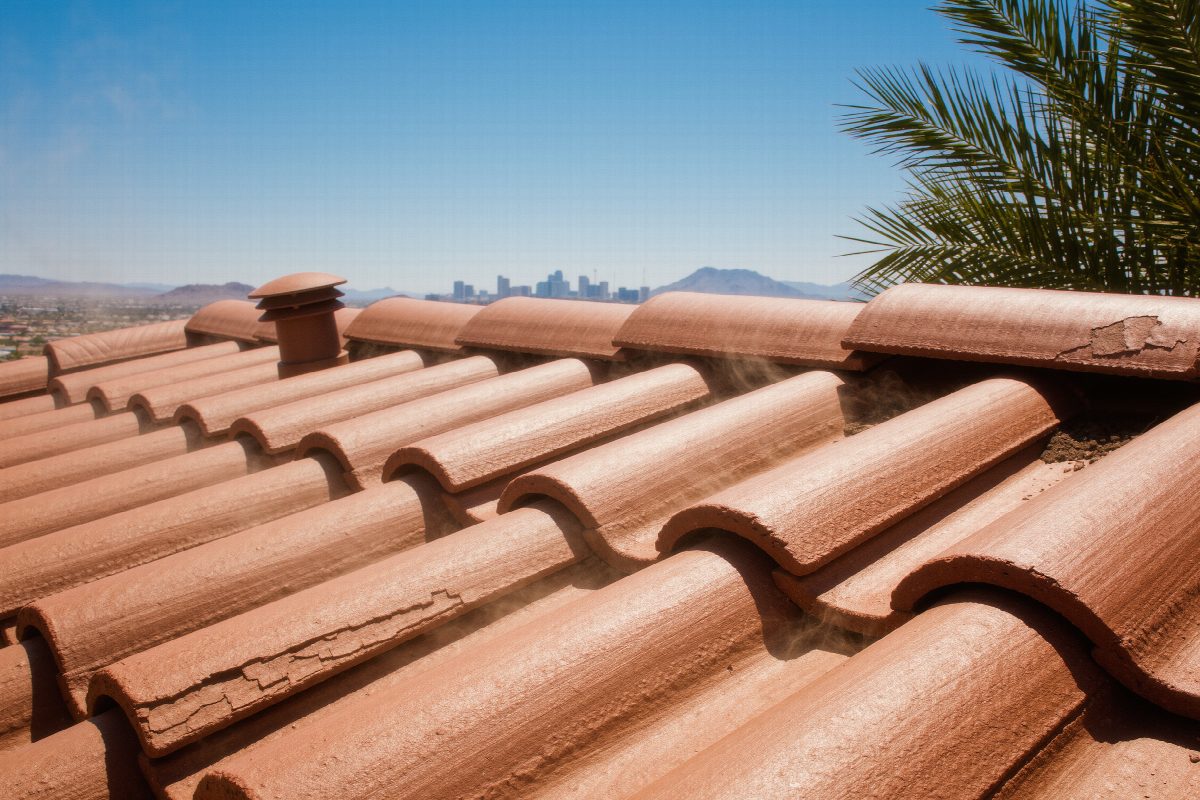
The lakefront homes went up with concrete tile over asphalt felt in the late 1980s and early 1990s. Felt is brittle at twenty and failing at thirty, and the record holds 122 excessive heat reports and 36 heat-warning days in 2019 alone to explain why. The leak shows at a second-story ceiling corner, over the garage, or along the wall where a lower roof meets the upper story. A tile underlayment replacement relays your own tile over synthetic underlayment, and on these streets it is either already done or overdue.
Outflow wind across the lakes
The record holds 21 thunderstorm wind reports and 16 high wind reports since 2010. The August 3, 2011 microburst, estimated at 69 mph, put 8 power poles down on 59th Avenue between Union Hills and Bell; the July 30, 2018 storm was estimated at 75 mph at the Glendale airport; the August 12, 2022 outflow, estimated at 70 mph, put at least 15 poles down near Bell Road. Wind gets a clean run across the water and lifts the eave course and hips on the lake-facing side first. What we check after a wind event.
Leaks at the places tile cannot protect
Most of our leak calls here are not the field of the roof. They are pipe boots that cracked, valley metal that rusted through under thirty years of dust and tree litter, and the flashing where a one-story garage roof dies into the two-story wall. The record holds 60 dust storm reports and 7 heavy rain reports; the dust fills the valleys and the heavy rain finds the result. A leak repair at those points is the most common job we do in Arrowhead Lakes.
Flat roofs toward Bell Road
The retail, medical and multifamily buildings between the neighborhood and the freeway carry foam, TPO and modified bitumen. They fail by neglect: a blocked drain, a coating left to chalk, a curb around a rooftop unit nobody resealed. One of our jobs here this year was a flat roof replacement that a recoat five years earlier would have prevented.
What the weather has actually done around Arrowhead Lakes since 2010.
The National Weather Service logs every storm report it can verify. These are the ones within 4 miles of Arrowhead Lakes: 122 excessive heat reports, 71 heat reports, 60 dust storm reports, 21 thunderstorm wind reports. The August 2011 microburst on 59th Avenue is the event that went through this neighborhood rather than past it, the July 2018 and August 2022 winds are the ones that took poles down nearby, and the single hail report of December 2019 is small enough to ignore; the 122 excessive heat reports are what age the felt.

| Date | Event | Recorded | Where | What it does to roofs | |
|---|---|---|---|---|---|
| Aug 12, 2022 | Thunderstorm WindProperty damage logged: $20,000 | 70 mph est. gustAt least 15 downed and/or snapped power poles along North 35th Avenue, near West Bell Road in Phoenix. Timing estimated from radar. Wind gust was estimated at 60-70 mph.… | Phoenix Turf Airport | Lifted tile, torn shingles, flashing peeled at the edges; wind-borne debris punctures flat roofs. | NOAA #1053670 |
| Jul 30, 2018 | Thunderstorm WindProperty damage logged: $15,000 | 75 mph est. gustThunderstorms with strong, gusty and damaging outflow winds moved through the northern portions of the greater Phoenix metropolitan area during the evening hours on July… | Glendale Municipal Airport Airport | Lifted tile, torn shingles, flashing peeled at the edges; wind-borne debris punctures flat roofs. | NOAA #766566 |
| Sep 27, 2014 | Thunderstorm WindProperty damage logged: $30,000 | 64 mph est. gustA severe squall line moved east across the western portion of the greater Phoenix metropolitan area during the middle of the afternoon on September 27th, and the associa… | Glendale Municipal Airport Airport | Lifted tile, torn shingles, flashing peeled at the edges; wind-borne debris punctures flat roofs. | NOAA #538910 |
| Jul 26, 2014 | Thunderstorm WindProperty damage logged: $5,000 | 69 mph est. gustStrong thunderstorms developed across the northern portions of the greater Phoenix metropolitan area during the late evening hours on July 26th, and they affected commun… | Phoenix Deer Valley Arp | Lifted tile, torn shingles, flashing peeled at the edges; wind-borne debris punctures flat roofs. | NOAA #526898 |
| Jul 19, 2013 | Thunderstorm WindProperty damage logged: $40,000 | 64 mph est. gustStrong thunderstorms developed across the northern portion of the greater Phoenix metropolitan area during the evening hours on July 19th. The storms generated gusty win… | Phoenix Deer Valley Arp | Lifted tile, torn shingles, flashing peeled at the edges; wind-borne debris punctures flat roofs. | NOAA #470169 |
| Aug 3, 2011 | Thunderstorm WindProperty damage logged: $80,000 | 69 mph est. gustThunderstorms produced damaging microburst winds across portions of the northwestern greater Phoenix area during the evening hours on August 3rd. According to reports fr… | Glendale Municipal Airport Airport | Lifted tile, torn shingles, flashing peeled at the edges; wind-borne debris punctures flat roofs. | NOAA #324665 |
| May 2, 2010 | High WindProperty damage logged: $50,000 | 58 mph est. gustSeveral homes in Chandler, near Kyrene and Ray, had roof tiles blown off. Tree limbs were also blown down. One woman described the wind sounding like a roaring train. | Greater Phoenix Area | Ridge caps and edge metal lift first; wind-driven rain gets under tile. | NOAA #221406 |
| May 2, 2010 | High WindProperty damage logged: $30,000 | 58 mph est. gustWinds damaged power poles and lines near the top of South Mountain, near 39th Avenue and Dunlop, and near Central and Dobbins. Power outages affected about 1000 customer… | Greater Phoenix Area | Ridge caps and edge metal lift first; wind-driven rain gets under tile. | NOAA #221403 |
Source: NOAA NCEI Storm Events Database, events from 2010 through 2026 with a reported location within 4 miles of Arrowhead Lakes, or an NWS zone warning covering it. Wind speeds marked "est." are NWS estimates from damage; "measured" gusts came from an instrument. Dollar figures are the property damage NWS logged for the whole event, not one roof.
Excessive-heat warning days covering Arrowhead Lakes, by year
Each bar is a day the NWS issued a heat warning or advisory for the forecast zone Arrowhead Lakes sits in. Heat is the slow storm: it is what ages underlayment, shingles and coatings between the loud ones.
Had one of these go over your roof? A free inspection with photos tells you what it did, in writing, before the next one. Storm damage is cheapest fixed the week it happens.
Every roof. Every property type.
One trusted, family-owned roofer for Arrowhead Lakes — homes, businesses, and multifamily communities alike.
Residential Roofing
Tile, shingle, foam, metal, and flat roofs for Arrowhead Lakes homes — installs, repairs, and replacements.
Commercial Roofing
TPO, PVC, EPDM, foam, and metal systems engineered for Arrowhead Lakes's toughest buildings.
Multifamily Roofing
Apartment, condo, and HOA roofing across Arrowhead Lakes — phased, documented, and warrantied.
An honest number takes four facts, not a city name.
We do not publish a Arrowhead Lakes price list, because there is no such thing as a Arrowhead Lakes roof. There is your roof: its square footage, its pitch, what is on it now, and how many layers and penetrations are hiding underneath. Our instant estimator asks exactly those questions and prices them from our real job costs, in about a minute, with no phone call.

Size and pitch
Priced by the roofing square (100 sq ft). Steep slopes and two-story walls add labor and safety setup; a flat roof adds drainage work.
The system
Tile is the most expensive to install and the cheapest to keep; shingles the reverse. Foam is a recoat every decade, not a tear-off.
What is underneath
Most Arrowhead Lakes tile roofs do not need new tile; they need new underlayment. Rotten decking, extra layers and old skylights are the surprises, and we price them before we start, not after. What a full replacement involves.
Permit and disposal
Where Glendale requires a permit, the fee and the inspections are part of the quote. So is the dumpster. Financing is available on every job.
What the City of Glendale requires before the first tile moves.
Read from the official pages, linked below, and worth reading yourself: a permit pulled in your name by a licensed contractor is the paper trail that protects your warranty, your insurance claim, and your sale price. We pull the permit and schedule the inspections on every job that needs one. The authority is City of Glendale Development Services - Building Safety, Codes & Services, 623-930-2800 (Development Services); 623-915-3263 (inspection scheduling); Building Official 623-930-3151.

The inspection scheduling page lists residential inspection code 628 "Roof/Deck Nailing" and commercial codes 126 "Roof/Deck Nailing" and 168 "Roofing"; inspections are scheduled at 623-915-3263. No re-roof-specific sequence is published.
2024 IBC, 2024 IRC, 2024 IMC, 2024 IPC, 2024 IECC, 2024 IFGC, 2024 IFC, 2023 NEC, 2024 ISPSC, 2024 IEBC, 2024 IPMC, ICC A117.1-2017, with Glendale amendments; the Building Codes page links the "2024 Code Adoption Ordinance" as "Effective January 9th, 2026". Prior cycle: 2018 I-codes adopted by a 2019 ordinance.
No re-roof fee line. Fee Schedule (dated 4/24/2019): permit fees for new buildings, additions and pools are valuation-based; "Other types of permits have fees based on the amount of time estimated to inspect the project"; "Minimum Commercial Permit Fee $114.35".
Q & A page: "Property owners, licensed contractors or authorized agents may apply for a building permit." Contractors need an Arizona ROC license and a Glendale business license; residential owners doing their own work sign a verification statement.
Permit expiration: "You must call for and pass one inspection within a 180-day period in order to keep your permit active." (Q & A page). Permit Packets page currently reads "*PACKETS TO BE UPDATED SOON*".
Rules change and we are roofers, not the building department: confirm the current requirement with the City of Glendale before work starts. Rules above were read from the linked official pages on October 25, 2026.

What lasts here, and how long.
The Arrowhead associations settled the look in the 1980s, and the sun and the lake have been testing it since. These are the systems on these streets and how each holds up.
Concrete tile, the Arrowhead default
S-profile tile in the tans and terracottas of the era. The tile is good for fifty years; the underlayment beneath it is the roof, and on the lakefront streets it has either been replaced once or is thirty-plus years old. Specify synthetic underlayment, relay your own tile, and replace the valley metal while it is open; thirty-year-old valley metal is usually the leak.
Foam with elastomeric coating, on the flats
The commercial roofs toward Bell Road and the flat patio sections on some homes. A system you recoat every ten to fifteen years rather than replace; let the coating chalk through and the sun eats the foam.
Architectural shingle, on a few plans
The shortest-lived roof in the neighborhood at 18 to 25 years, and some here are on their second. Granule loss at the downspouts is the early warning, and a replacement is a two-day job on most of these plans.
Single-ply membranes, on the multifamily
TPO and modified bitumen on the apartment and condominium communities near the freeway. Reflective membranes last longest; ponding at a blocked drain takes years off any of them.
| Roof system | Expected life here | What decides it |
|---|---|---|
| Concrete tile | 50 years or more for the tile; 20 to 25 for the underlayment beneath it | The tile outlives the felt it sits on. Most "tile roof replacements" here are underlayment replacements with the tile relaid. |
| Asphalt shingles (architectural) | 18 to 25 years | The Valley sun ages shingles faster than the label says; granule loss is the tell. |
| Spray polyurethane foam with elastomeric coating | 25 years and up, with a recoat every 10 to 15 | Foam is a system you maintain, not replace; let the coating go and the foam goes with it. |
| Standing-seam metal | 40 to 60 years | Expansion and contraction loosen fasteners over decades; otherwise it shrugs off the heat. |
| Modified bitumen or single-ply (TPO, PVC) on flat roofs | 15 to 25 years | Reflective membranes last longest; ponding water takes years off any of them. |
Ranges reflect roofs in this climate region under normal maintenance; a warranty up to 30 years is available on qualifying systems we install. Compare systems on our residential roofing page.
Every part of Arrowhead Lakes was built in a different decade, and the roofs show it.
Arrowhead Lakes is one neighborhood with three kinds of street, and the roofs age by distance from the water.

| Area | Housing and roofs | What we see on inspections |
|---|---|---|
| The lakefront lots | Late 1980s and early 1990s two-story tile homes on the water; the oldest roofs in the neighborhood, the biggest trees, and the most wind exposure. | Felt past thirty years where it has not been replaced; stained ceilings on the lake side after storms; lifted eave and hip tile after the 2011, 2018 and 2022 winds; sprinkler scale and tree litter in the valleys. |
| The interior and fairway streets | 1990s tile homes on the streets behind the lakes and around the country club; HOA-governed profiles and colors. | Underlayment at twenty-five to thirty years; cracked pipe boots and rusted valley metal; leaks where garage roofs meet the second-story wall; cracked tile around solar mounts. |
| Bell Road and the freeway frontage | Retail, medical, office and multifamily roofs under foam, TPO and modified bitumen, many with rooftop units. | Recoats past due, drains blocked with dust, curb flashing around mechanical units, and the occasional full replacement that a recoat would have prevented. |
The services an Arrowhead Lakes roof actually needs.
A whole neighborhood of 1990s tile hitting the same milestone, with lakeside debris on top.
Get your free Arrowhead Lakes roofing estimate.
Tell us about your property and our team will follow up fast with an honest assessment and a clear plan — no pressure, no obligation.
- Superior ratings across Google, Yelp & Facebook.
- Industry-leading warranty up to 30 years.
- Family owned, licensed, bonded & insured. AZ ROC #325294.
Prefer to talk? Call (602) 314-4650. Prefer to pick a time? Book online.
Get Your Free Estimate
Free roof inspection · Response within 24 hrs
Thank you!
Your request has been received. Our team will contact you shortly.

A roof here has a calendar. Here is ours.
Arrowhead Lakes keeps the Valley's roof calendar with the lake added: the trees shed all year and the sprinklers never stop, so the valleys want clearing before the dust and again before the winter rain.
- May
Clear every scupper, drain and gutter; cut back limbs over the roof; check that tile at the eaves and hips is seated.
Dust storms arrive before the rain. A blocked drain plus a monsoon cell is a ceiling leak. - Early June
Inspect foam and flat roofs for exposed foam, blisters or ponding marks; have coatings due this year done now.
Coatings need dry weather to cure, and July will not give it to you. - After every big monsoon storm
Walk the ground line for displaced or broken tile, lifted shingles and debris; check ceilings and the garage.
Wind damage is cheapest fixed the same week it happens. - Late September
Book a post-monsoon inspection with photos; reseal pipe boots, skylight curbs and parapet caps.
The summer cooked the sealants; the fall is when you find out which ones. - December through February
Watch flat roofs during winter rain; the slow, soaking storms find leaks the monsoon missed.
Winter rain sits on a roof for days instead of minutes.
Would rather not climb a ladder? Our free inspection covers every item on this list, with photos and a written report you keep. What a 21-point inspection looks at.
Asked in Arrowhead Lakes, answered plainly.
Does a re-roof in Arrowhead Lakes need a City of Glendale permit?
The City's official pages we read do not state plainly whether a like-for-like residential re-roof needs a permit. They do list a residential inspection code for roof and deck nailing, say that property owners, licensed contractors or authorized agents may apply, and note that a permit stays active only if an inspection is passed within 180 days; the City's permit packets page currently says the packets are being updated. The permit section above quotes those pages and links to them. Because the rule is not stated, we confirm it with Glendale for your specific job before work starts.
Our lakefront home is from the late 1980s and the roof has never been touched. What are we looking at?
Felt underlayment somewhere past thirty years, which is beyond the range it was ever expected to last. The tile is almost certainly fine. The job is to lift it, replace the felt with synthetic underlayment, replace the valley metal and the flashings at the second-story walls, and relay the same tile with matched replacements for any that are cracked. You keep the roof the association approved. If the house has had a leak, we also check the sheathing under it, which is the one thing that turns this into a bigger job.
Where do thirty-year-old tile roofs here actually leak?
Our leak repairs in Arrowhead Lakes this year point to the same few places. Pipe boots, whose rubber cracks after about fifteen summers. Valley metal, which rusts through under decades of dust and lake-tree litter. The flashing where a one-story garage or patio roof dies into the two-story wall, which was sealed once in 1991. And the eave course on the lake-facing side, where wind-driven rain gets under tile that outflow has lifted. None of them are the field of the roof, and all of them are cheaper to fix than the drywall they ruin.
Does living on the lake change anything about the roof?
The water itself does little. What it brings does more: wind gets a clean run across the lake at the back of the house, the irrigated banks grow the biggest trees in the neighborhood, and sprinkler overspray leaves mineral scale on eave tile and gutters on the water side. We see lifted lake-side eave tile, litter-filled valleys and stained lake-facing ceilings more often on the water than on the interior streets. The fix is maintenance, not a different roof: clear the valleys, keep limbs back, and check the lake-side eaves after each storm.
What did the August 2011 microburst do, and what should I check after the next one?
The NWS estimated it at 69 mph and it put 8 power poles down on 59th Avenue between Union Hills and Bell, which is this neighborhood's western edge. Microbursts hit downward and then outward, so they lift the eave course and the hips, then drive rain under what they lifted. After any storm like it, look from the ground at the eaves, hips and ridge for slipped tile, at the patio cover, and at the yard for pieces of roof. Then book the free inspection; wind damage is cheapest fixed within the week.
Will the Arrowhead Lakes association need to approve the work?
For a like-for-like underlayment replacement that relays your existing tile, usually a notice is enough. For a change of tile profile or color, or a new material on anything visible from the street or the water, expect a submittal; the lakefront streets are the most particular because the roofs are visible from across the lake. We prepare the paperwork and the color match as part of the job, and we match discontinued 1980s tile profiles from salvage when the association wants the original look kept.
Concrete or clay tile is the armor: it shrugs off sun and hail for fifty years and more. It is not the waterproofing. Broken or slipped tile lets water onto the layer below, which is where leaks are born.
The real roof: a sheet under the tile that carries water to the eaves. Felt cooks under tile in this heat and goes brittle at twenty years; synthetic underlayment lasts far longer. Most "tile roof replacements" are underlayment replacements with the tile relaid.
The plywood or planks everything is nailed to. It only fails after the underlayment has leaked for a while; soft or stained decking means the leak is old. Replacing decking is structural work and needs a permit almost everywhere.
Metal where the roof meets a wall, a chimney or a change of slope. It is where most leaks start, because it depends on sealant that the sun dries out. A good inspection spends half its time here.
Every pipe through the roof wears a rubber or lead boot. The rubber ones crack in the sun in eight to twelve years, and water follows the pipe straight into the house. Cheap to replace, expensive to ignore.
The metal edge that sends water into the gutter instead of behind the fascia. Monsoon wind lifts the first course of tile here first, and a gutter packed with dust and fronds turns a storm into a waterfall over the door.
Tap or hover a part of the roof. Every one of these is on our free inspection in Arrowhead Lakes.
Roofing near Arrowhead Lakes.
We serve the entire Phoenix metro. A few of the communities close to Arrowhead Lakes:
Your roof deserves the best in Arrowhead Lakes.
Superior ratings, an industry-leading warranty, and a family-owned team that treats your roof like our own. Reach out today for a free, no-obligation estimate.