Biltmore Highlands roofing, seam by seam.
Concrete tile, foam flats and the additions in between on the hillside homes above the Biltmore — one licensed, family-owned roofer.
Biltmore Highlands has the address without the resort traffic, and roofs that have been remodeled at least as many times as the kitchens.
The Highlands climb the lower slopes of the Phoenix Mountains north of the Arizona Biltmore, off Lincoln Drive, on streets that bend with the grade and lots big enough for a pool, a guest house and citrus that has been shading the roof since the Johnson administration. The houses went up from the 1960s into the 1980s, most of them custom: low ranches and contemporaries from the first decade with flat or barely pitched roofs, then the Santa Barbara and territorial houses of the 1970s and 1980s under concrete tile, with flat sections behind parapets where the architect wanted a clean line. Almost none wear their first roof. What they wear is a history: a shake roof converted to tile, a carport enclosed and roofed flat, an addition tied into the original with whatever the remodeler had on the truck. The sun works on all of it, with more than two hundred heat reports logged by the National Weather Service inside four miles since 2010, and the slope catches the outflow wind that runs down the mountain ahead of a monsoon cell.
We have relaid tile over new underlayment on the lanes off Lincoln, recoated the foam flats on the 1960s houses lower on the hill, and chased more leaks to the seam between an original roof and a 1990s addition than to any other single cause. Mature trees are the other story. A shaded roof is a cooler house and a fuller valley, and a sixty-year-old pine or eucalyptus over a tile roof means needles in the pans, limbs on the ridge and, when the wind is right, a tree on the house. Behind the gutter line many of these houses still carry their original wood fascia, and on a roof this age the rot usually starts there long before the roofing gives out. We are family owned and operated, licensed, bonded and insured, and on a house with this much history we open it up and show you rather than guess from the driveway.
Below is the weather record for this slope since 2010 from the National Weather Service, the City of Phoenix rule on when a re-roof needs a permit, the systems that hold up on these lots and the ones that do not, and the questions the owners here ask. Then book the free inspection. Owners in the Highlands tend to be staying, and the roof should be planned on that timeline.
Four things that break Biltmore Highlands roofs, in the order they do it.
Hillside lots, big trees and fifty years of remodeling give the Highlands a failure sequence of its own. It starts with what falls on the roof and ends with what was under it all along.
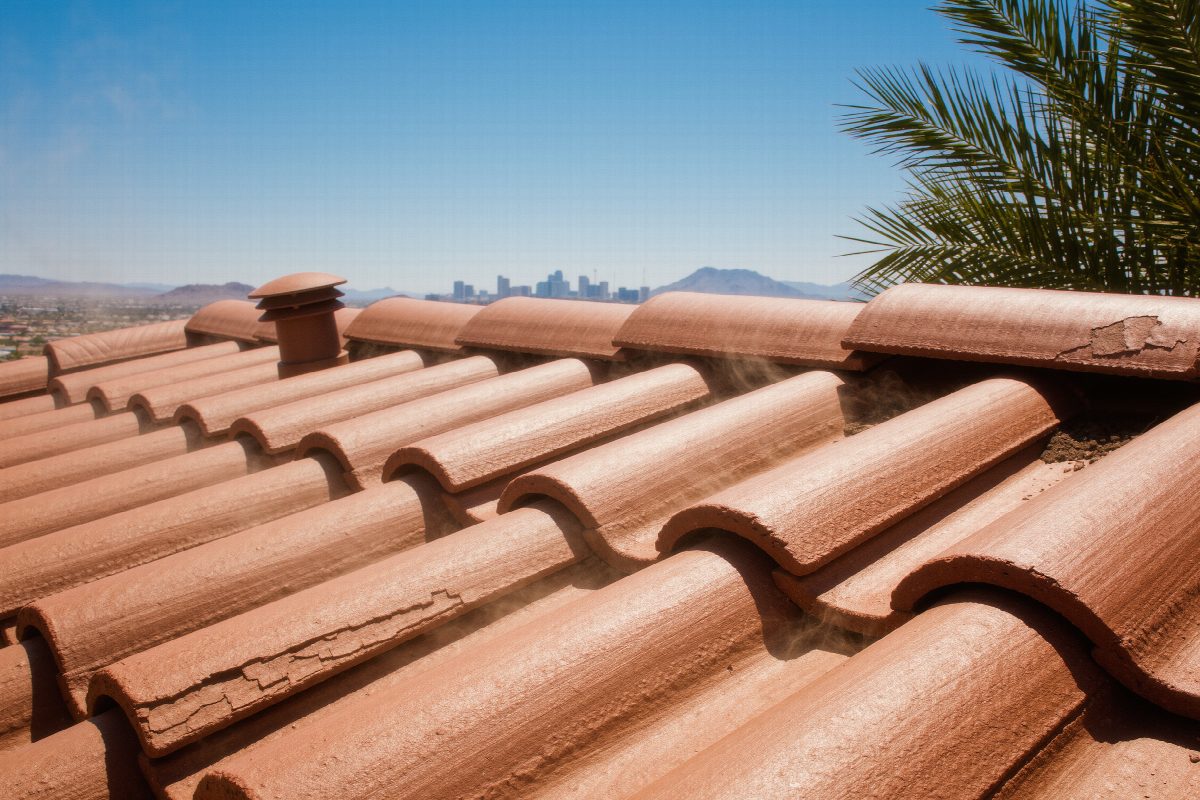
Needles, leaves and dust in the valleys
The NWS has 52 dust storm reports inside four miles since 2010, and the trees add their own layer every week of the year. On a multi-level hillside roof the valleys and the scuppers behind the parapets are where it all collects, and a packed valley on a tile roof sends water sideways under the tile instead of down it. The May cleaning is not optional here.
Outflow wind down the mountain, and what it carries
The slope faces the wind that comes down the Phoenix Mountains ahead of a storm. The NWS estimated 70 mph on September 12, 2023 when it put a tree estimated at 90 feet onto a house at 40th Street and Indian School, 72 mph on August 23, 2018, and 70 mph on September 27, 2025 when the roof came partly off the ice rink at 38th Street and Thomas. Lifted eave tile and ridge caps are the usual result; a limb through the tile is the expensive one. Storm repair starts with the trees.
The seams where additions meet the original roof
A flat patio roof tied into a pitched main roof, a 1994 carport enclosure, a second-story addition dropped onto a 1968 ranch: every one of them has a transition, and the transition was made with sealant by whoever did the remodel. Sealant lasts a few summers here. The water gets in at the seam and shows up two rooms away, and the fix is metal flashing under the upper roof and over the lower one.
Underlayment and fascia at the end of their life
Concrete tile from the 1970s and 1980s sits on felt that was rated for a different climate and has been cooking for forty summers. Shake roofs converted to tile in the 1990s often got undersized battens and the cheapest felt on the truck. Behind the gutters, the original wood fascia has been wet at every storm since. The tile is fine; what it sits on is the job.
What the weather has actually done around Biltmore Highlands since 2010.
The National Weather Service logs every storm report it can verify. These are the ones within 4 miles of Biltmore Highlands: 227 heat reports, 83 excessive heat reports, 52 dust storm reports, 34 thunderstorm wind reports. The storms that matter in the Highlands are wind with something in it: the 70 mph gust of September 12, 2023 that put a tree estimated at 90 feet onto a house at 40th Street and Indian School, the 70 mph wind of September 27, 2025 that peeled the roof off the ice rink at 38th Street and Thomas, and the 72 mph gust and inch hail of August 23, 2018. The inch hail of September 26, 2025 fell near Denton Lane, a few blocks from the resort, without reported damage.

| Date | Event | Recorded | Where | What it does to roofs | |
|---|---|---|---|---|---|
| Sep 27, 2025 | Thunderstorm WindProperty damage logged: $1,000,000 | 70 mph est. gustThe AZ Ice Arcadia Rink located in the area of 38th street and Thomas Road in Phoenix suffered significant damage, with the roof of the building partially peeled off and… | Kendall | Lifted tile, torn shingles, flashing peeled at the edges; wind-borne debris punctures flat roofs. | NOAA #1293565 |
| Sep 26, 2025 | Hail | 1" hailReports of 1 inch diameter hail in between East Denton Lane and East Vernon Avenue in Phoenix. No injuries or damage reported. | Phoenix | Bruised shingles, cracked tile, dented soft metals; foam coatings chip. | NOAA #1293460 |
| Sep 12, 2023 | Thunderstorm WindProperty damage logged: $5,000 | 70 mph est. gustA very large uprooted tree fell onto the roof of a home located along the area of North 40th Street and Indian School Road in Phoenix. Tree was estimated to be 90 feet t… | Papago Aaf Airport | Lifted tile, torn shingles, flashing peeled at the edges; wind-borne debris punctures flat roofs. | NOAA #1140004 |
| Aug 12, 2022 | Thunderstorm WindProperty damage logged: $3,000 | 70 mph est. gustSocial media pictures showed a large saguaro toppled over and destroying a shed along the area of North 12th Street and East Northern Avenue in Phoenix. Timing estimated… | Cactus | Lifted tile, torn shingles, flashing peeled at the edges; wind-borne debris punctures flat roofs. | NOAA #1053720 |
| Nov 29, 2019 | TornadoProperty damage logged: $100,000 | TornadoA powerful Pacific upper level low and associated cold front moved east across central and northern portions of the greater Phoenix metropolitan area during the early mo… | Cactus | Decking exposed, structural damage, whole slopes stripped. | NOAA #863484 |
| Sep 23, 2019 | HailProperty damage logged: $5,000 | 0.88" hailScattered to numerous showers and thunderstorms developed across the greater Phoenix metropolitan area, including central Phoenix, during afternoon and early evening hou… | Phoenix | Bruised shingles, cracked tile, dented soft metals; foam coatings chip. | NOAA #850057 |
| Aug 23, 2018 | Hail | 1" hailThunderstorms developed across the northern portion of the greater Phoenix area during the early evening hours on August 23rd; one of the stronger storms affected the co… | Cactus | Bruised shingles, cracked tile, dented soft metals; foam coatings chip. | NOAA #772453 |
| Jul 30, 2018 | Thunderstorm WindProperty damage logged: $20,000 | 70 mph est. gustThunderstorms with strong, gusty and damaging outflow winds moved across the central portion of the greater Phoenix area during the evening hours on July 30th; some of t… | Phoenix | Lifted tile, torn shingles, flashing peeled at the edges; wind-borne debris punctures flat roofs. | NOAA #766477 |
Source: NOAA NCEI Storm Events Database, events from 2010 through 2026 with a reported location within 4 miles of Biltmore Highlands, or an NWS zone warning covering it. Wind speeds marked "est." are NWS estimates from damage; "measured" gusts came from an instrument. Dollar figures are the property damage NWS logged for the whole event, not one roof.
Excessive-heat warning days covering Biltmore Highlands, by year
Each bar is a day the NWS issued a heat warning or advisory for the forecast zone Biltmore Highlands sits in. Heat is the slow storm: it is what ages underlayment, shingles and coatings between the loud ones.
Had one of these go over your roof? A free inspection with photos tells you what it did, in writing, before the next one. Storm damage is cheapest fixed the week it happens.
Every roof. Every property type.
One trusted, family-owned roofer for Biltmore Highlands — homes, businesses, and multifamily communities alike.
Residential Roofing
Tile, shingle, foam, metal, and flat roofs for Biltmore Highlands homes — installs, repairs, and replacements.
Commercial Roofing
TPO, PVC, EPDM, foam, and metal systems engineered for Biltmore Highlands's toughest buildings.
Multifamily Roofing
Apartment, condo, and HOA roofing across Biltmore Highlands — phased, documented, and warrantied.
An honest number takes four facts, not a city name.
We do not publish a Biltmore Highlands price list, because there is no such thing as a Biltmore Highlands roof. There is your roof: its square footage, its pitch, what is on it now, and how many layers and penetrations are hiding underneath. Our instant estimator asks exactly those questions and prices them from our real job costs, in about a minute, with no phone call.

Size and pitch
Priced by the roofing square (100 sq ft). Steep slopes and two-story walls add labor and safety setup; a flat roof adds drainage work.
The system
Tile is the most expensive to install and the cheapest to keep; shingles the reverse. Foam is a recoat every decade, not a tear-off.
What is underneath
Most Biltmore Highlands tile roofs do not need new tile; they need new underlayment. Rotten decking, extra layers and old skylights are the surprises, and we price them before we start, not after. What a full replacement involves.
Permit and disposal
Where Phoenix requires a permit, the fee and the inspections are part of the quote. So is the dumpster. Financing is available on every job.
What the City of Phoenix requires before the first tile moves.
Read from the official pages, linked below, and worth reading yourself: a permit pulled in your name by a licensed contractor is the paper trail that protects your warranty, your insurance claim, and your sale price. We pull the permit and schedule the inspections on every job that needs one. The authority is City of Phoenix Planning & Development Department (PDD), 602-262-7811 (Planning & Development general); 602-495-0800 (inspection requests, per Owner's Guide); TTY 7-1-1.

Same-material re-roof is exempt. Phoenix Building Construction Code (PBCC) Administrative Provisions Section 105.2.1 item 16: "Re-roofing with the same type of material as the original roofing and provided not more than two layers of asphalt shingles are applied over an existing asphalt shingle roof.
PDD Online FAQ: "If doing a repair (like for like materials) with no structural additions, no permit is required.". No square-foot or dollar threshold is published.
PDD Online FAQ: "If roof structure is changed, a permit is required." and "If no new structural components of the roof are added, like plywood, no permit is required.". The Owner's Guide lists "Some roof replacements (call first)" among home improvements that require permits.
2024 IBC, 2024 IRC, 2024 IMC, 2024 IFGC, 2024 IECC, 2024 IEBC, 2024 ISPSC, 2024 IPC/UPC, 2023 NEC, with City of Phoenix Administrative Provisions and Amendments. "Current Codes Adopted - Effective August 1, 2025 (Ordinance G-7397)" (Phoenix Construction Code History, TRT/DOC/00550 Rev.
No published flat re-roof fee. Development Fee Schedule (Effective 1/20/2026): "Permit fees for new construction and additions are based on the valuation of the project." Plan review fees are a percentage of the permit fee with a minimum charge..
PDD Online FAQ: "Property owners can apply for any permit. However, the property owner can only perform the work on single family residential properties that are occupied by the owner. All other projects require a licensed contractor.".
The Reroofing OTC application asks for roof slope, roof drains, scuppers, tear-off vs. recover, and "UL Class/Rating of new membrane assembly", and whether electrical, plumbing, gas line or HVAC are relocated. The Work Exempt from Permit document states exemptions do not authorize work that violates the code.
Rules change and we are roofers, not the building department: confirm the current requirement with the City of Phoenix before work starts. Rules above were read from the linked official pages on October 25, 2026.

What lasts here, and how long.
The Highlands have no single roof, which means the right system is decided house by house, and sometimes section by section on the same house.
Concrete tile, on the 1970s and 1980s houses
Right for the Santa Barbara and territorial architecture and nearly permanent on its own. The underlayment under it is the roof, and on most Highlands houses it is due. Relaid over synthetic underlayment with proper battens, your own tile goes back on and the house looks untouched.
Foam with elastomeric coating, on the flats
The 1960s ranches and contemporaries, and the parapet sections on the later houses, run best under spray foam and a white coating. Seamless, self-flashing, and a system you recoat on the cycle in the table rather than replace. Shade from the trees helps the coating and hurts the drainage.
Standing-seam metal, on the remodels
The contemporary remodels on the upper streets use it for the look, and the wind rewards the choice. Fasteners and the flashing at the many penetrations a remodel adds are what need checking after year fifteen.
Shake, and what replaced it
Many of these roofs started under wood shake and were converted to tile when the shake failed. The conversion added weight to framing designed for wood, which is a structural question and a City permit question before it is a roofing one.
| Roof system | Expected life here | What decides it |
|---|---|---|
| Concrete tile | 50 years or more for the tile; 20 to 25 for the underlayment beneath it | The tile outlives the felt it sits on. Most "tile roof replacements" here are underlayment replacements with the tile relaid. |
| Asphalt shingles (architectural) | 18 to 25 years | The Valley sun ages shingles faster than the label says; granule loss is the tell. |
| Spray polyurethane foam with elastomeric coating | 25 years and up, with a recoat every 10 to 15 | Foam is a system you maintain, not replace; let the coating go and the foam goes with it. |
| Standing-seam metal | 40 to 60 years | Expansion and contraction loosen fasteners over decades; otherwise it shrugs off the heat. |
| Modified bitumen or single-ply (TPO, PVC) on flat roofs | 15 to 25 years | Reflective membranes last longest; ponding water takes years off any of them. |
Ranges reflect roofs in this climate region under normal maintenance; a warranty up to 30 years is available on qualifying systems we install. Compare systems on our residential roofing page.
Every part of Biltmore Highlands was built in a different decade, and the roofs show it.
The Highlands change with the elevation: the higher the lot, the more wind, the more levels and the more seams. The streets we are on most often, from the resort up the hill, with the Biltmore page covering the corridor below.

| Area | Housing and roofs | What we see on inspections |
|---|---|---|
| The lower streets toward 24th Street and the resort | 1960s ranches and contemporaries on the flattest lots: flat and low-slope roofs under foam or modified bitumen, deep overhangs, the biggest trees in the neighborhood. | Coatings a decade past due, valleys and scuppers full of litter, original wood fascia rotting behind the gutters, and a flat addition on nearly every one. |
| The lanes off Lincoln Drive | 1970s and 1980s custom homes under concrete tile, Santa Barbara and territorial styles, with parapet flats and long hips on terraced lots. | Underlayment at the end of its life, ridge and eave tile loosened by outflow wind, sealant-only flashing at the parapet-to-tile transitions. |
| The hillside cul-de-sacs below the preserve | The highest lots, 1980s homes stepped down the grade: multi-level tile roofs with an upper roof draining onto a lower one, the most exposed to the wind. | Roof-to-wall tie-ins above lower roofs, wind-lifted caps after every big storm, and solar re-roof coordination on the newer installs. |
The services a Biltmore Highlands roof actually needs.
Mid-century homes with additions, re-covers and shaded valleys.
Get your free Biltmore Highlands roofing estimate.
Tell us about your property and our team will follow up fast with an honest assessment and a clear plan — no pressure, no obligation.
- Superior ratings across Google, Yelp & Facebook.
- Industry-leading warranty up to 30 years.
- Family owned, licensed, bonded & insured. AZ ROC #325294.
Prefer to talk? Call (602) 314-4650. Prefer to pick a time? Book online.
Get Your Free Estimate
Free roof inspection · Response within 24 hrs
Thank you!
Your request has been received. Our team will contact you shortly.

A roof here has a calendar. Here is ours.
In the Highlands the calendar has a tree in every line. Clear the valleys in May, trim what hangs over the ridge before the wind comes, and look at the fascia in the fall when the leaves are off.
- May
Clear every scupper, drain and gutter; cut back limbs over the roof; check that tile at the eaves and hips is seated.
Dust storms arrive before the rain. A blocked drain plus a monsoon cell is a ceiling leak. - Early June
Inspect foam and flat roofs for exposed foam, blisters or ponding marks; have coatings due this year done now.
Coatings need dry weather to cure, and July will not give it to you. - After every big monsoon storm
Walk the ground line for displaced or broken tile, lifted shingles and debris; check ceilings and the garage.
Wind damage is cheapest fixed the same week it happens. - Late September
Book a post-monsoon inspection with photos; reseal pipe boots, skylight curbs and parapet caps.
The summer cooked the sealants; the fall is when you find out which ones. - December through February
Watch flat roofs during winter rain; the slow, soaking storms find leaks the monsoon missed.
Winter rain sits on a roof for days instead of minutes.
Would rather not climb a ladder? Our free inspection covers every item on this list, with photos and a written report you keep. What a 21-point inspection looks at.
Asked in Biltmore Highlands, answered plainly.
Does a re-roof in Biltmore Highlands need a City of Phoenix permit?
A same-material re-roof and a like-for-like repair are exempt under the City of Phoenix rule; the permit section above is read from the City's pages and links to them. Replacing decking, adding sheathing or changing the structure requires a permit, and on a Highlands house that comes up more than you would think: a shake-to-tile conversion that was never checked for weight, or a flat addition whose framing has been wet for years. Where a permit is required we pull it in your name and schedule the inspections, and the record follows the house when you sell.
My tile roof was converted from shake in the 1990s. What should I worry about?
Three things. Weight, because concrete tile is far heavier than the shake the rafters were sized for. Battens, because the conversion crews often used undersized or widely spaced battens that let the tile creep downhill over thirty years. And underlayment, because the felt under a 1990s conversion is now as old as the one it replaced. We check the framing from the attic, the battens once the tile is stacked, and we replace the underlayment with synthetic. If the framing is marginal, a lighter tile or a different system is the honest answer.
The leak is where the addition meets the house. Why does it keep coming back?
Because it keeps getting fixed with sealant. A seam between two roofs built in different decades moves with the heat, and sealant cracks where it moves. The permanent repair is metal: step flashing or a continuous apron under the upper roof's underlayment and over the lower roof's surface, with a cricket where a wall or a chimney would otherwise trap water. It costs more than a tube of sealant once, and less than a tube of sealant every summer.
What do I do about the trees over my roof?
Trim what touches or hangs over the roof before June, because the NWS wind record for this slope is mostly trees doing the damage. After a storm, if a limb is through the tile or a tree is on the house, get the roof covered before the next cell: temporary tarping is a same-day service for us, and it is what your insurer expects you to do first. Then we document the damage with photographs for the claim and plan the repair with your own tile where it survived.
Foam on my 1960s flat roof: recoat or replace?
Recoat, if the coating has not been let go completely. Foam is two parts: the foam insulates and sheds water, the elastomeric coating protects the foam from the sun. On the recoat cycle in the table above, the foam itself lasts indefinitely. Where the coating has chalked through and the foam is pitted and gray, the damaged foam is cut out and resprayed before the new coating goes on. How we recoat and when covers the shaded-roof problem the Highlands have: coatings cure slower under trees.
Does hail happen here?
Rarely, and small. The NWS has 5 hail reports inside four miles since 2010, the largest an inch, on August 23, 2018 and again on September 26, 2025 near Denton Lane. Inch hail does little to concrete tile. It dents a foam coating, bruises shingle and cracks skylights and the plastic covers on vents, which is where we look after a hail report. On a foam or shingle roof a free inspection is worth doing before the small damage becomes a leak.
Concrete or clay tile is the armor: it shrugs off sun and hail for fifty years and more. It is not the waterproofing. Broken or slipped tile lets water onto the layer below, which is where leaks are born.
The real roof: a sheet under the tile that carries water to the eaves. Felt cooks under tile in this heat and goes brittle at twenty years; synthetic underlayment lasts far longer. Most "tile roof replacements" are underlayment replacements with the tile relaid.
The plywood or planks everything is nailed to. It only fails after the underlayment has leaked for a while; soft or stained decking means the leak is old. Replacing decking is structural work and needs a permit almost everywhere.
Metal where the roof meets a wall, a chimney or a change of slope. It is where most leaks start, because it depends on sealant that the sun dries out. A good inspection spends half its time here.
Every pipe through the roof wears a rubber or lead boot. The rubber ones crack in the sun in eight to twelve years, and water follows the pipe straight into the house. Cheap to replace, expensive to ignore.
The metal edge that sends water into the gutter instead of behind the fascia. Monsoon wind lifts the first course of tile here first, and a gutter packed with dust and fronds turns a storm into a waterfall over the door.
Tap or hover a part of the roof. Every one of these is on our free inspection in Biltmore Highlands.
Roofing near Biltmore Highlands.
We serve the entire Phoenix metro. A few of the communities close to Biltmore Highlands:
Your roof deserves the best in Biltmore Highlands.
Superior ratings, an industry-leading warranty, and a family-owned team that treats your roof like our own. Reach out today for a free, no-obligation estimate.



