Cottonwood roofing, built for the valley.
Shingle, metal, tile and flat roofs from Old Town to Verde Village — one family-owned, licensed roofer.
Cottonwood sits low enough to get a Phoenix summer and high enough to get a Flagstaff snow, and its roofs take both in the same year.
Cottonwood is the working hub of the Verde Valley, thirty-three hundred feet up with Mingus Mountain at its back and the river at its feet, and the weather that reaches it is a mixture nobody designs a roof for on purpose. The record within eight miles since 2010 leads with heavy snow, then flash flood, heavy rain and thunderstorm wind, with hail to two inches at Cornville in October 2010 and an eighty-seven-mile-an-hour gust in February 2023, and summers hot enough to chalk a coating in a few seasons. Most of the housing wears architectural shingle. Old Town and the ranchettes run to metal. The Mingus Avenue corridor and the Old Town storefronts are low-slope membranes and foam, and the newer subdivisions on the hill carry concrete tile over underlayment now old enough to matter.
We have worked on the 1920s to 1940s buildings of Old Town along Main Street, the 1970s and 1980s manufactured and site-built homes of Verde Village, the 2000s tile tracts of Cottonwood Ranch and Mesa Verde, and the strip retail, medical and light-industrial roofs on Mingus Avenue and the state route through town. The common thread is a roof sold as a desert roof and asked to be a mountain roof every January: shingles with no ice barrier at the eaves, manufactured-home roofs with nowhere for meltwater to go, metal panels fastened tight enough to buckle in the first freeze. We are family owned and operated, licensed, bonded and insured, and we bring the right detailing up from the Valley rather than guessing at it.
What follows is what the weather service has logged around Cottonwood since 2010, what the City of Cottonwood now requires before any roof work begins, the systems that hold up here and the neighborhoods we know. Read it, then book the free inspection, ideally in the fall before the snow or in April before the storms.
Four things that break Cottonwood roofs, in the order they arrive.
Cottonwood gets its weather from two directions: the monsoon that builds over the Rim and runs down the valley in July, and the winter storms that cross Mingus Mountain from the west. The damage arrives in that order.
Monsoon rain with nowhere to go
Flash flood accounts for 18 reports in the record and heavy rain for 13, and the September 2023 storm is typical: quarter-sized hail, very heavy rain and local flooding in the Cottonwood area in one afternoon. On the low-slope roofs of Verde Village and Mingus Avenue that rain has to leave through a scupper, and if the scupper is blocked the roof becomes a pond. On shingle roofs it finds the valley that was never lined. Monsoon leak repair is the call we take most often here in August.
Thunderstorm wind off the Rim
The record holds 11 thunderstorm wind reports, and they are not small. The July 2018 storm measured seventy-two miles an hour at the Camp Verde station and snapped a mature cottonwood near Cornville; the October 2022 storm blew over two cypress trees at Cornville and dropped well over an inch of rain. Outflow wind lifts shingle at the rakes and ridges, strips coating that has chalked, and peels any metal edge that was not hemmed.
Hail, from Cornville in
Six hail reports, and the one everyone remembers is October 2010, when two-inch stones fell on Cornville and damaged vehicles across the area. Since then it has been inch hail: Cottonwood in August 2022, the Smelter City side in September 2023, Cornville again in July 2025. Inch hail bruises shingles in a way that does not show as a leak for a year or two, and two-inch hail breaks tile and dents metal. A hail inspection with photos right after the storm is what makes the insurance claim work.
Winter: snow, freeze and the wind that comes with it
Heavy snow is the largest entry with 22 reports, and the strongest wind in the table, eighty-seven miles an hour in February 2023, came with a winter system and took shingles off roofs across the county. Snow on a manufactured-home roof in Verde Village melts into standing water, wet tile in the subdivisions cracks in the freeze, sealant at every pipe boot ages a year each winter, and the damage all shows at once in April.
What the weather has actually done around Cottonwood since 2010.
The National Weather Service logs every storm report it can verify. These are the ones within 8 miles of Cottonwood: 22 heavy snow reports, 18 flash flood reports, 13 heavy rain reports, 11 thunderstorm wind reports. Heavy snow is the largest entry with 22 reports, but the table is really about summer: the two-inch Cornville hail of October 2010, the seventy-two-mile-an-hour thunderstorm wind of July 2018, and the inch hail in Cottonwood in August 2022 and September 2023 are the storms that generated roof calls; the February 2023 high wind is the winter exception.

| Date | Event | Recorded | Where | What it does to roofs | |
|---|---|---|---|---|---|
| Jul 3, 2025 | Hail | 1" hailA social media post showed hail up to the size of quarters. The location has been estimated. | Cornville | Bruised shingles, cracked tile, dented soft metals; foam coatings chip. | NOAA #1262344 |
| Sep 13, 2023 | Hail | 1" hailQuarter sized hail (one inch in diameter), very heavy rain, and local flooding was reported in the Cottonwood area. | Smelter City | Bruised shingles, cracked tile, dented soft metals; foam coatings chip. | NOAA #1131448 |
| Feb 22, 2023 | High Wind | 87 mph measured gustThe peak wind gust at the Sunset Point RAWS was 88 MPH at 653 AM. Wind damage in the Chino Valley included a shed blown over, shingles missing/minor roof damage, and tre… | Yavapai County Valleys And Basins | Ridge caps and edge metal lift first; wind-driven rain gets under tile. | NOAA #1080067 |
| Oct 3, 2022 | Thunderstorm WindProperty damage logged: $2,000 | 58 mph est. gustTwo Arizona Cypress trees blew over from wind with a thunderstorm. The storm also produce d 1.33 inches of rain. | Cornville | Lifted tile, torn shingles, flashing peeled at the edges; wind-borne debris punctures flat roofs. | NOAA #1056078 |
| Aug 23, 2022 | Hail | 1" hailHail up to one inch in diameter fell in Cottonwood. | Cottonwood | Bruised shingles, cracked tile, dented soft metals; foam coatings chip. | NOAA #1055316 |
| Jul 27, 2018 | Thunderstorm Wind | 72 mph measured gustThe MESONET station in Camp Verde measured a 72 MPH wind gust at 405 PM from a thunderstorm in the area. A large cottonwood tree was snapped by wind 1 mile south-southwe… | Cornville | Lifted tile, torn shingles, flashing peeled at the edges; wind-borne debris punctures flat roofs. | NOAA #781574 |
| Oct 6, 2010 | HailProperty damage logged: $20,000 | 2" hailTwo inch diameter hail fell in Corneville with minor damage to vehicles. | Cornville | Bruised shingles, cracked tile, dented soft metals; foam coatings chip. | NOAA #262031 |
| Oct 6, 2010 | Hail | 1.75" hailA thunderstorm produced hail across Cornville that ranged from quarter to golf ball sized (1 to 1.75 inches in diameter). | Cornville | Bruised shingles, cracked tile, dented soft metals; foam coatings chip. | NOAA #261137 |
Source: NOAA NCEI Storm Events Database, events from 2010 through 2026 with a reported location within 8 miles of Cottonwood, or an NWS zone warning covering it. Wind speeds marked "est." are NWS estimates from damage; "measured" gusts came from an instrument. Dollar figures are the property damage NWS logged for the whole event, not one roof.
Had one of these go over your roof? A free inspection with photos tells you what it did, in writing, before the next one. Storm damage is cheapest fixed the week it happens.
Every roof. Every property type.
One trusted, family-owned roofer for Cottonwood — homes, businesses, and multifamily communities alike.
Residential Roofing
Tile, shingle, foam, metal, and flat roofs for Cottonwood homes — installs, repairs, and replacements.
Commercial Roofing
TPO, PVC, EPDM, foam, and metal systems engineered for Cottonwood's toughest buildings.
Multifamily Roofing
Apartment, condo, and HOA roofing across Cottonwood — phased, documented, and warrantied.
An honest number takes four facts, not a city name.
We do not publish a Cottonwood price list, because there is no such thing as a Cottonwood roof. There is your roof: its square footage, its pitch, what is on it now, and how many layers and penetrations are hiding underneath. Our instant estimator asks exactly those questions and prices them from our real job costs, in about a minute, with no phone call.

Size and pitch
Priced by the roofing square (100 sq ft). Steep slopes and two-story walls add labor and safety setup; a flat roof adds drainage work.
The system
Tile is the most expensive to install and the cheapest to keep; shingles the reverse. Foam is a recoat every decade, not a tear-off.
What is underneath
Most Cottonwood tile roofs do not need new tile; they need new underlayment. Rotten decking, extra layers and old skylights are the surprises, and we price them before we start, not after. What a full replacement involves.
Permit and disposal
Where Cottonwood requires a permit, the fee and the inspections are part of the quote. So is the dumpster. Financing is available on every job.
What the City of Cottonwood requires before the first tile moves.
Read from the official pages, linked below, and worth reading yourself: a permit pulled in your name by a licensed contractor is the paper trail that protects your warranty, your insurance claim, and your sale price. We pull the permit and schedule the inspections on every job that needs one. The authority is Community Development, Building Division, 928-634-5505 (Community Development); 928-634-5526 (City); inspection hotline (928) 340-2724 being phased out.

"ATTN: ROOFING CONTRACTORS—All residential and commercial properties will need a permit for all roof work, including new roofs, re-roofing, and repairs, starting July 1, 2025."
2025 Building Code Update, R105.2 exempt work item 11: "Roof assembly repair in which no more than 100 square feet of the roofing assembly is replaced or repaired and does not require removal or displacement of mechanical, plumbing, or electrical systems." 100 square feet
"Effective July 1, 2025, the Community Development and Fire Department adopted and began enforcing the 2024 International Codes and the 2025 Fee Schedules": 2024 IBC, IRC, IEBC, IFGC, IPC, IMC, IFC, IPMC, 2023 NEC; 2018 IECC retained (IRC Chapter 11 replaced with 2018 IRC Chapter 11).
2025 Community Development Fee Schedule (adopted May 20, 2025, effective July 1, 2025) has no roofing line item; "Inspection fees where no fee is indicated $90.47-per hour".
"All contractors are required to be licensed through the State of Arizona"; "If building under the owner-builder exemption you do not have to have a contractor license" (own property, not for sale or rent); handyman exemption for jobs under $1,000 or where no building permit is required. (FAQ QID=126, QID=127)
Class A/B roof assemblies, Class A within 3 ft of a lot line. R109.3.1: fall protection must be in place for "all elevated work and rooftop inspections." An older owner-builder brochure lists "Recover or re-roof" as not needing a permit; it predates the July 1, 2025 rule.
Rules change and we are roofers, not the building department: confirm the current requirement with the City of Cottonwood before work starts. Rules above were read from the linked official pages on October 25, 2026.

What lasts here, and how long.
Cottonwood roofs have to shed snow in January and reflect sun in July, and the City has required Class A fire-rated assemblies near the lot lines. These are the systems that do the job and what decides how long.
Architectural shingles, the Cottonwood default
The lifespan table above gives them 20 to 30 years here. The low end is a roof with no ice barrier at the eaves and a south slope that takes the sun; the high end has the barrier, a Class A rating and a ridge vent that keeps the deck cool. Look for granules in the gutters and lifted tabs after a windy night as the early warnings.
Standing-seam metal, in Old Town and on the ranchettes
Sheds snow, laughs at hail under two inches, and carries the fire rating the City wants near a lot line. It is the right roof for a 1930s house on Main Street and for a barn on the edge of town, and it is installed with clips so it can move with a sixty-degree daily swing. What we install and why.
Low-slope membranes and foam, on Mingus Avenue
Modified bitumen, TPO and foam on the commercial and medical buildings and on a lot of manufactured homes. They do not fail from snow; they fail where meltwater stands at a seam or a scupper froze full. Drainage first, then a reflective coating in good condition for the summer.
Concrete tile, on the newer subdivisions
Right for Cottonwood Ranch and Mesa Verde, with the usual caveat: the underlayment is the roof, and tile that has absorbed a winter rain cracks in the freeze that follows. Budget for a few replacement tiles each spring and an underlayment replacement around the twenty-year mark.
| Roof system | Expected life here | What decides it |
|---|---|---|
| Asphalt shingles (architectural) | 20 to 30 years | Snow load and freeze-thaw shorten the low end; ice barrier at eaves is the difference. |
| Standing-seam metal | 40 to 60 years | Sheds snow, handles freeze-thaw; the fasteners and penetrations are what need attention. |
| Concrete or clay tile | 40 to 50 years for the tile; 20 to 25 for the underlayment | Tile cracks in hard freezes when it has absorbed water; the underlayment still sets the real life. |
| Modified bitumen or single-ply on low slopes | 20 to 25 years | Snow and standing meltwater find seams; drainage matters more than the membrane. |
Ranges reflect roofs in this climate region under normal maintenance; a warranty up to 30 years is available on qualifying systems we install. Compare systems on our residential roofing page.
Every part of Cottonwood was built in a different decade, and the roofs show it.
Cottonwood is a small city with a county town wrapped around it, and the roofs, and the permit rules, change at a line most homeowners cannot see. A few of the areas we are in most often.

| Area | Housing and roofs | What we see on inspections |
|---|---|---|
| Old Town | 1920s to 1940s commercial buildings and bungalows along Main Street: low-slope and flat roofs on the storefronts, metal and shingle on the houses, some of them on their third roof. | Ponding and blocked scuppers on the storefronts, parapet flashing, and shingle laid over old roofing that should have come off. |
| Verde Village | 1970s and 1980s manufactured and site-built homes on the east side, unincorporated Yavapai County rather than the City, with low-slope and shallow-pitch roofs. | Roof-over systems on manufactured homes, meltwater standing where the roof has sagged, and permit rules that follow the County's like-for-like exemption instead of Cottonwood's. |
| Cottonwood Ranch and Mesa Verde | 2000s subdivisions on the hill above town: concrete tile over felt, stucco, HOA-governed colors. | Underlayment approaching its life, tile cracked by freeze-thaw, and hail bruising from the 2022 and 2023 storms. |
| Mingus Avenue and the state route corridor | Strip retail, medical offices, the hospital campus and light-industrial buildings: modified bitumen, TPO and foam, most of it low slope. | Mechanical-unit flashing, drains that have not been cleaned since the last tenant, and coatings chalked through by the summer sun. |
| The ranchettes and the river edge | Acreage properties toward Clarkdale and along the Verde: metal roofs on houses, barns and shops, some older shingle, few HOAs. | Fastener back-out and sealant failure on twenty-year-old metal, wind damage at the eaves, and additions that meet the main roof in a valley nobody flashed. |
Get your free Cottonwood roofing estimate.
Tell us about your property and our team will follow up fast with an honest assessment and a clear plan — no pressure, no obligation.
- Superior ratings across Google, Yelp & Facebook.
- Industry-leading warranty up to 30 years.
- Family owned, licensed, bonded & insured. AZ ROC #325294.
Prefer to talk? Call (602) 314-4650. Prefer to pick a time? Book online.
Get Your Free Estimate
Free roof inspection · Response within 24 hrs
Thank you!
Your request has been received. Our team will contact you shortly.

A roof here has a calendar. Here is ours.
Cottonwood has a roof year with two deadlines: the week before the first snow, and the week before the first monsoon cell comes over the Rim. The calendar below works backward from each.
- Late September
Clear pine needles from valleys and gutters; check that every flashing seal is pliable, not cracked.
The first hard freeze opens any joint that dried out over summer. - November
Confirm attic ventilation is clear and insulation is even; inspect ice-and-water barrier at eaves if the roof is older than fifteen years.
Uneven attic heat is what makes ice dams. - After each snowstorm over a foot
Look for icicles at the eaves and water stains at exterior walls. Rake the first few feet of snow if dams form.
A dam backs meltwater under shingles, where it finds the nail holes. - April
Walk the ground line and look for cracked or slipped tiles and lifted shingles; book an inspection before the summer storms.
Freeze-thaw damage shows up now, before the monsoon tests it. - July and August
Clear debris from gutters and scuppers between storms; look at ceilings after every heavy rain.
Monsoon rain comes hard and fast, and a blocked drain is a pond.
Would rather not climb a ladder? Our free inspection covers every item on this list, with photos and a written report you keep. What a 21-point inspection looks at.
Asked in Cottonwood, answered plainly.
Does roof work in Cottonwood need a City permit?
Yes, and the rule is new. Since July 1, 2025 the City of Cottonwood requires a permit for all roof work on residential and commercial properties, including new roofs, re-roofs and repairs. The one exemption under the current code is a repair of 100 square feet or less that does not disturb mechanical, plumbing or electrical systems. An older owner-builder brochure that says re-roofing needs no permit predates the rule. The permit section above is read from the City's pages; we pull the permit in your name and schedule the inspections.
My house is in Verde Village. Is that Cottonwood or the County?
Verde Village is unincorporated Yavapai County, even though the mailing address says Cottonwood, and that changes the permit rule. The County exempts a like-for-like residential re-roof within limits on sheathing replacement and the number of layers, while the City requires a permit for every roof job. We check the parcel before we quote, because the answer decides whether the job carries a permit and an inspection. Our Verde Valley page covers the County side of the line in detail.
Will my insurance cover hail damage in Cottonwood?
Usually, when the damage is documented soon after the storm. The record shows hail of an inch in Cottonwood in August 2022 and on the Smelter City side in September 2023, and two inches at Cornville in October 2010, which is the size that breaks tile and dents metal. Inch hail bruises shingles without an immediate leak, so an adjuster months later may call it wear. Our inspection is free, photographs every slope, and produces a written report dated to the storm, which is what makes the claim straightforward.
Shingle or metal for a Cottonwood house?
Shingle is cheaper to install and fine for twenty to thirty years when it has an ice barrier at the eaves and a Class A rating. Metal costs more, sheds snow, takes hail better and outlasts the mortgage; on Old Town houses and anything near the ranch edges it is usually the better buy. The deciding factor is often the lot: the City requires a Class A assembly within a few feet of a lot line, and on a narrow Old Town lot that settles it. We will price both on the same visit.
What about the roof on a manufactured home in Verde Village?
They are the roofs we see fail most often in the valley, because they are shallow, built light, and hold meltwater in January and ponded rain in August. The answers are a properly supported roof-over that adds pitch, or a foam system with a reflective coating that seals the seams and drains to the edge. Either one is a permanent fix if the drainage is right. A patch on a sagging membrane is not, and we will say so rather than sell it.
Do you work on commercial roofs along Mingus Avenue?
Yes. The retail, medical and light-industrial roofs on Mingus and the state route through town are modified bitumen, TPO and foam, and the work is recoats, mechanical-unit flashing, drain repairs and phased replacements planned around tenants. Those roofs take the same hail and the same snow as the houses do, with the added problem of equipment penetrations nobody has sealed in years. Commercial roofing has its own crews and carries the same warranty as our residential work.
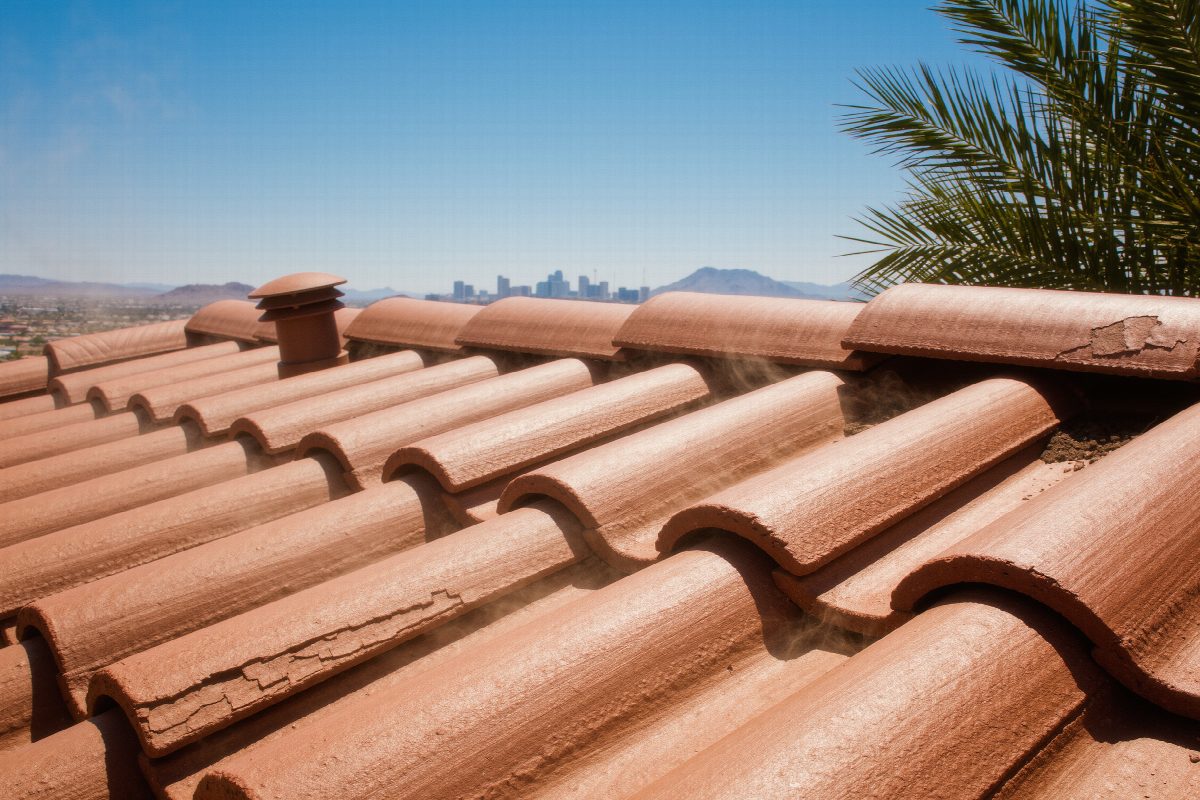
Concrete or clay tile sheds snow and sun for fifty years, but tile that has soaked up water cracks in a hard freeze. The tile is the armor; the layer under it is the roof.
The real roof: a membrane under the tile or shingles that carries water to the eaves. Up here it needs an ice-and-water barrier at the eaves and valleys, or meltwater dams and backs up under the roof.
The plywood or planks everything is nailed to. It only fails after the underlayment has leaked for a while; soft or stained decking means the leak is old. Replacing decking is structural work and needs a permit almost everywhere.
Metal where the roof meets a wall, a chimney or a change of slope. It is where most leaks start, because it depends on sealant that the sun dries out. A good inspection spends half its time here.
Every pipe through the roof wears a rubber or lead boot. The rubber ones crack in the sun in eight to twelve years, and water follows the pipe straight into the house. Cheap to replace, expensive to ignore.
The metal edge that sends water into the gutter instead of behind the fascia. Where ice dams form, this is the first place water backs up; keep gutters clear of pine needles before the snow.
Tap or hover a part of the roof. Every one of these is on our free inspection in Cottonwood.
Roofing near Cottonwood.
We serve communities across northern Arizona. A few of the communities close to Cottonwood:
Your roof deserves the best in Cottonwood.
Superior ratings, an industry-leading warranty, and a family-owned team that treats your roof like our own. Reach out today for a free, no-obligation estimate.