Glendale roofing, done the old way.
Shingle, tile, foam and flat roofs from Catlin Court to Arrowhead — one family-owned, licensed roofer.
Glendale was a farm town before it was a sports town, and its roofs still tell you which part of the city you are standing in.
Glendale grew in rings. The center, around the old town square and Catlin Court, is 1910s to 1940s bungalows under shingle and the occasional clay tile. The ring around that is the 1950s to 1970s ranches between Grand Avenue and Thunderbird, flat roofs and shingles and carports. North of Bell Road is Arrowhead, 1980s and 1990s concrete tile around lakes and fairways, and west along the Agua Fria Freeway is the newest ring: the stadium, the arena, the hotels and the big-box roofs of Westgate, acres of single-ply membrane. Every ring is under the same sky. The record within eight miles of Glendale since 2010 holds 121 thunderstorm wind reports, 60 dust storms, 47 flash floods, 18 hail reports and three tornadoes, and the hail has landed on Glendale itself: an inch and a half of it on October 18, 2015.
We have worked on all of the rings: the bungalows off 58th Avenue and the Craftsman homes of Catlin Court, the ranches along Olive and Northern, the tile in Arrowhead Ranch and Arrowhead Lakes, the apartment communities along 59th Avenue and Bell, and the commercial and multifamily roofs around Westgate and the Glendale Municipal Airport. We are family owned and operated, licensed, bonded and insured, and Glendale is the part of the West Valley where we have spent the most time on shingle roofs, which are honest, affordable and short-lived under this sun.
What follows is the record: the storms the National Weather Service has logged around Glendale since 2010, what the City publishes on permits, the work we have closed here this year, and the questions Glendale homeowners and property managers ask. Then book the free inspection; it comes with photographs and a written report that is yours whether or not you hire us.
Five things that break Glendale roofs, in the order they do it.
Glendale sits on the flat floor of the northwest Valley with open farmland and desert to the west, which means it gets the dust first and the outflow wind straight on. Heat does the slow work; the storms do the fast work; hail, rarely, does the expensive work.
Heat on shingle roofs
Glendale has more shingle roofs than most Valley cities, and shingles take the heat worst: 122 excessive-heat reports and 71 heat reports in the record, with heat warnings on 36 days in 2019 alone. Granules wash into the gutters, the mat goes brittle, and a roof rated for thirty years is done at eighteen to twenty-five. Shingle roofs are the most common replacement we do in Glendale.
Dust from the fields to the west
There are 60 dust storm reports in the Glendale record. The dust comes off the open ground west of Luke Air Force Base and arrives before the rain, and it settles in every scupper, drain and gutter on a flat or low-slope roof. The storm behind it then puts two inches of water on a roof that cannot drain. Clearing drains in May and after every haboob is the cheapest roof work there is.
Thunderstorm wind
The largest storm category after heat: 121 reports since 2010, with an 81-mile-an-hour gust in Peoria on July 29, 2010 and a 75-mile-an-hour microburst on July 24, 2024 that collapsed a warehouse near 47th Avenue and Van Buren. Wind lifts the eave course on tile, strips shingle tabs, peels ridge caps and takes carports and patio roofs with it. The damage shows at the edges first and is cheapest fixed within the week.
Flash flooding on the flats
With 47 flash flood reports, Glendale gets more of them than its size suggests, and on a flat roof a flash flood is simply water arriving faster than the scuppers can pass it. Foam that has sagged, drains set higher than the deck and parapet caps that let water behind the wall are the leaks we find on the ranches and the commercial roofs.
Hail, in October
Hail is rare, 18 reports, and then it is not: an inch and a half fell on Glendale on October 18, 2015, with an inch and a quarter at the Municipal Airport the same afternoon, and inch stones fell nearby on September 26, 2025. Hail bruises shingles in a way you cannot see from the ground, and the bruises leak a year later. An inspection with photographs is the first step in a hail claim.
What the weather has actually done around Glendale since 2010.
The National Weather Service logs every storm report it can verify. These are the ones within 8 miles of Glendale: 122 excessive heat reports, 121 thunderstorm wind reports, 71 heat reports, 60 dust storm reports. The inch-and-a-half hail on Glendale on October 18, 2015 and the two tornadoes that crossed Cactus and Sunnyslope before dawn on November 29, 2019 are the rows that matter most to a homeowner; the 121 thunderstorm wind reports and the 60 dust storms are the ones that fill our schedule every summer.

| Date | Event | Recorded | Where | What it does to roofs | |
|---|---|---|---|---|---|
| Sep 26, 2025 | Hail | 1.25" hailReports of 1-1.25 inch diameter hail between West Highland Avenue and West Coolidge Street in Phoenix. No damage or injuries reported. | Phoenix | Bruised shingles, cracked tile, dented soft metals; foam coatings chip. | NOAA #1293474 |
| Sep 26, 2025 | Hail | 1" hailPhoto of estimated quarter-sized hail along Western Desert Hills Drive in Sun Lakes. Location approximated based on radar. No damage or injuries reported. | Sun City | Bruised shingles, cracked tile, dented soft metals; foam coatings chip. | NOAA #1293448 |
| Jul 24, 2024 | Thunderstorm WindProperty damage logged: $2,000,000 | 75 mph est. gustLarge warehouse facility located in the area of West Van Buren Street and North 47th Avenue in Phoenix collapsed with multiple walls and portion of roof missing. A perso… | Phoenix Farm Aero Ar | Lifted tile, torn shingles, flashing peeled at the edges; wind-borne debris punctures flat roofs. | NOAA #1202318 |
| Nov 29, 2019 | TornadoProperty damage logged: $100,000 | TornadoA powerful Pacific upper level low and associated cold front moved east across central and northern portions of the greater Phoenix metropolitan area during the early mo… | Cactus | Decking exposed, structural damage, whole slopes stripped. | NOAA #863484 |
| Nov 29, 2019 | TornadoProperty damage logged: $40,000 | TornadoA powerful Pacific upper level low and associated cold front pushed east across the central and northern portions of the greater Phoenix metropolitan area during the ear… | Sunnyslope | Decking exposed, structural damage, whole slopes stripped. | NOAA #863479 |
| Oct 18, 2015 | HailProperty damage logged: $5,000 | 1.5" hailScattered thunderstorms developed across the greater Phoenix metropolitan area during the afternoon hours on October 18th, and some of the stronger storms affected the c… | Glendale | Bruised shingles, cracked tile, dented soft metals; foam coatings chip. | NOAA #600235 |
| Oct 18, 2015 | Hail | 1.25" hailAn area of low pressure moving across central Arizona acted upon elevated amounts of moisture and instability to produce scattered thunderstorms during the afternoon hou… | Glendale Municipal Airport Airport | Bruised shingles, cracked tile, dented soft metals; foam coatings chip. | NOAA #600226 |
| Jul 18, 2011 | HailProperty damage logged: $500 | 1" hailA strong thunderstorm moved across Youngtown during the early evening hours on July 18 and generated gusty winds in excess of 50 mph. A trained weather spotter reported … | Sun City | Bruised shingles, cracked tile, dented soft metals; foam coatings chip. | NOAA #320574 |
Source: NOAA NCEI Storm Events Database, events from 2010 through 2026 with a reported location within 8 miles of Glendale, or an NWS zone warning covering it. Wind speeds marked "est." are NWS estimates from damage; "measured" gusts came from an instrument. Dollar figures are the property damage NWS logged for the whole event, not one roof.
Excessive-heat warning days covering Glendale, by year
Each bar is a day the NWS issued a heat warning or advisory for the forecast zone Glendale sits in. Heat is the slow storm: it is what ages underlayment, shingles and coatings between the loud ones.
Had one of these go over your roof? A free inspection with photos tells you what it did, in writing, before the next one. Storm damage is cheapest fixed the week it happens.
Every roof. Every property type.
One trusted, family-owned roofer for Glendale — homes, businesses, and multifamily communities alike.
Residential Roofing
Tile, shingle, foam, metal, and flat roofs for Glendale homes — installs, repairs, and replacements.
Commercial Roofing
TPO, PVC, EPDM, foam, and metal systems engineered for Glendale's toughest buildings.
Multifamily Roofing
Apartment, condo, and HOA roofing across Glendale — phased, documented, and warrantied.
An honest number takes four facts, not a city name.
We do not publish a Glendale price list, because there is no such thing as a Glendale roof. There is your roof: its square footage, its pitch, what is on it now, and how many layers and penetrations are hiding underneath. Our instant estimator asks exactly those questions and prices them from our real job costs, in about a minute, with no phone call.

Size and pitch
Priced by the roofing square (100 sq ft). Steep slopes and two-story walls add labor and safety setup; a flat roof adds drainage work.
The system
Tile is the most expensive to install and the cheapest to keep; shingles the reverse. Foam is a recoat every decade, not a tear-off.
What is underneath
Most Glendale tile roofs do not need new tile; they need new underlayment. Rotten decking, extra layers and old skylights are the surprises, and we price them before we start, not after. What a full replacement involves.
Permit and disposal
Where Glendale requires a permit, the fee and the inspections are part of the quote. So is the dumpster. Financing is available on every job.
What the City of Glendale requires before the first tile moves.
Read from the official pages, linked below, and worth reading yourself: a permit pulled in your name by a licensed contractor is the paper trail that protects your warranty, your insurance claim, and your sale price. We pull the permit and schedule the inspections on every job that needs one. The authority is City of Glendale Development Services - Building Safety, Codes & Services, 623-930-2800 (Development Services); 623-915-3263 (inspection scheduling); Building Official 623-930-3151.

The inspection scheduling page lists residential inspection code 628 "Roof/Deck Nailing" and commercial codes 126 "Roof/Deck Nailing" and 168 "Roofing"; inspections are scheduled at 623-915-3263. No re-roof-specific sequence is published.
2024 IBC, 2024 IRC, 2024 IMC, 2024 IPC, 2024 IECC, 2024 IFGC, 2024 IFC, 2023 NEC, 2024 ISPSC, 2024 IEBC, 2024 IPMC, ICC A117.1-2017, with Glendale amendments; the Building Codes page links the "2024 Code Adoption Ordinance" as "Effective January 9th, 2026". Prior cycle: 2018 I-codes adopted by a 2019 ordinance.
No re-roof fee line. Fee Schedule (dated 4/24/2019): permit fees for new buildings, additions and pools are valuation-based; "Other types of permits have fees based on the amount of time estimated to inspect the project"; "Minimum Commercial Permit Fee $114.35".
Q & A page: "Property owners, licensed contractors or authorized agents may apply for a building permit." Contractors need an Arizona ROC license and a Glendale business license; residential owners doing their own work sign a verification statement.
Permit expiration: "You must call for and pass one inspection within a 180-day period in order to keep your permit active." (Q & A page). Permit Packets page currently reads "*PACKETS TO BE UPDATED SOON*".
Rules change and we are roofers, not the building department: confirm the current requirement with the City of Glendale before work starts. Rules above were read from the linked official pages on October 25, 2026.

What lasts here, and how long.
Glendale wears every roof system the Valley has, ring by ring. The four that hold up here and what decides how long.
Architectural shingles, on the first two rings
The bungalows, the ranches and most of the 1970s subdivisions are shingle, and shingle is still the right answer on them: affordable, quick, and good for eighteen to twenty-five years here. Impact-rated shingles are worth the upcharge after what October 2015 did to the city.
Concrete tile, in Arrowhead and north of Bell
The tile lasts fifty years or more; the felt beneath it lasts twenty to twenty-five, and the first Arrowhead subdivisions are past that now. An underlayment replacement relays your own tile over synthetic.
Spray foam with elastomeric coating, on the flats
The flat-roofed ranches along Olive and Northern and much of the older commercial are foam. Recoat every ten to fifteen years and it lasts indefinitely; let the coating go and the sun eats the foam.
TPO and modified bitumen, around Westgate and the airport
The big-box, hotel, warehouse and apartment roofs carry single-ply or modified bitumen. White membranes last longest, ponding takes years off any of them, and drains and curbs are where the leaks are.
| Roof system | Expected life here | What decides it |
|---|---|---|
| Concrete tile | 50 years or more for the tile; 20 to 25 for the underlayment beneath it | The tile outlives the felt it sits on. Most "tile roof replacements" here are underlayment replacements with the tile relaid. |
| Asphalt shingles (architectural) | 18 to 25 years | The Valley sun ages shingles faster than the label says; granule loss is the tell. |
| Spray polyurethane foam with elastomeric coating | 25 years and up, with a recoat every 10 to 15 | Foam is a system you maintain, not replace; let the coating go and the foam goes with it. |
| Standing-seam metal | 40 to 60 years | Expansion and contraction loosen fasteners over decades; otherwise it shrugs off the heat. |
| Modified bitumen or single-ply (TPO, PVC) on flat roofs | 15 to 25 years | Reflective membranes last longest; ponding water takes years off any of them. |
Ranges reflect roofs in this climate region under normal maintenance; a warranty up to 30 years is available on qualifying systems we install. Compare systems on our residential roofing page.
Every part of Glendale was built in a different decade, and the roofs show it.
Glendale runs from the old town square to the open fields on its western edge, and the roofs change by the decade the ring was built. The areas we are in most weeks.

| Area | Housing and roofs | What we see on inspections |
|---|---|---|
| Historic downtown and Catlin Court | 1910s to 1940s bungalows and Craftsman homes around the town square and 58th Avenue; shingle, some clay tile, flat additions and porches. | Roof-over-roof shingle layers; flashing at brick chimneys; porch and addition roofs with no slope; design sensitivity on the visible slopes. |
| The ranches between Grand Avenue and Thunderbird | 1950s to 1970s ranches off Olive, Northern and 59th Avenue; flat foam and shingle, carports everywhere. | Foam past its recoat; ponding on sagged decks; carport and patio roofs that leave in outflow wind; shingles at the end of their life. |
| Arrowhead Ranch and Arrowhead Lakes | 1980s and 1990s concrete tile around the lakes and the golf course north of Bell Road; HOA-governed profiles and colors. | First-generation felt past its life; wind-lifted eave tile; HOA color matching; cracked tile from solar installers. |
| Thunderbird Park and the 59th Avenue corridor | 1970s and 1980s subdivisions between Cactus and Union Hills; shingle and early concrete tile, apartment communities along the arterials. | Shingle replacements by the block; underlayment on the earliest tile; apartment roofs on deferred recoats. |
| Westgate, the sports district and the Agua Fria Freeway | Stadium, arena, hotels, big-box retail and warehouses from the 2000s on; TPO, PVC and modified bitumen by the acre. | Drains and mechanical curbs, membrane seams on the sun side, and recoats and replacements planned around event schedules and tenants. |
| The airport and west Glendale | Light industrial and flex roofs around the Glendale Municipal Airport, with newer tile subdivisions filling in toward the White Tanks; the October 2015 hail landed here. | Hail-bruised shingles and dented coatings from 2015; dust in every drain by June; wind at the edge of the open fields. |
Get your free Glendale roofing estimate.
Tell us about your property and our team will follow up fast with an honest assessment and a clear plan — no pressure, no obligation.
- Superior ratings across Google, Yelp & Facebook.
- Industry-leading warranty up to 30 years.
- Family owned, licensed, bonded & insured. AZ ROC #325294.
Prefer to talk? Call (602) 314-4650. Prefer to pick a time? Book online.
Get Your Free Estimate
Free roof inspection · Response within 24 hrs
Thank you!
Your request has been received. Our team will contact you shortly.

A roof here has a calendar. Here is ours.
Glendale's roof year is the Valley's, with the dust arriving a little earlier and from the west. The weeks before the monsoon are when the useful work gets done.
- May
Clear every scupper, drain and gutter; cut back limbs over the roof; check that tile at the eaves and hips is seated.
Dust storms arrive before the rain. A blocked drain plus a monsoon cell is a ceiling leak. - Early June
Inspect foam and flat roofs for exposed foam, blisters or ponding marks; have coatings due this year done now.
Coatings need dry weather to cure, and July will not give it to you. - After every big monsoon storm
Walk the ground line for displaced or broken tile, lifted shingles and debris; check ceilings and the garage.
Wind damage is cheapest fixed the same week it happens. - Late September
Book a post-monsoon inspection with photos; reseal pipe boots, skylight curbs and parapet caps.
The summer cooked the sealants; the fall is when you find out which ones. - December through February
Watch flat roofs during winter rain; the slow, soaking storms find leaks the monsoon missed.
Winter rain sits on a roof for days instead of minutes.
Would rather not climb a ladder? Our free inspection covers every item on this list, with photos and a written report you keep. What a 21-point inspection looks at.
Asked in Glendale, answered plainly.
Does Glendale require a permit to replace a roof?
The City of Glendale does not publish a roofing-specific rule in the pages we read; what it publishes is in the permit section above, including the roof and deck nailing inspections it lists and who may apply for a permit. Because the rule is not spelled out, we confirm with the City's building safety department before every Glendale re-roof and tell you what we were told. When a permit is required, we pull it in your name and schedule the inspections; a permit on file is also what your insurer and your eventual buyer will ask for.
My shingle roof is only fifteen years old. Why is it failing?
Because Glendale is not the climate the label was written for. The record holds 122 excessive-heat reports and 71 heat reports since 2010, and shingles here run eighteen to twenty-five years, not thirty. Look for granules in the gutters, tabs that have curled at the corners, and bald spots on the south and west slopes. A roof at fifteen may have several years left with the right repairs, or it may not; the inspection is how you find out, and it is free.
Was my roof damaged by the October 2015 hail, and can I still claim it?
Possibly, and probably not. The hail of October 18, 2015 reached an inch and a half in Glendale, which is large enough to bruise shingles and crack tile, and a roof that was never inspected afterward may still carry that damage. Most policies set a deadline for storm claims that has long passed, so a claim on that storm is unlikely to succeed. What a current inspection can do is document the condition so that damage from the next storm is clearly separated from the last one.
What should I check after a monsoon windstorm in Glendale?
From the ground, with binoculars if you have them: the eave course and hips of a tile roof for slipped tile, the ridge for lifted caps, shingle slopes for tabs standing up or missing, the flat sections for standing water, and the yard for pieces of the carport. Inside, check the garage ceiling and the closets on the windward side. The record holds 121 thunderstorm wind reports since 2010, and the damage from each one is cheapest fixed within the week. What we repair, and how fast.
Will my Arrowhead HOA need to approve the new roof?
In Arrowhead Ranch, Arrowhead Lakes and most of the subdivisions north of Bell Road, yes: tile profile and color are governed, and some associations want a sample with the submittal. An underlayment replacement that relays your existing tile usually needs nothing more than notice, since the visible roof does not change. We prepare the paperwork and the color match as part of the job and have been through it with most of the large associations.
Do you handle commercial and multifamily roofs around Westgate?
Yes: the hotels, retail and warehouses around the stadium and the arena, the flex buildings near the airport, and the apartment communities along 59th Avenue and Bell. The roofs are TPO, PVC, modified bitumen and foam, and the work is recoats, drain and curb repairs, balcony waterproofing and phased replacements planned around tenants and event calendars. Multifamily and commercial have their own pages, their own crews and the same warranty as our residential work.
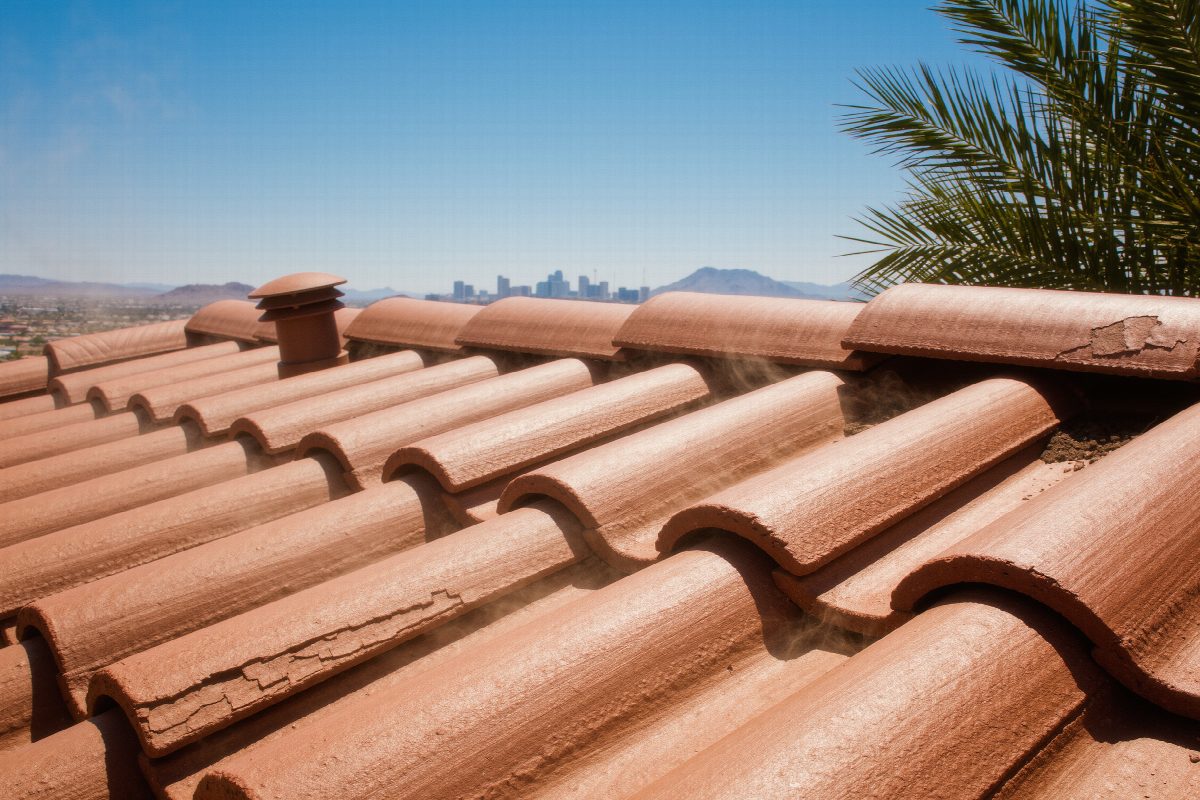
Concrete or clay tile is the armor: it shrugs off sun and hail for fifty years and more. It is not the waterproofing. Broken or slipped tile lets water onto the layer below, which is where leaks are born.
The real roof: a sheet under the tile that carries water to the eaves. Felt cooks under tile in this heat and goes brittle at twenty years; synthetic underlayment lasts far longer. Most "tile roof replacements" are underlayment replacements with the tile relaid.
The plywood or planks everything is nailed to. It only fails after the underlayment has leaked for a while; soft or stained decking means the leak is old. Replacing decking is structural work and needs a permit almost everywhere.
Metal where the roof meets a wall, a chimney or a change of slope. It is where most leaks start, because it depends on sealant that the sun dries out. A good inspection spends half its time here.
Every pipe through the roof wears a rubber or lead boot. The rubber ones crack in the sun in eight to twelve years, and water follows the pipe straight into the house. Cheap to replace, expensive to ignore.
The metal edge that sends water into the gutter instead of behind the fascia. Monsoon wind lifts the first course of tile here first, and a gutter packed with dust and fronds turns a storm into a waterfall over the door.
Tap or hover a part of the roof. Every one of these is on our free inspection in Glendale.
Roofing near Glendale.
We serve the entire Phoenix metro. A few of the communities close to Glendale:
Your roof deserves the best in Glendale.
Superior ratings, an industry-leading warranty, and a family-owned team that treats your roof like our own. Reach out today for a free, no-obligation estimate.



