Paradise Valley roofing, quietly done.
Flat foam, built-up, clay and concrete tile on estate lots between Camelback and Mummy Mountain — one family-owned, licensed roofer.
Paradise Valley is a town of one-acre lots and no streetlights, and the roofs are either flat enough to walk or heavy enough to need a crane.
There are two kinds of roof in Paradise Valley, and they were built forty years apart. The first is the flat or low-slope roof of the mid-century ranch, the long low house behind the oleanders on Mockingbird Lane or off McDonald Drive, with parapets, scuppers and a foam or built-up system that has been patched by every owner since the Goldwater years. The second is the tile roof of the estate that replaced the ranch next door: clay or heavy concrete, long valleys, a dozen roof-to-wall transitions, and underlayment working harder than it was designed to under a hundred pounds of tile per square. Both sit under the same sun. The National Weather Service has logged 301 storm reports within six miles of the Town since 2010, and the ones that matter here are wind off the mountains and, every decade or so, hail.
We have worked the hillside homes of Clearwater Hills, the resort-corridor houses along Lincoln Drive, the acre-lot ranches between Tatum and Invergordon, and the newer estates on the golf-course edges near the Paradise Valley Country Club. We have relaid two-piece clay mission tile by hand, recoated foam on flats that have never once drained properly, and learned to stage a tear-off on a hillside lot where the driveway is the only flat ground. We are family owned and operated, licensed, bonded and insured, and we have found that Paradise Valley clients do not want a sales call. They want to know what is wrong, what it costs, and when the crew leaves.
This page is what the weather has actually done here since 2010 according to the NWS, what the Town and your association will want on paper before work starts, the systems that hold up on an acre lot and the ones that do not, and the questions we are asked at the gate. When you have read it, book the free inspection. We photograph every slope and every scupper and you keep the report either way.
What breaks a Paradise Valley roof, in the order it happens.
The Town sits in a bowl between Camelback, Mummy Mountain and the Phoenix Mountains. The sun works on it all year, the mountains throw outflow wind and runoff at it in summer, and the roofs are large enough that a small problem has room to become an expensive one.
The sun on the flats
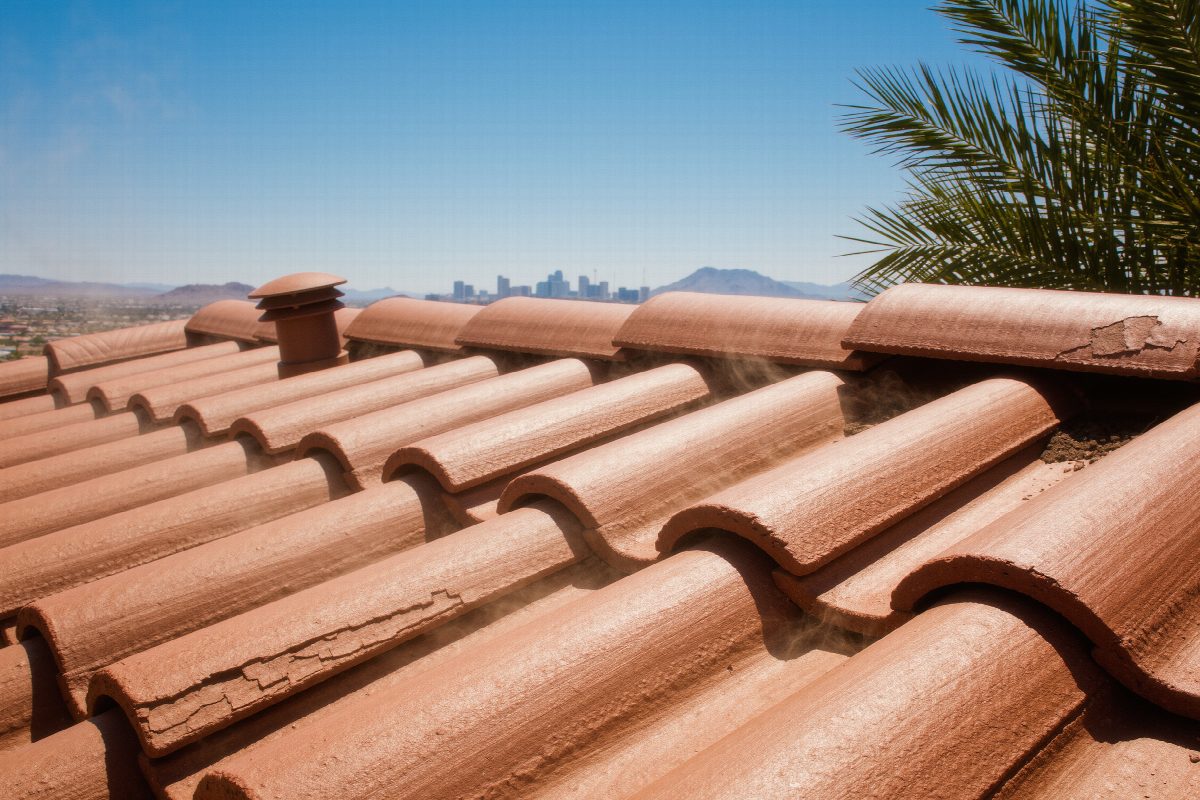
The NWS has issued excessive-heat products for this area 67 times since 2010, with 15 heat-warning days in 2018 alone. A flat roof takes that sun full on. Elastomeric coatings chalk, thin and crack at the parapet; once the foam under them is exposed, the sun eats it in a season. A foam recoat on schedule is the cheapest roofing decision a Paradise Valley owner will ever make, and the most often skipped.
Underlayment under heavy tile
The estates built since the 1990s carry clay or heavy concrete tile over felt that was never meant to spend twenty-five summers at a hundred and fifty degrees. The tile is fine. The felt cracks at the laps, the valleys rust through, and the first evidence is a stain on a guest-room ceiling. A tile underlayment replacement relays your own tile over synthetic underlayment and new valley metal; on heavy tile it is skilled, slow work.
Outflow wind off the mountains
Thunderstorm wind is the single most common event in the record here, 76 reports since 2010. The microburst of July 22, 2021 ran from McCormick Ranch down to Scottsdale Road and McDonald Drive at 81 miles an hour and took out hundreds of trees on the Town's eastern edge. Wind lifts eave tile and ridge caps, peels a loose coating at the parapet, and drops a mesquite limb on whatever is beneath it. Wind damage is cheapest fixed the week it happens.
Hail, in October
Paradise Valley does not get hail in summer; it gets it in the fall, when the air cools and the storms go vertical. The hail of October 5, 2010 reached 2.5 inches a few miles east and damaged hundreds of roofs across Scottsdale; on October 16, 2022, two-inch stones fell at 64th Street and Shea. Tile cracks, foam bruises, and the damage hides until the next rain. The NWS has 12 hail reports within six miles; one is plenty.
What the weather has actually done around Paradise Valley since 2010.
The National Weather Service logs every storm report it can verify. These are the ones within 6 miles of Paradise Valley: 76 thunderstorm wind reports, 67 excessive heat reports, 52 dust storm reports, 35 flash flood reports. The 81-mile-an-hour microburst of July 2021 and the two-inch hail at 64th Street and Shea in October 2022 are the events to remember; the 76 thunderstorm wind reports and 35 flash flood reports since 2010 are the pattern that keeps a flat roof honest.

| Date | Event | Recorded | Where | What it does to roofs | |
|---|---|---|---|---|---|
| Oct 13, 2025 | Hail | 1" hailQuarter-size diameter hail reported along the area of North College Avenue and East Mckellips Road in Tempe. No damages or injuries reported. | Papago Aaf Airport | Bruised shingles, cracked tile, dented soft metals; foam coatings chip. | NOAA #1296353 |
| Sep 26, 2025 | Hail | 1" hailReport of 1 inch diameter hail near 92nd Place and East Laurel Lane in Scottsdale. No injuries or damage reported. | Scottsdale Municipal Airport | Bruised shingles, cracked tile, dented soft metals; foam coatings chip. | NOAA #1293451 |
| Oct 16, 2022 | Hail | 2" hailHailstones up to 2 inches in diameter reported near 64th St. and Shea Blvd in Paradise Valley. No damages or injuries were reported. | Paradise Valley | Bruised shingles, cracked tile, dented soft metals; foam coatings chip. | NOAA #1061575 |
| Oct 16, 2022 | Hail | 1.5" hailHailstones up to 1.5 inches in diameter were reported in the area of East McDonald Drive and North 86th street in Paradise Valley. No damages or injuries were reported. | Scottsdale | Bruised shingles, cracked tile, dented soft metals; foam coatings chip. | NOAA #1061577 |
| Jul 22, 2021 | Thunderstorm WindProperty damage logged: $1,000,000 | 81 mph est. gustA microburst caused considerable damage from the McCormick Rach area and down to Scottsdale Road and McDonald Road with hundreds of downed trees and several downed power… | Papago Aaf Airport | Lifted tile, torn shingles, flashing peeled at the edges; wind-borne debris punctures flat roofs. | NOAA #976648 |
| Aug 8, 2018 | Thunderstorm WindProperty damage logged: $30,000 | 75 mph est. gustThunderstorms with strong and gusty outflow winds moved through the central and northern portions of the greater Phoenix metropolitan area during the evening hours on Au… | Scottsdale | Lifted tile, torn shingles, flashing peeled at the edges; wind-borne debris punctures flat roofs. | NOAA #768264 |
| Aug 31, 2015 | Thunderstorm WindProperty damage logged: $50,000 | 75 mph est. gustScattered strong thunderstorms moved across the central portion of the greater Phoenix metropolitan area during the evening hours on August 31st; the stronger storms gen… | Papago Aaf Airport | Lifted tile, torn shingles, flashing peeled at the edges; wind-borne debris punctures flat roofs. | NOAA #594390 |
| Oct 5, 2010 | HailProperty damage logged: $110,000,000 | 2.5" hailThis storm moved from south of Chandler to far north Scottsdale. As the storm moved through Scottsdale, the storm dropped up to tennis ball sized hail. The hail damaged … | Scottsdale | Bruised shingles, cracked tile, dented soft metals; foam coatings chip. | NOAA #266217 |
Source: NOAA NCEI Storm Events Database, events from 2010 through 2026 with a reported location within 6 miles of Paradise Valley, or an NWS zone warning covering it. Wind speeds marked "est." are NWS estimates from damage; "measured" gusts came from an instrument. Dollar figures are the property damage NWS logged for the whole event, not one roof.
Excessive-heat warning days covering Paradise Valley, by year
Each bar is a day the NWS issued a heat warning or advisory for the forecast zone Paradise Valley sits in. Heat is the slow storm: it is what ages underlayment, shingles and coatings between the loud ones.
Had one of these go over your roof? A free inspection with photos tells you what it did, in writing, before the next one. Storm damage is cheapest fixed the week it happens.
Every roof. Every property type.
One trusted, family-owned roofer for Paradise Valley — homes, businesses, and multifamily communities alike.
Residential Roofing
Tile, shingle, foam, metal, and flat roofs for Paradise Valley homes — installs, repairs, and replacements.
Commercial Roofing
TPO, PVC, EPDM, foam, and metal systems engineered for Paradise Valley's toughest buildings.
Multifamily Roofing
Apartment, condo, and HOA roofing across Paradise Valley — phased, documented, and warrantied.
An honest number takes four facts, not a city name.
We do not publish a Paradise Valley price list, because there is no such thing as a Paradise Valley roof. There is your roof: its square footage, its pitch, what is on it now, and how many layers and penetrations are hiding underneath. Our instant estimator asks exactly those questions and prices them from our real job costs, in about a minute, with no phone call.

Size and pitch
Priced by the roofing square (100 sq ft). Steep slopes and two-story walls add labor and safety setup; a flat roof adds drainage work.
The system
Tile is the most expensive to install and the cheapest to keep; shingles the reverse. Foam is a recoat every decade, not a tear-off.
What is underneath
Most Paradise Valley tile roofs do not need new tile; they need new underlayment. Rotten decking, extra layers and old skylights are the surprises, and we price them before we start, not after. What a full replacement involves.
Permit and disposal
Where Paradise Valley requires a permit, the fee and the inspections are part of the quote. So is the dumpster. Financing is available on every job.
What the Town of Paradise Valley requires before the first tile moves.
Read from the official pages, linked below, and worth reading yourself: a permit pulled in your name by a licensed contractor is the paper trail that protects your warranty, your insurance claim, and your sale price. We pull the permit and schedule the inspections on every job that needs one. The authority is Community Development Department - Building Safety, (480) 348-3692; [email protected].

No statement found. Building Permit Application Information: "A demolition permit is required when there is more than 12 linear feet of building wall or fence or 12 square feet of roof or structure to be removed."
Town Inspections List includes "120 ROOF NAILING" and "190 FINAL BUILDING"; "ROOF NAILING & SHEAR: Must be approved before dry-in." (Building Safety Inspections List PDF).
2015 IRC, 2015 IBC, 2015 IMC, 2015 IPC, 2015 IFGC, 2015 IECC, 2015 IPMC, 2021 IFC and 2014 NEC per the Town handout "International Codes adopted by Town of Paradise Valley" (updated July 2023). Wind design 115 mph; ice barrier underlayment not required.
Building permit fees "shall be based on the valuation of the construction"; plan review fee is 65% of the building permit fee (General Permitting Information PDF). Town Master Fee Schedule on Municode.
"All owner/builder projects valued at $25,000 or more require a letter of authorization from the owner." An Owner Builder Declaration of Intent form is published.
An HOA Acknowledgement form is required with the building permit application. Extra requirements apply on hillside-designated property.
Rules change and we are roofers, not the building department: confirm the current requirement with the Town of Paradise Valley before work starts. Rules above were read from the linked official pages on October 25, 2026.

What lasts here, and how long.
Paradise Valley architecture runs from 1950s desert ranch to Santa Barbara estate to glass-and-steel contemporary, and each one wants a different roof. These are the systems that hold up on an acre lot.
Spray foam with elastomeric coating
The right answer for most of the mid-century flats: seamless, insulating, self-flashing at the parapets, and recoated rather than replaced. White coatings only; a dark flat roof here runs far hotter than the air above it. Drainage has to be solved first, because foam will faithfully hold a pond forever.
Clay and heavy concrete tile
The estate standard, and nearly permanent on its own. Two-piece clay mission tile is the most beautiful roof in the Valley and the most demanding to relay; budget for the underlayment at year twenty and the tile outlives the house. Confirm the framing before adding clay to a roof that was built for shake.
Built-up and modified bitumen
What is actually under the gravel on many older flats. Sound ones can be covered with foam or a reflective cap sheet rather than torn off; saturated ones cannot. The inspection tells which.
Standing-seam metal
The desert-contemporary homes and the hillside remodels like the look, and the wind likes the hold. Fasteners and penetrations are what need checking after year fifteen, and expansion noise on a hundred-and-ten-degree afternoon is normal.
| Roof system | Expected life here | What decides it |
|---|---|---|
| Concrete tile | 50 years or more for the tile; 20 to 25 for the underlayment beneath it | The tile outlives the felt it sits on. Most "tile roof replacements" here are underlayment replacements with the tile relaid. |
| Asphalt shingles (architectural) | 18 to 25 years | The Valley sun ages shingles faster than the label says; granule loss is the tell. |
| Spray polyurethane foam with elastomeric coating | 25 years and up, with a recoat every 10 to 15 | Foam is a system you maintain, not replace; let the coating go and the foam goes with it. |
| Standing-seam metal | 40 to 60 years | Expansion and contraction loosen fasteners over decades; otherwise it shrugs off the heat. |
| Modified bitumen or single-ply (TPO, PVC) on flat roofs | 15 to 25 years | Reflective membranes last longest; ponding water takes years off any of them. |
Ranges reflect roofs in this climate region under normal maintenance; a warranty up to 30 years is available on qualifying systems we install. Compare systems on our residential roofing page.
Every part of Paradise Valley was built in a different decade, and the roofs show it.
Paradise Valley is small, but the roofs change with the slope and the decade. A few of the corners we are in most often.

| Area | Housing and roofs | What we see on inspections |
|---|---|---|
| Clearwater Hills and the Mummy Mountain slopes | Hillside custom homes from the 1950s to today: flat decks with parapets, tile estates, metal on the remodels. Steep drives, hillside-designated lots, the Town's extra requirements. | Ponding on decks that were never pitched; crane and staging planning before any tile work; drainage from the roof to a hillside that moves water fast. |
| Lincoln Drive and the resort corridor | Mid-century ranches on the north slope of Camelback, the resort properties, and newer estates on the old resort land. | Foam and built-up flats on the ranches, mechanical-unit flashing and phased recoats on the resort roofs, tile transitions on the new builds. |
| Between Tatum and Invergordon | 1960s and 1970s acre-lot ranches, many flat or low-slope, interleaved with teardowns rebuilt as tile estates. | Third-generation coatings on the originals; heavy tile and complicated valleys on the replacements; wind damage at the eaves after outflow storms. |
| The Country Club and the eastern edge | 1970s to 1990s tile and shake-converted homes around the Paradise Valley Country Club and out toward 64th Street and Shea, where the 2022 hail fell. | First-generation felt at or past its life; shake-to-tile conversions on battens that were sized for shake; hail checks on tile and foam. |
Get your free Paradise Valley roofing estimate.
Tell us about your property and our team will follow up fast with an honest assessment and a clear plan — no pressure, no obligation.
- Superior ratings across Google, Yelp & Facebook.
- Industry-leading warranty up to 30 years.
- Family owned, licensed, bonded & insured. AZ ROC #325294.
Prefer to talk? Call (602) 314-4650. Prefer to pick a time? Book online.
Get Your Free Estimate
Free roof inspection · Response within 24 hrs
Thank you!
Your request has been received. Our team will contact you shortly.

A roof here has a calendar. Here is ours.
Paradise Valley gets two roof seasons: the summer storms that come over the mountains, and the long heat that works on the flats in between. The maintenance that matters happens in the weeks before each.
- May
Clear every scupper, drain and gutter; cut back limbs over the roof; check that tile at the eaves and hips is seated.
Dust storms arrive before the rain. A blocked drain plus a monsoon cell is a ceiling leak. - Early June
Inspect foam and flat roofs for exposed foam, blisters or ponding marks; have coatings due this year done now.
Coatings need dry weather to cure, and July will not give it to you. - After every big monsoon storm
Walk the ground line for displaced or broken tile, lifted shingles and debris; check ceilings and the garage.
Wind damage is cheapest fixed the same week it happens. - Late September
Book a post-monsoon inspection with photos; reseal pipe boots, skylight curbs and parapet caps.
The summer cooked the sealants; the fall is when you find out which ones. - December through February
Watch flat roofs during winter rain; the slow, soaking storms find leaks the monsoon missed.
Winter rain sits on a roof for days instead of minutes.
Would rather not climb a ladder? Our free inspection covers every item on this list, with photos and a written report you keep. What a 21-point inspection looks at.
Asked in Paradise Valley, answered plainly.
Does a re-roof in Paradise Valley need a Town permit?
The Town of Paradise Valley does not publish an explicit rule for re-roofing the way Phoenix and Scottsdale do; its building guidance covers permits by project valuation, a roof-nailing inspection on permitted work, an HOA acknowledgement form with any permit application, and extra requirements on hillside-designated lots. The permit section above is read from the Town's own pages and links to them. Because the rule is not stated, we confirm with the Town building department before work starts on every Paradise Valley job and pull whatever is required in your name.
My house is on a hillside lot. What changes?
Access, staging and drainage. On a hillside-designated property the Town applies extra requirements, and the practical problems are ours to solve: where the tile pallets land, whether a crane can reach the back slope, how the tear-off debris leaves without touching the native desert. We plan that before the first tile comes off. Drainage matters more here than on the flats, because water leaving a hillside roof moves fast and goes somewhere; scuppers, downspouts and splash blocks are part of the roof.
Can the flat roof on my 1960s ranch be recoated instead of replaced?
Usually, and it is the better outcome. Foam is a system you maintain: the foam insulates and sheds water, the elastomeric coating protects the foam from the sun. If the coating has only chalked and thinned, a cleaning, repairs at the parapets and penetrations, and a new coat bring it back for another ten to fifteen years. If it has worn through and the foam is pitted and dark, the foam has to be removed down to sound material first, and that is a different job.
Can my roof carry clay tile if it was built for shake?
Sometimes, and a roofer who says yes without looking at the framing is guessing. Two-piece clay and heavy concrete tile weigh several times what cedar shake did, and the 1970s trusses in the Country Club area were sized for shake. We check the framing, and where it will not carry the load we have good options: a lightweight concrete tile that matches the profile, or a structural letter and reinforcement from an engineer when the heavy clay is the only acceptable look.
What should I look at after a windstorm?
The edges before the middle. Walk the ground line for broken tile and pieces of ridge cap, look at the eave course and hips with binoculars, and check the flat sections from any upper window for standing water or a coating peeled back at the parapet. Inside, check the garage and any ceiling on the windward side. The NWS has 76 thunderstorm wind reports within six miles since 2010, and the July 2021 microburst reached 81 miles an hour. Then book the free inspection and let us look from the roof.
Will my association need to approve the roof?
Many Paradise Valley neighborhoods have no association at all, and the ones that do, the gated and hillside communities in particular, tend to govern tile profile, color and visible roof equipment carefully. The Town itself requires an HOA acknowledgement form with any building permit application. We find out which applies on the first visit, prepare the submittal and the color match, and keep the project from stalling in a review meeting.
Do you work on the resorts and commercial properties?
Yes. The resort properties along Lincoln Drive and the small commercial and office buildings on the Town's edges are mostly flat: foam, built-up and single-ply membranes, with a great deal of rooftop mechanical equipment. The work is recoats, drain and flashing repairs, and phased replacements planned around guests and tenants. Commercial roofing has its own page and crews, with the same warranty as our residential work.
Concrete or clay tile is the armor: it shrugs off sun and hail for fifty years and more. It is not the waterproofing. Broken or slipped tile lets water onto the layer below, which is where leaks are born.
The real roof: a sheet under the tile that carries water to the eaves. Felt cooks under tile in this heat and goes brittle at twenty years; synthetic underlayment lasts far longer. Most "tile roof replacements" are underlayment replacements with the tile relaid.
The plywood or planks everything is nailed to. It only fails after the underlayment has leaked for a while; soft or stained decking means the leak is old. Replacing decking is structural work and needs a permit almost everywhere.
Metal where the roof meets a wall, a chimney or a change of slope. It is where most leaks start, because it depends on sealant that the sun dries out. A good inspection spends half its time here.
Every pipe through the roof wears a rubber or lead boot. The rubber ones crack in the sun in eight to twelve years, and water follows the pipe straight into the house. Cheap to replace, expensive to ignore.
The metal edge that sends water into the gutter instead of behind the fascia. Monsoon wind lifts the first course of tile here first, and a gutter packed with dust and fronds turns a storm into a waterfall over the door.
Tap or hover a part of the roof. Every one of these is on our free inspection in Paradise Valley.
Roofing near Paradise Valley.
We serve the entire Phoenix metro. A few of the communities close to Paradise Valley:
Your roof deserves the best in Paradise Valley.
Superior ratings, an industry-leading warranty, and a family-owned team that treats your roof like our own. Reach out today for a free, no-obligation estimate.