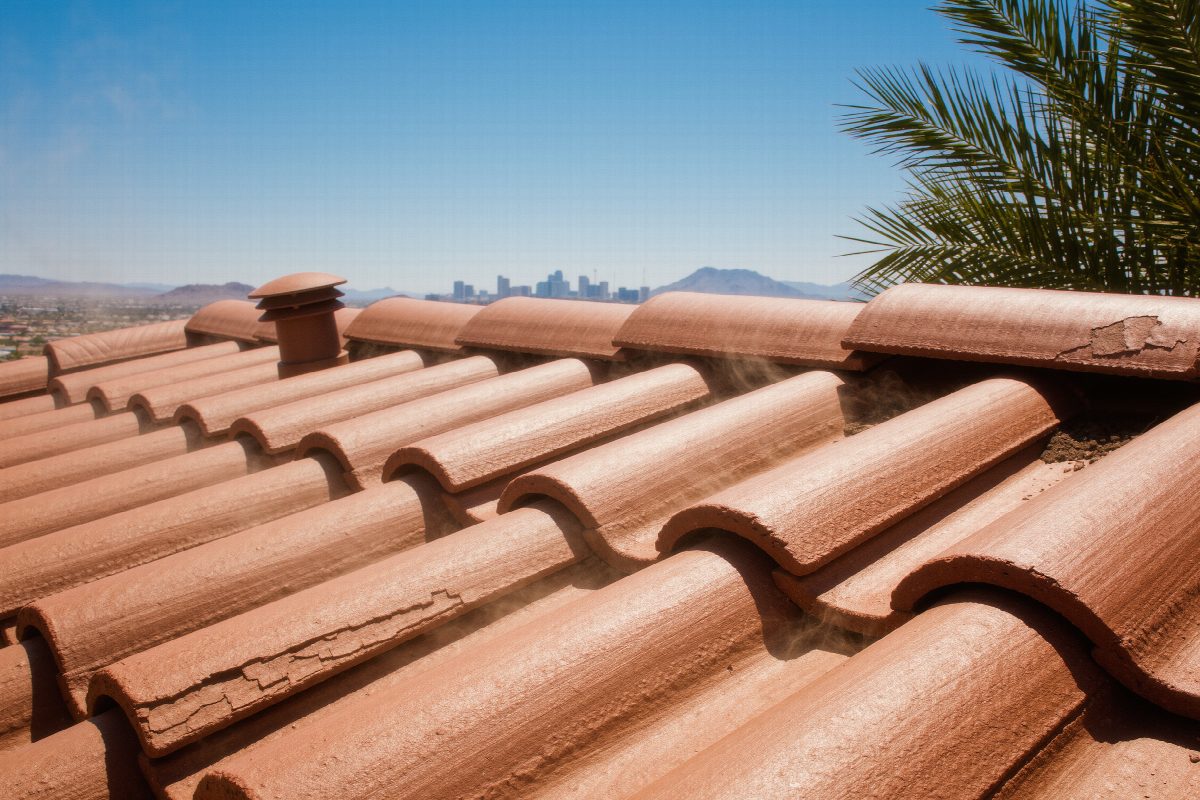
Tile, foam, shingle, flat and metal roofs from the historic districts to the master plans — one family-owned, licensed roofer.
Phoenix is the largest city in the country that was never meant to be here, and every roof in it is an argument with the sun that the sun eventually wins.
1,125storm reports logged by NOAA within 12 miles since 2010
2"largest hail on record nearby, Oct 16, 2022
90 mphstrongest storm gust on record nearby, Jul 9, 2018
No permitneeded for a like-for-like re-roof in Phoenix
Phoenix has two climates stacked on top of each other. The first is the Sonoran Desert, hot and dry and honest about it. The second is the heat island the city built for itself out of asphalt, concrete and a million rooftops, which holds the day's heat into the night so that a roof never fully cools between June and September. The National Weather Service issued heat warnings here on 74 to 89 days a year from 2018 through 2023. Then the monsoon arrives, usually in July, with a wall of dust out front and sixty-mile-an-hour outflow behind it, and the roof that has been baking for a month is asked, in ten minutes, to shed an inch of sideways rain. Most do. The ones that do not are the ones we get called about.
We are a Phoenix company, and the city's roofs are the ones we know best: the clay tile and flat parapet roofs of the 1920s bungalows in Willo, Alvarado and Encanto-Palmcroft; the shingle and foam of the 1950s ranches that filled Arcadia, North Central and Sunnyslope after the war; the concrete tile on the 1990s and 2000s master plans at Desert Ridge, Ahwatukee and Laveen; the modified bitumen and TPO on the warehouses along Grand Avenue and the garden apartments off Camelback. We are family owned and operated, licensed, bonded and insured, and we have never thought a roof in Maryvale deserved less care than one on the Biltmore side of 24th Street.
What follows is the record: what the weather has done inside twelve miles of central Phoenix since 2010 according to the National Weather Service, what the City requires before a roofer touches your house, what we have done here, and what we tell our own families. Read it, then book the free inspection. It comes with photographs and a written report.
What breaks roofs here
Five things that break Phoenix roofs, in the order they do it.
The damage here follows the calendar: heat from May on, dust in June and July, wind and rain with the monsoon, and hail, when it comes, in October. Each stage sets up the next.
Heat that never lets go
The record holds 279 heat reports and 248 excessive-heat reports since 2010, and the heat island means a roof deck on 7th Street cools less overnight than one in Cave Creek. Shingles lose their granules, foam coatings chalk, sealants go brittle, and the felt under tile cooks until it cracks at the laps. Nothing fails on a hot day; everything fails faster because of them.
Dust before the rain
The NWS has logged 70 dust storm reports here since 2010, and they arrive ahead of the cells that follow them. The dust settles in scuppers, gutters and the low corners of a flat roof, and then the rain has nowhere to go. A blocked scupper plus two inches of rain in an hour is a ceiling leak in a house with a sound roof. What to clear, and when.
Outflow wind from the monsoon cells
Thunderstorm wind is the most common event in the Phoenix record: 286 reports since 2010, the hardest a ninety-mile-an-hour microburst at Sky Harbor on July 9, 2018 that did its damage across downtown and the airport. Wind lifts the eave course on a tile roof, peels ridge caps, flips shingles and drives rain under whatever it lifts. The damage shows at the edges first and is cheapest fixed the week it happens.
Rain that falls faster than the roof can drain
Flash flooding, 92 reports, describes exactly what happens on a flat roof in a monsoon cell: water arriving faster than the scuppers can pass it. Phoenix has more flat roofs than any city in the Valley, from Willo bungalows to Deer Valley warehouses, and ponding is what shortens their lives. Sagging foam, a drain set higher than the deck around it, a parapet cap that lets water behind the wall: these are the Phoenix flat-roof leaks.
Hail, in the fall, when nobody expects it
There are 43 hail reports in the record, and the big ones cluster in October: two-inch stones near 64th Street and Shea on October 16, 2022, an inch and a half at Sky Harbor on October 5, 2021, and golf-ball hail along the Loop 202 in Ahwatukee on November 19, 2025. Hail bruises shingles, cracks tile at the thin edges and dents foam. Most of it is an insurance claim, and the claim depends on documentation. Hail damage and insurance.
Storm history, on the record
What the weather has actually done around Phoenix since 2010.
The National Weather Service logs every storm report it can verify. These are the ones within 12 miles of Phoenix: 286 thunderstorm wind reports, 279 heat reports, 248 excessive heat reports, 92 flash flood reports. The ninety-mile-an-hour microburst at Sky Harbor on July 9, 2018, the two-inch hail in Paradise Valley on October 16, 2022, and the pair of tornadoes that crossed Cactus and Sunnyslope before dawn on November 29, 2019 are the rows people remember; the 286 thunderstorm wind reports and the seventy-plus heat-warning days a year since 2018 are the rows that actually age a Phoenix roof.
Date
Event
Recorded
Where
What it does to roofs
Nov 19, 2025
HailProperty damage logged: $3,000
1.75" hailTwo reports of ping pong to golf ball sized hail along Loop 202 WB between 24th and 40th street in Ahwatukee, with video evidence of hail dents on a vehicle. No injuries…
1.5" hailHailstones up to 1.5 inches in diameter were reported in the area of East McDonald Drive and North 86th street in Paradise Valley. No damages or injuries were reported.
TornadoA powerful Pacific upper level low and associated cold front moved east across central and northern portions of the greater Phoenix metropolitan area during the early mo…
TornadoA powerful Pacific upper level low and associated cold front pushed east across the central and northern portions of the greater Phoenix metropolitan area during the ear…
90 mph est. gustScattered thunderstorms affected the central portions of the greater Phoenix area, including downtown Phoenix and areas around Sky Harbor Airport, during the afternoon h…
sky Harbor Airport
Lifted tile, torn shingles, flashing peeled at the edges; wind-borne debris punctures flat roofs.
1.5" hailScattered thunderstorms developed across the greater Phoenix metropolitan area during the afternoon hours on October 18th, and some of the stronger storms affected the c…
Source: NOAA NCEI Storm Events Database, events from 2010 through 2026 with a reported location within 12 miles of Phoenix, or an NWS zone warning covering it. Wind speeds marked "est." are NWS estimates from damage; "measured" gusts came from an instrument. Dollar figures are the property damage NWS logged for the whole event, not one roof.
Excessive-heat warning days covering Phoenix, by year
Each bar is a day the NWS issued a heat warning or advisory for the forecast zone Phoenix sits in. Heat is the slow storm: it is what ages underlayment, shingles and coatings between the loud ones.
3
3
2
4
1
75
85
86
78
89
74
27
1011121314151617181920212223242526
Had one of these go over your roof? A free inspection with photos tells you what it did, in writing, before the next one. Storm damage is cheapest fixed the week it happens.
An honest number takes four facts, not a city name.
We do not publish a Phoenix price list, because there is no such thing as a Phoenix roof. There is your roof: its square footage, its pitch, what is on it now, and how many layers and penetrations are hiding underneath. Our instant estimator asks exactly those questions and prices them from our real job costs, in about a minute, with no phone call.
Priced by the roofing square (100 sq ft). Steep slopes and two-story walls add labor and safety setup; a flat roof adds drainage work.
The system
Tile is the most expensive to install and the cheapest to keep; shingles the reverse. Foam is a recoat every decade, not a tear-off.
What is underneath
Most Phoenix tile roofs do not need new tile; they need new underlayment. Rotten decking, extra layers and old skylights are the surprises, and we price them before we start, not after. What a full replacement involves.
Permit and disposal
Where Phoenix requires a permit, the fee and the inspections are part of the quote. So is the dumpster. Financing is available on every job.
Permits and codes in Phoenix
What the City of Phoenix requires before the first tile moves.
Read from the official pages, linked below, and worth reading yourself: a permit pulled in your name by a licensed contractor is the paper trail that protects your warranty, your insurance claim, and your sale price. We pull the permit and schedule the inspections on every job that needs one. The authority is City of Phoenix Planning & Development Department (PDD), 602-262-7811 (Planning & Development general); 602-495-0800 (inspection requests, per Owner's Guide); TTY 7-1-1.
Re-roof (like for like)No permit
Same-material re-roof is exempt. Phoenix Building Construction Code (PBCC) Administrative Provisions Section 105.2.1 item 16: "Re-roofing with the same type of material as the original roofing and provided not more than two layers of asphalt shingles are applied over an existing asphalt shingle roof.
RepairsUsually exempt
PDD Online FAQ: "If doing a repair (like for like materials) with no structural additions, no permit is required.". No square-foot or dollar threshold is published.
Decking or structural workPermit required
PDD Online FAQ: "If roof structure is changed, a permit is required." and "If no new structural components of the roof are added, like plywood, no permit is required.". The Owner's Guide lists "Some roof replacements (call first)" among home improvements that require permits.
Adopted codes
2024 IBC, 2024 IRC, 2024 IMC, 2024 IFGC, 2024 IECC, 2024 IEBC, 2024 ISPSC, 2024 IPC/UPC, 2023 NEC, with City of Phoenix Administrative Provisions and Amendments. "Current Codes Adopted - Effective August 1, 2025 (Ordinance G-7397)" (Phoenix Construction Code History, TRT/DOC/00550 Rev.
Permit feesNo permit
No published flat re-roof fee. Development Fee Schedule (Effective 1/20/2026): "Permit fees for new construction and additions are based on the valuation of the project." Plan review fees are a percentage of the permit fee with a minimum charge..
Who pulls it
PDD Online FAQ: "Property owners can apply for any permit. However, the property owner can only perform the work on single family residential properties that are occupied by the owner. All other projects require a licensed contractor.".
Other rules
The Reroofing OTC application asks for roof slope, roof drains, scuppers, tear-off vs. recover, and "UL Class/Rating of new membrane assembly", and whether electrical, plumbing, gas line or HVAC are relocated. The Work Exempt from Permit document states exemptions do not authorize work that violates the code.
Rules change and we are roofers, not the building department: confirm the current requirement with the City of Phoenix before work starts. Rules above were read from the linked official pages on October 25, 2026.
Materials that earn their keep in Phoenix
What lasts here, and how long.
Phoenix is where the Valley's roof systems were worked out, because of the sun. The four that hold up.
Concrete tile, on everything built since 1985
The tile is good for fifty years or more; the underlayment beneath it is good for twenty to twenty-five, and it runs well past a hundred and fifty degrees on a July afternoon. Nearly every "tile roof replacement" we do is an underlayment replacement with your own tile relaid over synthetic. Budget for it at year twenty.
Spray foam with elastomeric coating, on the flats
Phoenix made the foam roof a mass-market product, and for good reason: seamless, self-flashing, insulating and white. You recoat it every ten to fifteen years rather than replace it. The failure is always the same: the coating wears through, the sun eats the foam, and the recoat becomes a tear-off.
Architectural shingles, where the budget or the era calls for them
The cheapest roof to install and the shortest-lived under this sun: eighteen to twenty-five years, with granule loss in the gutters as the early warning. Impact-rated shingles are worth the upcharge where the October hail has landed.
Modified bitumen, TPO and PVC, on commercial and multifamily
The membranes on the city's warehouses, strip centers and apartment buildings. White membranes last longest, ponding takes years off any of them, and most of what we do on them is drain and flashing work, curb repair and recoats before a replacement is due.
Roof system
Expected life here
What decides it
Concrete tile
50 years or more for the tile; 20 to 25 for the underlayment beneath it
The tile outlives the felt it sits on. Most "tile roof replacements" here are underlayment replacements with the tile relaid.
Asphalt shingles (architectural)
18 to 25 years
The Valley sun ages shingles faster than the label says; granule loss is the tell.
Spray polyurethane foam with elastomeric coating
25 years and up, with a recoat every 10 to 15
Foam is a system you maintain, not replace; let the coating go and the foam goes with it.
Standing-seam metal
40 to 60 years
Expansion and contraction loosen fasteners over decades; otherwise it shrugs off the heat.
Modified bitumen or single-ply (TPO, PVC) on flat roofs
15 to 25 years
Reflective membranes last longest; ponding water takes years off any of them.
Ranges reflect roofs in this climate region under normal maintenance; a warranty up to 30 years is available on qualifying systems we install. Compare systems on our residential roofing page.
Phoenix by neighborhood
Every part of Phoenix was built in a different decade, and the roofs show it.
The roof on a Phoenix block is mostly a function of the decade it was platted. The areas we are in most weeks.
Your request has been received. Our team will contact you shortly.
The Phoenix roof year
A roof here has a calendar. Here is ours.
Phoenix has a storm season from late June to September and a heat season from May until the storms stop. The useful work happens in the weeks before each; the inspection happens after.
May
Clear every scupper, drain and gutter; cut back limbs over the roof; check that tile at the eaves and hips is seated.
Dust storms arrive before the rain. A blocked drain plus a monsoon cell is a ceiling leak.
Early June
Inspect foam and flat roofs for exposed foam, blisters or ponding marks; have coatings due this year done now.
Coatings need dry weather to cure, and July will not give it to you.
After every big monsoon storm
Walk the ground line for displaced or broken tile, lifted shingles and debris; check ceilings and the garage.
Wind damage is cheapest fixed the same week it happens.
Late September
Book a post-monsoon inspection with photos; reseal pipe boots, skylight curbs and parapet caps.
The summer cooked the sealants; the fall is when you find out which ones.
December through February
Watch flat roofs during winter rain; the slow, soaking storms find leaks the monsoon missed.
Winter rain sits on a roof for days instead of minutes.
Would rather not climb a ladder? Our free inspection covers every item on this list, with photos and a written report you keep. What a 21-point inspection looks at.
Does a roof replacement in Phoenix require a City permit?
Usually not. The City of Phoenix exempts a same-material re-roof from a building permit and treats a like-for-like repair the same way; the permit section above quotes the City's rules and links to them. A permit is required the moment the structure changes: new decking, a changed slope, a heavier material than the house was designed for. When a job crosses that line we pull the permit in your name and schedule the inspection.
Why do Phoenix roofs wear out faster than the warranty says?
Because the warranty was written for a national average. Between 2018 and 2023 the National Weather Service issued heat warnings here on 74 to 89 days a year, so a shingle or a foam coating spends more hours above its design temperature in one Phoenix summer than a roof in Ohio does in five. Shingles here run eighteen to twenty-five years, not thirty. Felt under tile is the shortest-lived part of the house.
What should I do after a dust storm?
Clear every scupper, drain and gutter before the rain that follows it. Dust storms, 70 of them in the Phoenix record since 2010, do their damage indirectly: they load every drain with silt, and the cell behind them turns a loaded drain into a ceiling leak. Afterward, look for standing water on a flat roof and debris in the valleys of a tile roof. If you find either, book the inspection before the next storm.
Can an old Phoenix foam roof be recoated instead of replaced?
Almost always, if the coating still covers the foam. The foam sheds water; the coating protects the foam from the sun. Recoat every ten to fifteen years and the foam lasts indefinitely; we have recoated roofs in Arcadia and Sunnyslope that were sprayed in the 1980s. Let the coating chalk through to bare foam and the sun pits it in a summer, and then it is a replacement. How we recoat, and how we decide.
I live in a historic district. Does that change the roof?
It changes what you can do to the part people see. In the City's designated historic districts, a change to a visible roofing material or profile generally goes through historic preservation review, and an in-kind replacement generally does not; we have been through the guidelines. Underlayment, decking, flashing and the flats behind a parapet are invisible from the street and are where most of the work is anyway. We prepare the submittal when the visible roof is involved.
Do you work on apartment communities and commercial buildings in Phoenix?
Yes, and they are a large share of the Phoenix book: the garden apartments along Camelback and Indian School, the warehouses along Grand Avenue and in the Deer Valley airpark. The roofs are foam, TPO, PVC and modified bitumen; the work is recoats, drain and flashing repair, and phased replacements planned around tenants. Multifamily and commercial have their own pages and the same warranty as our residential work.
Roof tile
Concrete or clay tile is the armor: it shrugs off sun and hail for fifty years and more. It is not the waterproofing. Broken or slipped tile lets water onto the layer below, which is where leaks are born.
Underlayment
The real roof: a sheet under the tile that carries water to the eaves. Felt cooks under tile in this heat and goes brittle at twenty years; synthetic underlayment lasts far longer. Most "tile roof replacements" are underlayment replacements with the tile relaid.
Decking
The plywood or planks everything is nailed to. It only fails after the underlayment has leaked for a while; soft or stained decking means the leak is old. Replacing decking is structural work and needs a permit almost everywhere.
Flashing
Metal where the roof meets a wall, a chimney or a change of slope. It is where most leaks start, because it depends on sealant that the sun dries out. A good inspection spends half its time here.
Pipe boots and vents
Every pipe through the roof wears a rubber or lead boot. The rubber ones crack in the sun in eight to twelve years, and water follows the pipe straight into the house. Cheap to replace, expensive to ignore.
Drip edge and gutter
The metal edge that sends water into the gutter instead of behind the fascia. Monsoon wind lifts the first course of tile here first, and a gutter packed with dust and fronds turns a storm into a waterfall over the door.
Tap or hover a part of the roof. Every one of these is on our free inspection in Phoenix.
In their words
Customers who mention Phoenix.
Real reviews from Google, Yelp and Facebook that happen to name Phoenix. We never attribute a review to a place it does not mention. Read all of our reviews.
★★★★★
I own a clothing store in Phoenix and September 27 my store was hit with the severe storms that attacked Phoenix. I walked in and the entire roof had gaping holes and rain had completely poured in and destroyed a portion of my store. At the same time we were promised another hit that night which would have destroyed everything. Someone recommended this company. They were there within an hour of my call. Repaired and…
Serving the Valley
Roofing near Phoenix.
We serve the entire Phoenix metro. A few of the communities close to Phoenix:
Superior ratings, an industry-leading warranty, and a family-owned team that treats your roof like our own. Reach out today for a free, no-obligation estimate.
Serving Arizona, California, Colorado, and Texas. See what your neighbors are saying.
Verified
"Working with Jose has been awesome quick response and quality work! Highly recommend American Roofing all day!"
A
Art C.
Google Review • Sep 2026
Verified
"Cameron has been very quick to come to the property when we have asked for a proposal for repairs. It's nice to not have to wait for days for someone to come out to give a proposal."
R
Rhonda D
Google Review • Sep 2026
Verified
"Jose and his team did an amazing job!!
His Customer service is excellent. Set expectations from the start, than exceeded them. Answers call quickly. Integrity in meeting both his quoted price and standards."
C
Charles S.
Google Review • Sep 2026
Verified
"Cameron was absolutely amazing! From start to finish, the customer service was exceptional. He was professional, friendly, attentive, and always responded quickly whenever I had a question or needed assistance…"
G
Gizelle L
Google Review • Sep 2026
Verified
"I'd like to thank Jose for his prompt action during this crazy monsoon season. Cleaned up my carports and put my residents minds at ease seeing the professional team inspecting our roofs!"
B
Brandon V.
Google Review • Sep 2026
Verified
"A huge shout out to Jose Alvarez, he is hardworking and very well at communicating on our project."
M
Mckenna A
Google Review • Sep 2026
Verified
"We have been using Cameron from American Roofing and waterproofing has been great at our property would highly recommend"
T
Troy D.
Google Review • Aug 2026
Verified
"I can't say enough great things about Jose! He was incredibly professional, thorough, and attentive throughout the entire process. He made sure everything was inspected carefully, explained their findings in a…"
H
Heather G.
Google Review • Aug 2026
Verified
"Cameron was fantastic to work with! I spoke with him about getting a roof inspection done, and from the start, he was professional, knowledgeable, and incredibly easy to work with. His customer service is top-n…"
"Spoke to Cameron about getting some work done on my roof he was very knowledgeable, had great customer service, and goes above and beyond for his customers. Would definitely recommend working with Cameron he is…"
"Called this company for a roof inspection they sent Cameron out in a very timely matter he had great customer service was able to answer any questions I had and gave me a fair quote!!"
"I have to say, American Roofing has an incredible team of people working for them. Having a dedicated representative like Cameron looking after me has been a true pleasure. While the entire team is outstanding…"
"Working with Jose has been awesome quick response and quality work! Highly recommend American Roofing all day!"
A
Art C.
Google Review • Sep 2026
Verified
"Cameron has been very quick to come to the property when we have asked for a proposal for repairs. It's nice to not have to wait for days for someone to come out to give a proposal."
R
Rhonda D
Google Review • Sep 2026
Verified
"Jose and his team did an amazing job!!
His Customer service is excellent. Set expectations from the start, than exceeded them. Answers call quickly. Integrity in meeting both his quoted price and standards."
C
Charles S.
Google Review • Sep 2026
Verified
"Cameron was absolutely amazing! From start to finish, the customer service was exceptional. He was professional, friendly, attentive, and always responded quickly whenever I had a question or needed assistance…"
G
Gizelle L
Google Review • Sep 2026
Verified
"I'd like to thank Jose for his prompt action during this crazy monsoon season. Cleaned up my carports and put my residents minds at ease seeing the professional team inspecting our roofs!"
B
Brandon V.
Google Review • Sep 2026
Verified
"A huge shout out to Jose Alvarez, he is hardworking and very well at communicating on our project."
M
Mckenna A
Google Review • Sep 2026
Verified
"We have been using Cameron from American Roofing and waterproofing has been great at our property would highly recommend"
T
Troy D.
Google Review • Aug 2026
Verified
"I can't say enough great things about Jose! He was incredibly professional, thorough, and attentive throughout the entire process. He made sure everything was inspected carefully, explained their findings in a…"
H
Heather G.
Google Review • Aug 2026
Verified
"Cameron was fantastic to work with! I spoke with him about getting a roof inspection done, and from the start, he was professional, knowledgeable, and incredibly easy to work with. His customer service is top-n…"
K
Kira W.
Google Review • Aug 2026
Verified
"Spoke to Cameron about getting some work done on my roof he was very knowledgeable, had great customer service, and goes above and beyond for his customers. Would definitely recommend working with Cameron he is…"
P
Paige L.
Google Review • Aug 2026
Verified
"Called this company for a roof inspection they sent Cameron out in a very timely matter he had great customer service was able to answer any questions I had and gave me a fair quote!!"
T
Tylor S.
Google Review • Aug 2026
Verified
"I have to say, American Roofing has an incredible team of people working for them. Having a dedicated representative like Cameron looking after me has been a true pleasure. While the entire team is outstanding…"
J
J.P.
Google Review • Aug 2026
Common Questions
Everything You Need to Know
Expert answers to your biggest roofing questions.
Absolutely. We are insurance claim specialists. We work directly with your insurance adjuster to ensure all damage is documented and covered. From the initial inspection to the final payout, we handle the paperwork so you don't have to.
We provide full roofing services across the entire Phoenix metro area, greater state of Arizona, California, Colorado and Texas. Not sure if we service your location call us at (602) 314-4650.
Yes. We back our work with industry-leading warranties on both materials and workmanship. Coverage varies by roof system and project type, so we'll walk you through exactly what your roof qualifies for — in writing — before any work begins.
We specialize in all major commercial systems, including TPO, PVC, EPDM, Built-Up (BUR), Modified Bitumen, and Metal Roofing. We also offer roof coating systems that can extend the life of your existing roof at a fraction of the replacement cost.
For emergency repairs, we offer 24/7 response. For roof replacements, our timeline depends on material availability and current schedule, but we typically can schedule inspections within 24-48 hours and begin work shortly after permit approval.
Don't Wait for the Next Storm
Secure Your Investment With Confidence
Join thousands of Arizona property owners who trust American Roofing & Waterproofing. Get a comprehensive 50-point inspection today.