Scottsdale roofing, done right.
Tile, foam, shingle and flat roofs across every Scottsdale ZIP — one family-owned, licensed roofer.
Scottsdale keeps its roofs the way it keeps its lawns and its manners: immaculate, and quietly expensive to maintain.
There is a certain pride to a Scottsdale address, and it does not stop at the front door. It runs up the stucco and across the roof, where concrete tile the color of the McDowells bakes at a hundred and fifteen degrees in July and then, some evening in August, takes a sixty-mile-an-hour slap of wind and a quarter inch of rain in ten minutes. The tile shrugs. The underlayment beneath it, a sheet of asphalt felt that has been cooking for twenty summers, does not. That is the Scottsdale roof in one sentence: the part you can see will outlive you, and the part you cannot see is on a timer.
We have worked on the desert-modern homes above Pinnacle Peak and the tidy 1970s ranches off Hayden, the gated tile seas of DC Ranch and the flat foam decks of Old Town's galleries and restaurants, and we have learned that a good Scottsdale roof is like good tailoring: you only notice it when it is done poorly. Our job is to make sure nobody ever notices ours. We are family owned and operated, licensed, bonded and insured, and we have never once believed that a fancy ZIP code entitles a homeowner to a worse roof or a bigger bill.
What follows is not a brochure. It is what the weather has done to Scottsdale since 2010 according to the National Weather Service, what the City requires before a roofer touches your tile, what we have actually done here, and what we tell our own neighbors when they ask. Read it, then book the free inspection and let us look at the part you cannot see.
Four things that break Scottsdale roofs, in the order they do it.
Scottsdale sits where the Valley floor meets the McDowell foothills, which means it gets the Phoenix heat and, from the north and east, the mountain outflow winds that come down the slopes ahead of a monsoon cell. The combination is specific, and so is the damage.
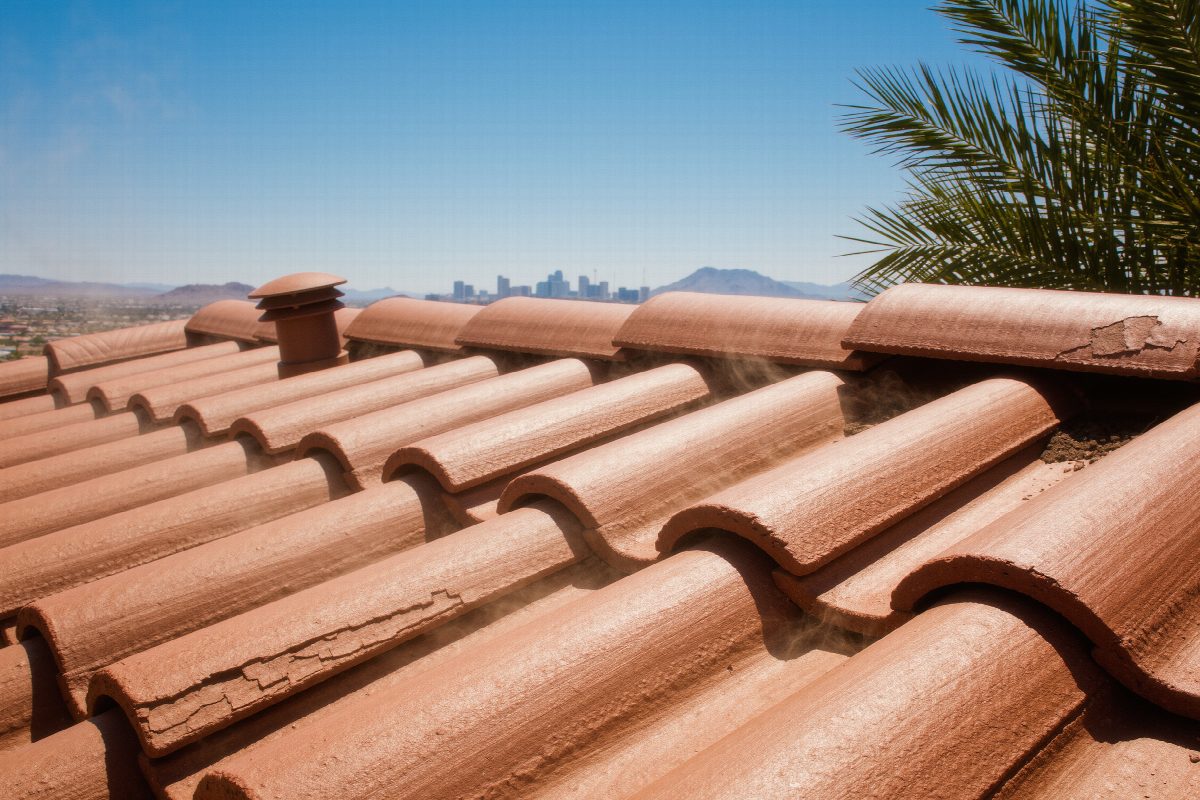
Underlayment that cooks under the tile
Most Scottsdale homes built from the 1980s on wear concrete tile over 30-pound felt. The tile is fine at fifty years. The felt is brittle at twenty, and the first sign is not a leak but a stain on the garage ceiling after a sideways rain. A tile underlayment replacement relays your own tile over new synthetic underlayment, and it is the most common big job we do here.
Outflow wind at the foothills
The NWS record for this area holds more than two hundred thunderstorm wind reports since 2010, most of them in the sixty-to-eighty-mile-an-hour range, and the hardest gusts hit north Scottsdale first. Wind gets under the eave course and the hips, lifts tile, and drives rain under what it does not lift. After a storm, look at the edges, not the middle.
Hail, rarely, and then badly
Scottsdale does not get hail often, which is why the October 5, 2010 storm is still talked about: hail to two and a half inches, over a hundred million dollars of damage across the east Valley, and a decade of insurance roof claims. The NWS logged 34 hail reports within ten miles of Scottsdale since 2010. One is enough.
Flat roofs and the ponding problem
Old Town, the Airpark and the newer desert-contemporary homes carry flat or low-slope roofs under foam or a membrane. Flat roofs do not leak because they are flat; they leak because water sits where the scuppers are blocked or the foam has sagged. A foam recoat every ten to fifteen years is the whole maintenance plan, and skipping it is the whole failure.
What the weather has actually done around Scottsdale since 2010.
The National Weather Service logs every storm report it can verify. These are the ones within 10 miles of Scottsdale: 220 thunderstorm wind reports, 67 excessive heat reports, 60 flash flood reports, 52 dust storm reports. The two-and-a-half-inch hail of October 2010 and the hundred-mile-an-hour thunderstorm gust of July 2022 are the bookends; the hundreds of smaller wind reports in between are what actually keep us busy.

| Date | Event | Recorded | Where | What it does to roofs | |
|---|---|---|---|---|---|
| Sep 26, 2025 | Hail | 1.75" hailReport of golf-ball sized hail leading to dented cars on Bell Rd in North Scottsdale. No injuries reported. | Scottsdale Municipal Airport | Bruised shingles, cracked tile, dented soft metals; foam coatings chip. | NOAA #1293469 |
| Sep 26, 2025 | Hail | 1.25" hailReports of 1-1.25 inch diameter hail between West Highland Avenue and West Coolidge Street in Phoenix. No damage or injuries reported. | Phoenix | Bruised shingles, cracked tile, dented soft metals; foam coatings chip. | NOAA #1293474 |
| Oct 16, 2022 | Hail | 2" hailHailstones up to 2 inches in diameter reported near 64th St. and Shea Blvd in Paradise Valley. No damages or injuries were reported. | Paradise Valley | Bruised shingles, cracked tile, dented soft metals; foam coatings chip. | NOAA #1061575 |
| Jul 17, 2022 | Thunderstorm WindProperty damage logged: $5,000,000 | 100 mph est. gustSR-87 was closed between Loop-202 and Shea Blvd due to widespread wind damage. One mobile home and one modular home were destroyed resulting in one injury, requiring the… | Dreamland Villa | Lifted tile, torn shingles, flashing peeled at the edges; wind-borne debris punctures flat roofs. | NOAA #1048130 |
| Nov 29, 2019 | TornadoProperty damage logged: $100,000 | TornadoA powerful Pacific upper level low and associated cold front moved east across central and northern portions of the greater Phoenix metropolitan area during the early mo… | Cactus | Decking exposed, structural damage, whole slopes stripped. | NOAA #863484 |
| Jul 9, 2018 | Thunderstorm WindProperty damage logged: $75,000 | 90 mph est. gustScattered thunderstorms affected the central portions of the greater Phoenix area, including downtown Phoenix and areas around Sky Harbor Airport, during the afternoon h… | sky Harbor Airport | Lifted tile, torn shingles, flashing peeled at the edges; wind-borne debris punctures flat roofs. | NOAA #758024 |
| Mar 1, 2014 | TornadoProperty damage logged: $50,000 | TornadoA strong upper level low pressure system moved slowly east across Arizona on Saturday March 1st, and it led to the formation of isolated severe thunderstorms across the … | McQueen | Decking exposed, structural damage, whole slopes stripped. | NOAA #494705 |
| Oct 5, 2010 | HailProperty damage logged: $110,000,000 | 2.5" hailThis storm moved from south of Chandler to far north Scottsdale. As the storm moved through Scottsdale, the storm dropped up to tennis ball sized hail. The hail damaged … | Scottsdale | Bruised shingles, cracked tile, dented soft metals; foam coatings chip. | NOAA #266217 |
Source: NOAA NCEI Storm Events Database, events from 2010 through 2026 with a reported location within 10 miles of Scottsdale, or an NWS zone warning covering it. Wind speeds marked "est." are NWS estimates from damage; "measured" gusts came from an instrument. Dollar figures are the property damage NWS logged for the whole event, not one roof.
Excessive-heat warning days covering Scottsdale, by year
Each bar is a day the NWS issued a heat warning or advisory for the forecast zone Scottsdale sits in. Heat is the slow storm: it is what ages underlayment, shingles and coatings between the loud ones.
Had one of these go over your roof? A free inspection with photos tells you what it did, in writing, before the next one. Storm damage is cheapest fixed the week it happens.
Every roof. Every property type.
One trusted, family-owned roofer for Scottsdale — homes, businesses, and multifamily communities alike.
Residential Roofing
Tile, shingle, foam, metal, and flat roofs for Scottsdale homes — installs, repairs, and replacements.
Commercial Roofing
TPO, PVC, EPDM, foam, and metal systems engineered for Scottsdale's toughest buildings.
Multifamily Roofing
Apartment, condo, and HOA roofing across Scottsdale — phased, documented, and warrantied.
An honest number takes four facts, not a city name.
We do not publish a Scottsdale price list, because there is no such thing as a Scottsdale roof. There is your roof: its square footage, its pitch, what is on it now, and how many layers and penetrations are hiding underneath. Our instant estimator asks exactly those questions and prices them from our real job costs, in about a minute, with no phone call.

Size and pitch
Priced by the roofing square (100 sq ft). Steep slopes and two-story walls add labor and safety setup; a flat roof adds drainage work.
The system
Tile is the most expensive to install and the cheapest to keep; shingles the reverse. Foam is a recoat every decade, not a tear-off.
What is underneath
Most Scottsdale tile roofs do not need new tile; they need new underlayment. Rotten decking, extra layers and old skylights are the surprises, and we price them before we start, not after. What a full replacement involves.
Permit and disposal
Where Scottsdale requires a permit, the fee and the inspections are part of the quote. So is the dumpster. Financing is available on every job.
What the City of Scottsdale requires before the first tile moves.
Read from the official pages, linked below, and worth reading yourself: a permit pulled in your name by a licensed contractor is the paper trail that protects your warranty, your insurance claim, and your sale price. We pull the permit and schedule the inspections on every job that needs one. The authority is Planning and Development Services - Permit Services / One Stop Shop, Permit Services 480-312-2500; One Stop Shop 480-312-7725; Inspection Services 480-312-5750.

Like-for-like re-roof is exempt. Listed under 'Work that does not require a permit': "Re-roofing when the same roofing material is used". A change of material is not addressed by name; the same page lists "Alteration of building exterior" under work that requires a Building Permit.
Roof repair is not named. General statement: "home improvement projects that are cosmetic, do not involve structural changes, and do not require skilled trades ... do not require a permit" (same page).
Not stated for roofs. Page says projects that require "construction, structural improvements, demolition" require a permit.
No roof-specific inspection published; same-material re-roof needs no permit. Permitted projects: "Inspections are requested and completed in phases."
2021 IBC, IEBC, IPC, IMC, IFGC, IFC, ISPSC and 2020 NEC with city amendments effective Jan. 1, 2023; 2021 IRC and 2021 IECC amendments effective Jan. 7, 2023 (Ordinance No. 4575, Resolution No. 12499); 2021 IgCC mandatory July 1, 2023. and the 2021 IRC amendments PDF.
No re-roof figure published (re-roof is exempt). Fee schedule: "Work completed without a permit will be fined an amount equal to double the permit fee."
Exempt work "can be done by the homeowner, or their contracted professional"; no owner-builder rule for permitted roof work found.
Cool-roof rule: 2021 IRC amendments add Section N1102.6 (R402.6) requiring low-sloped roof surfaces (Climate Zones 0-3) to meet a 3-year-aged SRI of 64, or aged reflectance 0.55 and emittance 0.75, unless prohibited by the ESLO (Resolution No. 12499, p. 8).
Rules change and we are roofers, not the building department: confirm the current requirement with the City of Scottsdale before work starts. Rules above were read from the linked official pages on October 25, 2026.

What lasts here, and how long.
Scottsdale HOAs have opinions about color and profile, the sun has opinions about everything else. These are the systems that hold up here and what decides how long.
Concrete tile, the Scottsdale default
Right for the architecture and nearly immortal on its own. The underlayment is the roof; budget for it at year twenty and the tile lasts a lifetime. Ask for synthetic underlayment, not felt, when it is replaced.
Foam with elastomeric coating, on the flats
Seamless, reflective and self-flashing, which is why it is on most Old Town commercial roofs. It is a system you recoat, not replace. White coatings matter here: a dark flat roof in Scottsdale runs 40 degrees hotter than the air.
Standing-seam metal, in the foothills
The desert-modern homes north of Dynamite like it for the look; the wind likes it for the hold. Fasteners and penetrations are what need checking after year fifteen.
Shingles, where the HOA allows them
The cheapest roof to install and the shortest-lived under this sun: plan on 18 to 25 years, and look for granule loss in the gutters as the early warning.
| Roof system | Expected life here | What decides it |
|---|---|---|
| Concrete tile | 50 years or more for the tile; 20 to 25 for the underlayment beneath it | The tile outlives the felt it sits on. Most "tile roof replacements" here are underlayment replacements with the tile relaid. |
| Asphalt shingles (architectural) | 18 to 25 years | The Valley sun ages shingles faster than the label says; granule loss is the tell. |
| Spray polyurethane foam with elastomeric coating | 25 years and up, with a recoat every 10 to 15 | Foam is a system you maintain, not replace; let the coating go and the foam goes with it. |
| Standing-seam metal | 40 to 60 years | Expansion and contraction loosen fasteners over decades; otherwise it shrugs off the heat. |
| Modified bitumen or single-ply (TPO, PVC) on flat roofs | 15 to 25 years | Reflective membranes last longest; ponding water takes years off any of them. |
Ranges reflect roofs in this climate region under normal maintenance; a warranty up to 30 years is available on qualifying systems we install. Compare systems on our residential roofing page.
Every part of Scottsdale was built in a different decade, and the roofs show it.
Scottsdale runs some thirty miles north to south, and the roofs change by the decade the subdivision was platted. A few of the areas we are in most weeks.

| Area | Housing and roofs | What we see on inspections |
|---|---|---|
| Old Town and south Scottsdale | 1950s to 1970s ranches and bungalows, many with low-slope or flat sections; galleries, restaurants and offices on foam or built-up roofs. | Ponding and blocked scuppers on the flats; original felt under tile on the ranches; aging patio-roof panels that take flight in outflow winds. |
| McCormick Ranch and Gainey Ranch | Late 1970s to 1990s tile and shake-converted roofs around the lakes and fairways; HOA-governed profiles and colors. | First-generation underlayment at or past its life; shake-to-tile conversions with undersized battens; HOA approvals that we handle for you. |
| DC Ranch and Silverleaf | 2000s custom and semi-custom homes with heavy concrete and clay tile, long hips, and many roof-to-wall transitions. | Flashing at the transitions, cracked tile at the hips from foot traffic by other trades, and solar re-roof coordination. |
| Troon North and Pinnacle Peak | Desert-modern homes on the foothill slopes: tile, metal and flat sections, exposed to the strongest outflow winds in the city. | Lifted eave tile and ridge caps after wind events; sun-side coating failure on flat sections facing south and west. |
| Ancala and the Shea corridor | 1990s tile homes on the lower McDowell slopes and the golf course edges. | Twenty-five-year-old felt, wind damage at the eaves, and HOA color matching on replacement tile. |
| The Airpark and north-central commercial | Low-slope commercial, light-industrial and multifamily roofs: foam, TPO and modified bitumen, acres of it. | Recoats past due, mechanical-unit flashing, and drains that have not been cleaned since the last tenant. |
Get your free Scottsdale roofing estimate.
Tell us about your property and our team will follow up fast with an honest assessment and a clear plan — no pressure, no obligation.
- Superior ratings across Google, Yelp & Facebook.
- Industry-leading warranty up to 30 years.
- Family owned, licensed, bonded & insured. AZ ROC #325294.
Prefer to talk? Call (602) 314-4650. Prefer to pick a time? Book online.
Get Your Free Estimate
Free roof inspection · Response within 24 hrs
Thank you!
Your request has been received. Our team will contact you shortly.

A roof here has a calendar. Here is ours.
Scottsdale has two roof seasons: the storms from June to September, and the heat that works on the roof in between. Everything that matters happens in the weeks before each.
- May
Clear every scupper, drain and gutter; cut back limbs over the roof; check that tile at the eaves and hips is seated.
Dust storms arrive before the rain. A blocked drain plus a monsoon cell is a ceiling leak. - Early June
Inspect foam and flat roofs for exposed foam, blisters or ponding marks; have coatings due this year done now.
Coatings need dry weather to cure, and July will not give it to you. - After every big monsoon storm
Walk the ground line for displaced or broken tile, lifted shingles and debris; check ceilings and the garage.
Wind damage is cheapest fixed the same week it happens. - Late September
Book a post-monsoon inspection with photos; reseal pipe boots, skylight curbs and parapet caps.
The summer cooked the sealants; the fall is when you find out which ones. - December through February
Watch flat roofs during winter rain; the slow, soaking storms find leaks the monsoon missed.
Winter rain sits on a roof for days instead of minutes.
Would rather not climb a ladder? Our free inspection covers every item on this list, with photos and a written report you keep. What a 21-point inspection looks at.
Asked in Scottsdale, answered plainly.
Does a roof replacement in Scottsdale require a City permit?
For a like-for-like re-roof and for underlayment replacement, check the current rule with the City of Scottsdale building department; the permit section above is read from their official pages and links to them. Where a permit is required, we pull it in your name and schedule the inspections. A permit on file is also what your insurer and your eventual buyer will ask to see.
How does Scottsdale heat affect tile roof underlayment?
Concrete tile does not keep the sun off the underlayment; it stores heat and radiates it downward, so the felt under a Scottsdale tile roof can run well past a hundred and fifty degrees on a July afternoon. Asphalt felt loses its oils, goes brittle and cracks at the laps, usually between year fifteen and twenty-five. Synthetic underlayment tolerates the heat far better, which is why we specify it on every tile underlayment replacement.
What should I check after a monsoon windstorm?
From the ground, with binoculars if you have them: the eave course and the hips for slipped or missing tile, the ridge for lifted caps, the flat sections for standing water, and the yard for pieces of your roof. Inside, look at the garage ceiling and the closets on the windward side. Then book the free inspection; the NWS has logged more than two hundred thunderstorm wind reports within ten miles of Scottsdale since 2010, and the damage from each one is cheapest fixed within the week.
Will my HOA need to approve my new roof?
In most of Scottsdale north of Shea and in the Ranch communities, yes: tile profile and color are governed, and some associations require a submittal with a sample. We have been through the process with most of the large associations and we prepare the paperwork and the color match as part of the job.
Can a foam roof in Scottsdale be recoated instead of replaced?
Almost always, if the coating has not been allowed to fail completely. Foam is a two-part system: the foam insulates and sheds water, the elastomeric coating protects the foam from the sun. Recoat on a ten-to-fifteen-year cycle and the foam itself lasts indefinitely. Let the coating chalk through to bare foam and the sun eats the foam, and then it is a replacement. How we recoat and when.
How often should a Scottsdale roof be inspected?
Once a year, and after any storm you noticed. Our inspection is free, covers 21 points with photos of every slope, and comes with a written report you keep whether or not you hire us. For tile roofs past fifteen years, the inspection is mostly about the underlayment; for flat roofs it is about drainage and the coating.
Do you work on commercial and multifamily roofs in Scottsdale?
Yes, and they are a large share of our work here: the Airpark's low-slope warehouses and offices, the Old Town commercial core, and the condominium and apartment communities along Scottsdale Road and the Loop 101. Those roofs are mostly foam, TPO and modified bitumen, and the work is mostly recoats, drain and flashing repairs, and phased replacements planned around tenants. Multifamily and commercial roofing have their own pages, their own crews, and the same warranty as our residential work.
Concrete or clay tile is the armor: it shrugs off sun and hail for fifty years and more. It is not the waterproofing. Broken or slipped tile lets water onto the layer below, which is where leaks are born.
The real roof: a sheet under the tile that carries water to the eaves. Felt cooks under tile in this heat and goes brittle at twenty years; synthetic underlayment lasts far longer. Most "tile roof replacements" are underlayment replacements with the tile relaid.
The plywood or planks everything is nailed to. It only fails after the underlayment has leaked for a while; soft or stained decking means the leak is old. Replacing decking is structural work and needs a permit almost everywhere.
Metal where the roof meets a wall, a chimney or a change of slope. It is where most leaks start, because it depends on sealant that the sun dries out. A good inspection spends half its time here.
Every pipe through the roof wears a rubber or lead boot. The rubber ones crack in the sun in eight to twelve years, and water follows the pipe straight into the house. Cheap to replace, expensive to ignore.
The metal edge that sends water into the gutter instead of behind the fascia. Monsoon wind lifts the first course of tile here first, and a gutter packed with dust and fronds turns a storm into a waterfall over the door.
Tap or hover a part of the roof. Every one of these is on our free inspection in Scottsdale.
Roofing near Scottsdale.
We serve the entire Phoenix metro. A few of the communities close to Scottsdale:
Your roof deserves the best in Scottsdale.
Superior ratings, an industry-leading warranty, and a family-owned team that treats your roof like our own. Reach out today for a free, no-obligation estimate.


