Tucson roofing, built for the Old Pueblo.
Flat, foam, tile and shingle roofs from the historic districts to the east side tracts — one family-owned, licensed roofer.
Tucson gets its weather off the mountains and its roofs show it: the monsoon arrives earlier and wetter here than in Phoenix, and the city has more flat roofs to catch it.
Tucson sits at about twenty-four hundred feet in a basin ringed by the Santa Catalinas, the Rincons and the Tucson Mountains, and that geography writes the weather. The afternoon cells build over the Catalinas in late June, slide down the slopes and arrive over midtown already raining; the summer is a few degrees kinder than Phoenix and the monsoon is not. A large share of the older city wears a flat roof behind a parapet: built-up tar and gravel on the burnt-adobe and territorial homes, foam and elastomeric coating on the ones redone since the 1980s. The newer city, out past Kolb and up toward Oro Valley, is concrete tile over felt. Both have a weak point, and in both cases it is the part you cannot see from the street.
We have worked on the parapet roofs of Sam Hughes and Armory Park, where the scuppers are a century old and the canales drain onto the neighbor's wall; on the 1950s ranches off Broadway and Speedway with their low-slope additions and swamp-cooler curbs; on the tile tracts along Houghton and in Rita Ranch; and on the warehouses and apartment blocks off I-10 and Valencia. We are family owned and operated, licensed, bonded and insured, and our crews know which Tucson intersections flood before the radio says so.
This page is the long version: what the National Weather Service has recorded within twelve miles of downtown since 2010, what the City of Tucson requires before a roofer touches your roof and when it does not, what we have actually done here, and the answers we give when a Tucson homeowner or property manager asks a straight question. Read it, then book the free inspection.
Four things that break Tucson roofs, in the order they do it.
The sequence in Tucson runs from the heat that ages the materials to the storms that find what the heat has weakened. With 124 flash flood reports in the record, the rain comes hard and all at once; the hail is the surprise.
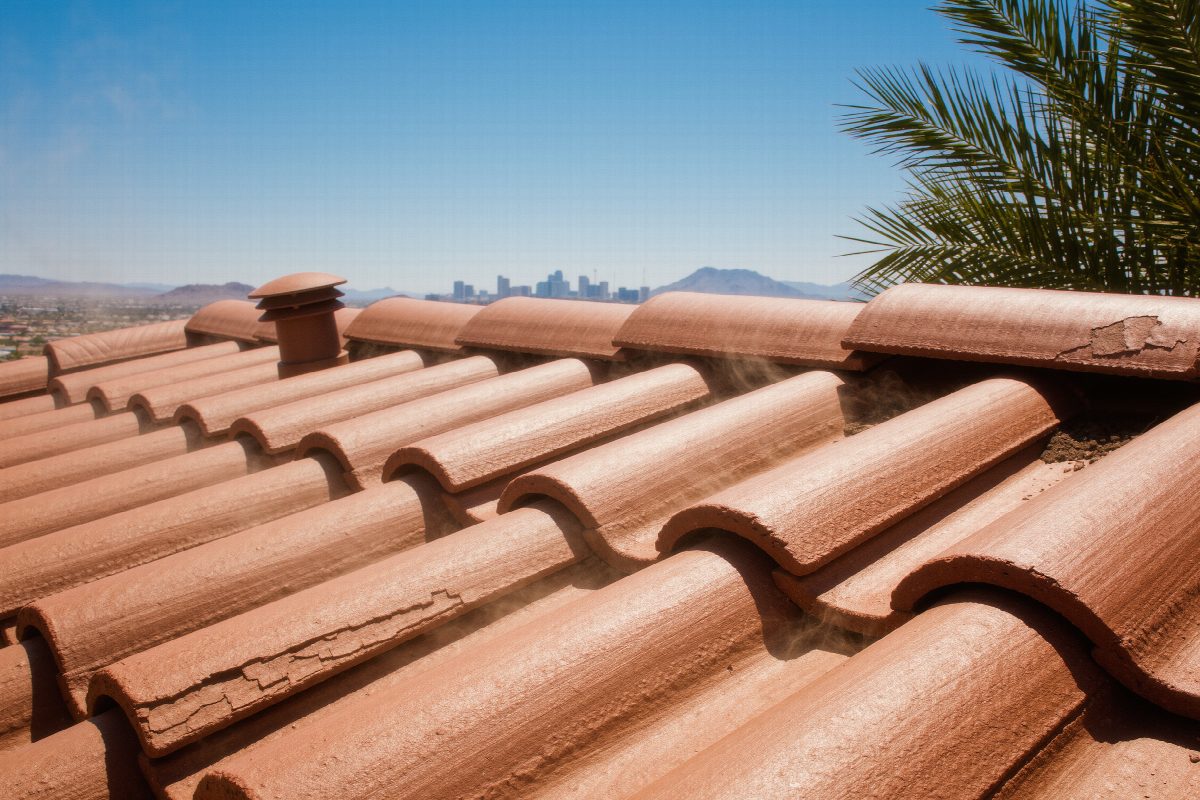
Coatings that chalk through on the flats
Tucson has more flat roofs per block than Phoenix ever did, and the ones that fail do it quietly. Elastomeric coating chalks under the sun, thins at the high spots, and one summer there is bare foam where the coating used to be. Foam without a coating drinks water, and then the sun eats it. A recoat on a ten-to-fifteen-year cycle is the entire maintenance plan; past that point it becomes a replacement. A blocked scupper behind a parapet does the same work faster: water that sits for a day finds the seam.
Felt that cooks under east side tile
The tile subdivisions from the 1980s on, from Rita Ranch up the Houghton corridor and across the northwest side, were built with asphalt felt under concrete tile. The tile is fine at fifty. The felt is brittle at twenty, and the first sign is a stain on a garage ceiling after a sideways rain. The fix is a tile underlayment replacement: your own tile relaid over new synthetic underlayment.
Monsoon wind off the Catalinas
The NWS has logged 186 thunderstorm wind reports within twelve miles of Tucson since 2010, and the worst of them run straight through midtown. The June 26, 2016 storm, estimated at 75 miles an hour, took trees down from the University to River Road and Campbell, dropped them onto carports and homes in Winterhaven, and tore up a church roof on Tucson Boulevard. Wind lifts the eave course on tile, peels the edge metal on flat roofs, and drives rain under whatever it did not lift.
Hail, more often than Phoenix gets it
Tucson gets real hail, and not rarely: 36 reports since 2010. Golf-ball stones crossed from the Foothills through Amphi on June 30, 2015 and damaged skylights and roofs on many homes and hundreds of vehicles. On July 28, 2023 it was 1.75-inch hail from Speedway and Wilmot to Broadway and Campbell, and a few weeks later a swath of 1.5-inch stones ran from the airport to the University and put holes in a school roof. Hail claims are a documentation job as much as a roofing job; the photos have to be taken before the next storm.
What the weather has actually done around Tucson since 2010.
The National Weather Service logs every storm report it can verify. These are the ones within 12 miles of Tucson: 186 thunderstorm wind reports, 137 heat reports, 124 flash flood reports, 65 excessive heat reports. The hail is what sets Tucson apart in the table: the June 2015 swath across the Foothills and midtown, the July and August 2023 storms, and the 1.25-inch stones at Drexel Heights in August 2024; the July 2024 EF-1 tornado along Valencia Road is the oddity, and the 186 thunderstorm wind reports are the routine.

| Date | Event | Recorded | Where | What it does to roofs | |
|---|---|---|---|---|---|
| Aug 21, 2024 | Hail | 1.25" hailReport from trained spotter of 1.25 inch diameter hail. | Drexel Hgts | Bruised shingles, cracked tile, dented soft metals; foam coatings chip. | NOAA #1211530 |
| Jul 2, 2024 | TornadoProperty damage logged: $50,000 | TornadoA tornado with a maximum intensity of EF-1 developed in the vicinity of the Amazon Fulfillment Center near Kolb Road and Valencia Road. The tornado tracked towards the e… | Littletown | Decking exposed, structural damage, whole slopes stripped. | NOAA #1179238 |
| Aug 21, 2023 | HailProperty damage logged: $100,000 | 1.5" hailA swath of large hail from 1 to 1.5 inches in diameter fell from near the Tucson Airport northwest to the campus of the University of Arizona, including at the NWS Tucso… | Emery Park | Bruised shingles, cracked tile, dented soft metals; foam coatings chip. | NOAA #1129886 |
| Jul 28, 2023 | HailProperty damage logged: $5,000 | 1.75" hailHail ranging from the size of quarters to golf balls fell from Speedway and Wilmot to Broadway and Campbell. There were sporadic reports of damage to car windows and sky… | Tucson | Bruised shingles, cracked tile, dented soft metals; foam coatings chip. | NOAA #1124323 |
| Sep 12, 2016 | HailProperty damage logged: $2,000 | 1" hailHail up to 1 inch in diameter occurred for a time near along Kolb Road near Escalante Rd, 29th St, and Golf Links Rd. One home near Kolb Rd and 29th St sustained damage … | davis Monthan A | Bruised shingles, cracked tile, dented soft metals; foam coatings chip. | NOAA #659792 |
| Jun 26, 2016 | Thunderstorm WindProperty damage logged: $1,000,000 | 75 mph est. gustMultiple reports from just east of the University of Arizona campus to near River Road and Campbell of large trees uprooted, limbs snapped, and power lines down. The roo… | Tucson | Lifted tile, torn shingles, flashing peeled at the edges; wind-borne debris punctures flat roofs. | NOAA #645895 |
| Jun 30, 2015 | HailProperty damage logged: $2,000,000 | 1.75" hailLarge hail up to golf ball size occurred in a swath across Tucson from the Catalina Foothills through midtown's Amphi area southwestward to the Tucson Estates area. Hund… | Sabino | Bruised shingles, cracked tile, dented soft metals; foam coatings chip. | NOAA #590976 |
| May 13, 2011 | Dust DevilProperty damage logged: $1,000 | Dust DevilStrong daytime heating and unstable conditions caused several dust devils to form across the region. One dust devil formed at Hoffman Park located at the 4800 block of S… | Tucson | Loose tile and patio-roof panels lift. | NOAA #303119 |
Source: NOAA NCEI Storm Events Database, events from 2010 through 2026 with a reported location within 12 miles of Tucson, or an NWS zone warning covering it. Wind speeds marked "est." are NWS estimates from damage; "measured" gusts came from an instrument. Dollar figures are the property damage NWS logged for the whole event, not one roof.
Excessive-heat warning days covering Tucson, by year
Each bar is a day the NWS issued a heat warning or advisory for the forecast zone Tucson sits in. Heat is the slow storm: it is what ages underlayment, shingles and coatings between the loud ones.
Had one of these go over your roof? A free inspection with photos tells you what it did, in writing, before the next one. Storm damage is cheapest fixed the week it happens.
Every roof. Every property type.
One trusted, family-owned roofer for Tucson — homes, businesses, and multifamily communities alike.
Residential Roofing
Tile, shingle, foam, metal, and flat roofs for Tucson homes — installs, repairs, and replacements.
Commercial Roofing
TPO, PVC, EPDM, foam, and metal systems engineered for Tucson's toughest buildings.
Multifamily Roofing
Apartment, condo, and HOA roofing across Tucson — phased, documented, and warrantied.
An honest number takes four facts, not a city name.
We do not publish a Tucson price list, because there is no such thing as a Tucson roof. There is your roof: its square footage, its pitch, what is on it now, and how many layers and penetrations are hiding underneath. Our instant estimator asks exactly those questions and prices them from our real job costs, in about a minute, with no phone call.

Size and pitch
Priced by the roofing square (100 sq ft). Steep slopes and two-story walls add labor and safety setup; a flat roof adds drainage work.
The system
Tile is the most expensive to install and the cheapest to keep; shingles the reverse. Foam is a recoat every decade, not a tear-off.
What is underneath
Most Tucson tile roofs do not need new tile; they need new underlayment. Rotten decking, extra layers and old skylights are the surprises, and we price them before we start, not after. What a full replacement involves.
Permit and disposal
Where Tucson requires a permit, the fee and the inspections are part of the quote. So is the dumpster. Financing is available on every job.
What the City of Tucson requires before the first tile moves.
Read from the official pages, linked below, and worth reading yourself: a permit pulled in your name by a licensed contractor is the paper trail that protects your warranty, your insurance claim, and your sale price. We pull the permit and schedule the inspections on every job that needs one. The authority is Planning & Development Services Department (PDSD), (520) 791-5550; general questions via 311.

No permit for same-type replacement: "Replacing roofing materials with the same type—like shingles for shingles or tile for tile" is exempt "as long as no structural work is involved and the property is not in a Historic Preservation Zone." The page labels roof surface repair/replacement as "Depends on details."
No square-foot or dollar threshold published. General statement: "Work may be exempt if repairs are minor, not structural, or limited to finishes such as paint or carpet." (same exemptions page)
"A permit is required for any structural roof work, including replacement of sheathing, decking, joists, or trusses." (exemptions page)
2024 International Codes (IBC, IRC, IEBC, IFGC, IMC, IPC, ISPSC, IFC) and 2023 NEC with local amendments, effective January 1, 2026; 2024 IECC effective July 1, 2026. ICC A117.1-2017. Local amendments authorized by Ordinance #12171
Owner-builder allowed on owner-occupied residential: "Homeowners who wish to use the exemption must be listed as the owner on the permit." "Rental units are considered commercial property, and all commercial permits require a licensed contractor." (Residential Permits page)
Historic Preservation Zone (HPZ), Neighborhood Preservation Zone (NPZ) or Historic Landmark: "any development requires a permit and a Historic Preservation Design Review"; roof surface work in an HPZ/NPZ needs Special District Review.
Rules change and we are roofers, not the building department: confirm the current requirement with the City of Tucson before work starts. Rules above were read from the linked official pages on October 25, 2026.

What lasts here, and how long.
Tucson has two roofing cultures, the flat-roof city inside the loop of the Rillito and the tile city outside it, and the right system depends on which one you live in.
Spray foam with elastomeric coating
The modern answer for the flat and parapet roofs of the central city. Seamless, insulating, self-flashing at the parapet, and white, which matters at this elevation under a sun with less air above it. Recoat every ten to fifteen years and the foam lasts indefinitely. How we foam and recoat.
Concrete tile
The default east of Wilmot and north of River Road. Nearly permanent on its own; the underlayment beneath it is the real roof, and it has a twenty-to-twenty-five-year life under Tucson heat. Specify synthetic underlayment when it is replaced, and expect that to be the big roofing bill of owning the house.
Modified bitumen and single-ply, on the commercial flats
The warehouses along I-10 and the apartment blocks south of Broadway mostly carry modified bitumen or TPO. Reflective membranes last longest; ponding takes years off any of them. Drain maintenance is most of what keeps them alive.
Shingles, on a budget
The cheapest roof to put on and the shortest-lived under this sun, eighteen to twenty-five years. Granules in the gutter are the early warning; a poor fit for anything with a low slope.
| Roof system | Expected life here | What decides it |
|---|---|---|
| Concrete tile | 50 years or more for the tile; 20 to 25 for the underlayment beneath it | The tile outlives the felt it sits on. Most "tile roof replacements" here are underlayment replacements with the tile relaid. |
| Asphalt shingles (architectural) | 18 to 25 years | The Tucson sun ages shingles faster than the label says; granule loss is the tell. |
| Spray polyurethane foam with elastomeric coating | 25 years and up, with a recoat every 10 to 15 | Foam is a system you maintain, not replace; let the coating go and the foam goes with it. |
| Standing-seam metal | 40 to 60 years | Expansion and contraction loosen fasteners over decades; otherwise it shrugs off the heat. |
| Modified bitumen or single-ply (TPO, PVC) on flat roofs | 15 to 25 years | Reflective membranes last longest; ponding water takes years off any of them. |
Ranges reflect roofs in this climate region under normal maintenance; a warranty up to 30 years is available on qualifying systems we install. Compare systems on our residential roofing page.
Every part of Tucson was built in a different decade, and the roofs show it.
Tucson's roofs sort by the decade the neighborhood was built and its distance from downtown. A few of the areas we are in most often.

| Area | Housing and roofs | What we see on inspections |
|---|---|---|
| Sam Hughes, Armory Park and the historic districts | 1900s to 1940s burnt adobe, brick and territorial homes with flat roofs behind parapets; built-up roofs on some, foam on most of the ones redone since the 1980s. | Failed parapet flashing, canales that drain onto a neighbor, built-up roofs under three generations of patches, and the Historic Preservation Zone review the City requires before the roof surface changes. |
| Midtown: Broadmoor, Winterhaven, Catalina Vista | 1950s and 1960s ranches, many in burnt adobe, with low-slope or flat roofs, carports, and additions from every decade since. | Swamp-cooler curbs and abandoned penetrations, low-slope sections that pond, and the mature trees that the June 2016 wind dropped onto carports here. |
| The east side: Houghton corridor and Rita Ranch | 1980s to 2000s tile tracts between Kolb and Houghton, south to Rita Ranch and Civano; HOA-governed colors and profiles. | Original felt at or past its life, cracked tile where other trades walked, and the wind and hail that cross this side of town from the Rincons. |
| The northwest side and Casas Adobes | 1970s to 1990s tile and shake-converted homes off Ina, Orange Grove and La Cholla, with flat-roofed custom homes on the ridges. | Shake-to-tile conversions with undersized battens, first-generation felt, and outflow wind off the Catalinas working at the eaves. |
| South side and the airport corridor | 1950s to 1970s block homes with flat and low-slope roofs; warehouses, flex space and apartment communities off Valencia, Kolb and I-10. | Ponding and blocked drains, roof-mounted equipment set without curbs, and the hail and tornado track of July and August 2024 along Valencia. |
Get your free Tucson roofing estimate.
Tell us about your property and our team will follow up fast with an honest assessment and a clear plan — no pressure, no obligation.
- Superior ratings across Google, Yelp & Facebook.
- Industry-leading warranty up to 30 years.
- Family owned, licensed, bonded & insured. AZ ROC #325294.
Prefer to talk? Call (602) 314-4650. Prefer to pick a time? Book online.
Get Your Free Estimate
Free roof inspection · Response within 24 hrs
Thank you!
Your request has been received. Our team will contact you shortly.

A roof here has a calendar. Here is ours.
Tucson's monsoon officially opens June 15 and most years means it; the flats need their scuppers cleared before then, and the tile needs a look after the last storm in September.
- Early June
Clear scuppers, drains and gutters; cut back palo verde and mesquite limbs that hang over the roof; check foam coating for chalking or exposed foam.
Monsoon season officially starts June 15. Everything that is loose will move. - Between monsoon storms
Walk the ground line for displaced tile, ponding on flat roofs and grit in the valleys; look at ceilings and closets for stains.
Damage compounds: one lifted tile lets the next storm under the roof. - Late September
Book a post-monsoon inspection with photos; address slipped tile and lifted edges before the rains in winter.
The small repairs now are the cheap ones. - January
Watch flat roofs during winter rain; recoat foam or elastomeric roofs due this year while temperatures are mild.
Coatings cure best between 50 and 90 degrees. - April
Check attic ventilation and soft metals before the heat; reseal pipe boots and skylight curbs.
Sealants that are already brittle will not survive another summer.
Would rather not climb a ladder? Our free inspection covers every item on this list, with photos and a written report you keep. What a 21-point inspection looks at.
Asked in Tucson, answered plainly.
Does a re-roof in Tucson need a City permit?
Usually not. The City of Tucson exempts replacing roofing with the same type, shingles for shingles or tile for tile, as long as there is no structural work and the property is not in a Historic Preservation Zone. Replacing sheathing, decking, joists or trusses needs a permit, and any roof surface work in a Historic Preservation Zone or Neighborhood Preservation Zone goes through design review first. The permit section above is read from the City's own pages and links to them. Where a permit or review is required we handle it; the City treats a rental as commercial property, so a licensed contractor pulls it.
Why do so many Tucson houses have flat roofs, and are they a problem?
Flat roofs are the oldest local tradition: the adobe and territorial houses of the historic districts were built with parapets and canales because that is how you roof a house in a dry climate with no timber nearby. They are not a problem when they drain. The failures we see are blocked scuppers, ponding behind a parapet, coating that has chalked through to bare foam, and flashing where the parapet meets the deck. A flat roof that is recoated on schedule and cleared before every monsoon outlasts most pitched roofs in town. Flat roof repair.
Does Tucson really get hail?
More than Phoenix does. The NWS has 36 hail reports within twelve miles of Tucson since 2010, and the big ones were not glancing: golf-ball hail across the Foothills and midtown in June 2015, and two storms in the summer of 2023 that damaged roofs, skylights and cars from the airport to the University. Hail bruises shingles, cracks tile and punches skylights, and the damage is often invisible from the ground. If hail fell on your street, get the roof photographed within days, before the next storm hides the evidence.
Do you work on commercial and multifamily roofs in Tucson?
Yes: the warehouses and flex buildings along I-10 and the airport corridor, the student housing near the University, and the apartment and condominium communities across the city. Those roofs are mostly foam, TPO and modified bitumen, and the work is recoats, drain and flashing repairs, rooftop-unit curbs, and phased replacements planned around tenants. Multifamily and commercial work have their own crews and the same warranty as our residential work.
How much worse is the heat getting for Tucson roofs?
The NWS record on this page answers that: Tucson was under a heat warning for 37 days in 2024 and 67 in 2025, against a handful a year in the early 2010s. Heat is the slow killer of roofs. It cooks the oils out of asphalt felt and shingles, chalks coatings, and works fasteners loose with every daily expansion cycle. The practical answer is reflective: white coatings on flat roofs, synthetic underlayment under tile, and attic ventilation that actually moves air.
Will my HOA have a say in the new roof?
In the tile subdivisions on the east and northwest sides, yes: color and profile are governed, and most associations want a submittal before work starts. In the historic districts it is the City, not an HOA, that reviews changes to the roof surface. We prepare the submittals and the color match as part of the job, and a photo of the neighbor's roof settles most of the questions before they are asked.
Concrete or clay tile is the armor: it shrugs off sun and hail for fifty years and more. It is not the waterproofing. Broken or slipped tile lets water onto the layer below, which is where leaks are born.
The real roof: a sheet under the tile that carries water to the eaves. Felt cooks under tile in this heat and goes brittle at twenty years; synthetic underlayment lasts far longer. Most "tile roof replacements" are underlayment replacements with the tile relaid.
The plywood or planks everything is nailed to. It only fails after the underlayment has leaked for a while; soft or stained decking means the leak is old. Replacing decking is structural work and needs a permit almost everywhere.
Metal where the roof meets a wall, a chimney or a change of slope. It is where most leaks start, because it depends on sealant that the sun dries out. A good inspection spends half its time here.
Every pipe through the roof wears a rubber or lead boot. The rubber ones crack in the sun in eight to twelve years, and water follows the pipe straight into the house. Cheap to replace, expensive to ignore.
The metal edge that sends water into the gutter instead of behind the fascia. Monsoon wind lifts the first course of tile here first, and a gutter packed with dust and fronds turns a storm into a waterfall over the door.
Tap or hover a part of the roof. Every one of these is on our free inspection in Tucson.
Roofing near Tucson.
We serve the entire Phoenix metro. A few of the communities close to Tucson:
Your roof deserves the best in Tucson.
Superior ratings, an industry-leading warranty, and a family-owned team that treats your roof like our own. Reach out today for a free, no-obligation estimate.



