Verrado roofing, facing west.
Tile, shingle, metal and flat roofs from the Founders streets to Victory and Main Street — one family-owned, licensed roofer.
Verrado was drawn to look like a town that had been there a hundred years, and the weather has spent twenty of them trying to make that true.
Verrado climbs the east face of the White Tank Mountains with tree-lined streets, front porches, a real Main Street and a pattern book that forbids two houses from looking alike. The roofs follow the book: concrete tile on most, architectural shingle on the farmhouse and craftsman plans, standing-seam metal over a good many porches, and flat sections on the Main Street buildings. What the book did not plan for is the exposure. Verrado faces the open desert and farmland to the south and west, which is the direction the dust storms come from, and it sits under a sun that has produced 70 excessive heat reports within five miles of here since 2010. There is nothing between the roofs and either one.
We have worked on the original Founders homes on the benches above Main Street, on the later phases that filled in along Verrado Way and Indian School Road, on the single-story tile roofs in Victory, and on the low-slope commercial roofs in the Main Street district and down at the freeway. The oldest houses went up in 2004 and the years just after, which means their underlayment is now crossing the twenty-year line as a group. The youngest are still under builder warranty. We are family owned and operated, licensed, bonded and insured, and we work out here enough to know which way the wind comes down the mountain.
This page is the storm record the National Weather Service keeps for the area around Verrado, what the City of Buckeye asks before a re-roof, which is less clear than it should be, what we see most on these particular streets, and the questions Verrado homeowners actually ask us. Read it, then book the free inspection and let us look under the tile before the next storm does.
Four things that break Verrado roofs, in the order they do it.
Verrado gets the Valley heat, the West Valley's dust and the outflow winds that come down the White Tanks ahead of a monsoon cell. Each one works on a different part of the roof, and they arrive in a reliable order.
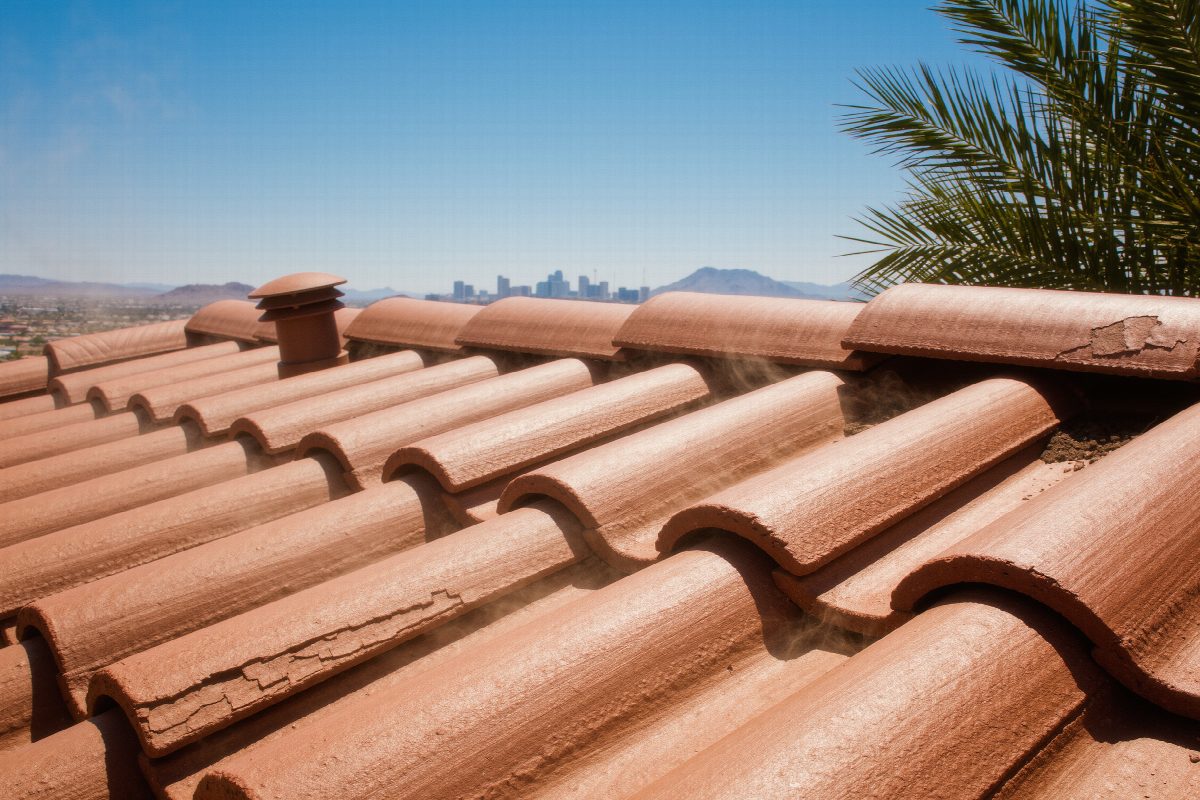
Felt that has cooked on the foothill since 2004
The Founders-era homes mostly carry concrete tile over asphalt felt, and the felt is now about twenty years into a job it does for twenty to twenty-five. There were 22 heat-warning days here in 2022 alone. The first sign is not a drip but a stain on a porch ceiling or an upstairs corner after a wind-driven rain. A tile underlayment replacement relays your own tile over synthetic underlayment, and on the original streets it is the job of this decade.
Dust storms off the open country to the southwest
The NWS has logged 55 dust storm reports within five miles of Verrado since 2010, and they arrive here with their full load because there is nothing upwind to catch it. The silt packs into valleys, behind chimney crickets and along the uphill side of porch-roof flashings, and the rain that follows turns it into a dam that sends water sideways under the tile. What a dust storm does to a roof, and what to clear before the next one.
Outflow wind down the mountain
On August 17, 2022, an outflow estimated at 70 mph uprooted trees across the Verrado community and pushed over a block wall. The record also holds two microbursts estimated at 81 mph at Valencia, in July 2011 and July 2014, the first of which tore a section of roof off Youngker High School. Wind lifts the eave course and the ridge caps first, and it takes porch roofs and patio covers whole. After a storm, look at the edges and the porches before the middle.
Hail, once in the record, and large
One hail report within five miles since 2010, and it was the November 21, 2019 storm that dropped hail measured at 1.25 inches at Perryville, just down the road. Hail that size chips glazed tile, dents metal porch roofs and vents, and bruises shingle. If your plan has a shingle or metal roof, that is an insurance conversation, and the record is on this page.
What the weather has actually done around Verrado since 2010.
The National Weather Service logs every storm report it can verify. These are the ones within 5 miles of Verrado: 70 excessive heat reports, 55 dust storm reports, 42 heat reports, 11 thunderstorm wind reports. The August 2022 outflow that uprooted trees across Verrado and the two 81 mph microbursts at Valencia in 2011 and 2014 are the events worth knowing by name; the November 2019 hail at Perryville is the one to mention to your insurer; the 55 dust storm reports are the ones that do the slow work.

| Date | Event | Recorded | Where | What it does to roofs | |
|---|---|---|---|---|---|
| Aug 17, 2022 | Thunderstorm WindProperty damage logged: $20,000 | 70 mph est. gustImages and videos showed numerous uprooted trees across the Verrado community in Buckeye, blocking numerous streets. Another image showed a block wall blown over in the … | Mc Micken | Lifted tile, torn shingles, flashing peeled at the edges; wind-borne debris punctures flat roofs. | NOAA #1053975 |
| Nov 21, 2019 | Hail | 1.25" hailStrong thunderstorms developed across the western portion of the greater Phoenix area during the afternoon hours on November 21st. One of the especially strong storms pr… | Perryville | Bruised shingles, cracked tile, dented soft metals; foam coatings chip. | NOAA #859878 |
| Jul 8, 2018 | Thunderstorm WindProperty damage logged: $25,000 | 60 mph est. gustIsolated high based thunderstorms developed over the central deserts west of Phoenix during the middle of the evening on July 8th, and one of the stronger storms generat… | Valencia | Lifted tile, torn shingles, flashing peeled at the edges; wind-borne debris punctures flat roofs. | NOAA #757089 |
| Jul 29, 2016 | Thunderstorm WindProperty damage logged: $6,000 | 69 mph est. gustScattered thunderstorms moved south across the western portion of the greater Phoenix metropolitan area during the evening hours on July 29th and some of them affected t… | Valencia | Lifted tile, torn shingles, flashing peeled at the edges; wind-borne debris punctures flat roofs. | NOAA #645869 |
| Jul 29, 2016 | Thunderstorm WindProperty damage logged: $20,000 | 64 mph est. gustStrong thunderstorms moved southwestward across the western portion of the greater Phoenix metropolitan area during the evening hours on July 29th. Some of the stronger … | Valencia | Lifted tile, torn shingles, flashing peeled at the edges; wind-borne debris punctures flat roofs. | NOAA #645874 |
| Jul 31, 2014 | Thunderstorm WindProperty damage logged: $250,000 | 81 mph est. gustStrong thunderstorms developed across portions of the greater Phoenix area, including the town of Buckeye, during the evening hours on July 31st. Due to hot and dry atmo… | Valencia | Lifted tile, torn shingles, flashing peeled at the edges; wind-borne debris punctures flat roofs. | NOAA #527146 |
| Jul 5, 2011 | Thunderstorm WindProperty damage logged: $600,000 | 81 mph est. gustThunderstorms with damaging microburst winds moved across the town of Buckeye during the evening hours on July 5th. Wind gusts estimated to be at least 60 knots ripped a… | Valencia | Lifted tile, torn shingles, flashing peeled at the edges; wind-borne debris punctures flat roofs. | NOAA #322371 |
| May 2, 2010 | High WindProperty damage logged: $50,000 | 58 mph est. gustSeveral homes in Chandler, near Kyrene and Ray, had roof tiles blown off. Tree limbs were also blown down. One woman described the wind sounding like a roaring train. | Greater Phoenix Area | Ridge caps and edge metal lift first; wind-driven rain gets under tile. | NOAA #221406 |
Source: NOAA NCEI Storm Events Database, events from 2010 through 2026 with a reported location within 5 miles of Verrado, or an NWS zone warning covering it. Wind speeds marked "est." are NWS estimates from damage; "measured" gusts came from an instrument. Dollar figures are the property damage NWS logged for the whole event, not one roof.
Excessive-heat warning days covering Verrado, by year
Each bar is a day the NWS issued a heat warning or advisory for the forecast zone Verrado sits in. Heat is the slow storm: it is what ages underlayment, shingles and coatings between the loud ones.
Had one of these go over your roof? A free inspection with photos tells you what it did, in writing, before the next one. Storm damage is cheapest fixed the week it happens.
Every roof. Every property type.
One trusted, family-owned roofer for Verrado — homes, businesses, and multifamily communities alike.
Residential Roofing
Tile, shingle, foam, metal, and flat roofs for Verrado homes — installs, repairs, and replacements.
Commercial Roofing
TPO, PVC, EPDM, foam, and metal systems engineered for Verrado's toughest buildings.
Multifamily Roofing
Apartment, condo, and HOA roofing across Verrado — phased, documented, and warrantied.
An honest number takes four facts, not a city name.
We do not publish a Verrado price list, because there is no such thing as a Verrado roof. There is your roof: its square footage, its pitch, what is on it now, and how many layers and penetrations are hiding underneath. Our instant estimator asks exactly those questions and prices them from our real job costs, in about a minute, with no phone call.

Size and pitch
Priced by the roofing square (100 sq ft). Steep slopes and two-story walls add labor and safety setup; a flat roof adds drainage work.
The system
Tile is the most expensive to install and the cheapest to keep; shingles the reverse. Foam is a recoat every decade, not a tear-off.
What is underneath
Most Verrado tile roofs do not need new tile; they need new underlayment. Rotten decking, extra layers and old skylights are the surprises, and we price them before we start, not after. What a full replacement involves.
Permit and disposal
Where Buckeye requires a permit, the fee and the inspections are part of the quote. So is the dumpster. Financing is available on every job.
What the City of Buckeye requires before the first tile moves.
Read from the official pages, linked below, and worth reading yourself: a permit pulled in your name by a licensed contractor is the paper trail that protects your warranty, your insurance claim, and your sale price. We pull the permit and schedule the inspections on every job that needs one. The authority is City of Buckeye Development Services Department - Permit Center, 623-349-6200; [email protected].

Two official sources differ. Permit Center page: "Permits are also required, but not limited to fencing, pools, spas, patios, solar and re-roofs.".
Residential Re-Roofing Checklist requires a roof plan with existing framing, "Existing Material and Weight", a sheathing detail ("typically 1/2" or larger plywood or OSB ... minimum 8d(penny) nails nailed 6" O.C. at the supported edges and 12" O.C.
Residential Re-Roofing Checklist: "Pre-inspection may be required." No other re-roof inspection sequence was read on an official page.
"Any permit applications and plans submitted for the first time to the city for review on or after January 1, 2025 shall comply with the City of Buckeye 2024 Construction Codes" (Permit Center page).
Development User Fee Schedule, Effective May 21, 2026: "Existing Roof Covering Replacement - BOSV*" (fee Based on Stated Value).
Residential Re-Roofing Checklist lists "Owner/ Builder form signed (if applicable)"; an Owner Builder Form (2016.01.20) is published on the Permit Center References page.
Checklist roof-slope categories: high slope over 5:12, low slope 2:12 to 5:12, flat below 2:12 with minimum 1/4" per foot drainage. Commercial Re-Roofing Checklist (Rev: 2021) requires roof plan, existing material and weight, attachment details, underlayment, proposed material and weight, and fire rating.
Rules change and we are roofers, not the building department: confirm the current requirement with the City of Buckeye before work starts. Rules above were read from the linked official pages on October 25, 2026.

What lasts here, and how long.
Verrado's pattern book chose the materials, and the design review committee keeps them chosen. These are the systems on these streets and what the foothill does to each.
Concrete tile, on most of the homes
Flat and S-profile tile in the earth tones the book allows. The tile is good for fifty years; the underlayment beneath it is the roof, and on 2004-era homes it is due. Specify synthetic when it is replaced and have every porch-roof and wall flashing redone while the tile is off.
Architectural shingle, on the farmhouse and craftsman plans
Right for the look, and the shortest-lived roof in the community: 18 to 25 years under this sun, less on the west slope that faces the afternoon. Granule loss at the downspouts is the early warning. When it is time, a shingle replacement is a two-day job on most plans.
Standing-seam metal, over the porches
Many plans carry metal porch and bay roofs as an accent. The metal is fine; the transition where it meets the stucco wall and the tile above is where water gets in, and the fasteners back out a little every summer. A sealant and fastener pass every few years is the whole maintenance plan.
Foam and single-ply, on Main Street and the flats
The commercial buildings in the Main Street district and the freeway retail carry foam or membrane roofs that are recoated rather than replaced. White coatings and clear scuppers are the entire difference between a twenty-year roof and a ten-year one.
| Roof system | Expected life here | What decides it |
|---|---|---|
| Concrete tile | 50 years or more for the tile; 20 to 25 for the underlayment beneath it | The tile outlives the felt it sits on. Most "tile roof replacements" here are underlayment replacements with the tile relaid. |
| Asphalt shingles (architectural) | 18 to 25 years | The Valley sun ages shingles faster than the label says; granule loss is the tell. |
| Spray polyurethane foam with elastomeric coating | 25 years and up, with a recoat every 10 to 15 | Foam is a system you maintain, not replace; let the coating go and the foam goes with it. |
| Standing-seam metal | 40 to 60 years | Expansion and contraction loosen fasteners over decades; otherwise it shrugs off the heat. |
| Modified bitumen or single-ply (TPO, PVC) on flat roofs | 15 to 25 years | Reflective membranes last longest; ponding water takes years off any of them. |
Ranges reflect roofs in this climate region under normal maintenance; a warranty up to 30 years is available on qualifying systems we install. Compare systems on our residential roofing page.
Every part of Verrado was built in a different decade, and the roofs show it.
Verrado was built from Main Street outward and upward over twenty years, and the roofs date themselves by distance from the clock tower.

| Area | Housing and roofs | What we see on inspections |
|---|---|---|
| The Founders streets around Main Street | The original 2004-to-2008 homes on the benches above and around the Main Street district; mixed styles, concrete tile on most, shingle and metal porch roofs on the rest; the biggest trees in the community. | Original felt at twenty years; stained porch ceilings; limbs on porch roofs after the 2022 outflow; lifted eave tile on the exposed west-facing slopes. |
| The later phases along Verrado Way and Indian School | Homes of the 2010s on the same pattern book, tile predominant, younger underlayment, more complicated rooflines with more valleys and wall transitions. | Valleys damming with dust; flashing at roof-to-wall transitions; cracked tile where solar and HVAC crews have walked. |
| Victory at Verrado | The active-adult section on the higher ground to the north: single-story tile homes from the mid-2010s on, long low rooflines, full exposure to wind off the mountain. | Ridge and hip caps lifted by outflow wind; dust in long shallow valleys; underlayment that is still young but on the most exposed ground in the community. |
| The Main Street district and the freeway commercial | Low-slope retail, office and civic roofs under foam, TPO and modified bitumen, plus the multifamily buildings near the center. | Blocked scuppers after dust storms, coatings due, and curb flashing around rooftop units. |
The services a Verrado roof actually needs.
Mixed architecture means mixed roofing. Porch and patio tie-ins are where we find trouble most often.
Get your free Verrado roofing estimate.
Tell us about your property and our team will follow up fast with an honest assessment and a clear plan — no pressure, no obligation.
- Superior ratings across Google, Yelp & Facebook.
- Industry-leading warranty up to 30 years.
- Family owned, licensed, bonded & insured. AZ ROC #325294.
Prefer to talk? Call (602) 314-4650. Prefer to pick a time? Book online.
Get Your Free Estimate
Free roof inspection · Response within 24 hrs
Thank you!
Your request has been received. Our team will contact you shortly.

A roof here has a calendar. Here is ours.
Verrado's maintenance year runs on the dust: clear the valleys and scuppers in May before the first haboob, check the edges after every storm, and have the sealants looked at in the fall.
- May
Clear every scupper, drain and gutter; cut back limbs over the roof; check that tile at the eaves and hips is seated.
Dust storms arrive before the rain. A blocked drain plus a monsoon cell is a ceiling leak. - Early June
Inspect foam and flat roofs for exposed foam, blisters or ponding marks; have coatings due this year done now.
Coatings need dry weather to cure, and July will not give it to you. - After every big monsoon storm
Walk the ground line for displaced or broken tile, lifted shingles and debris; check ceilings and the garage.
Wind damage is cheapest fixed the same week it happens. - Late September
Book a post-monsoon inspection with photos; reseal pipe boots, skylight curbs and parapet caps.
The summer cooked the sealants; the fall is when you find out which ones. - December through February
Watch flat roofs during winter rain; the slow, soaking storms find leaks the monsoon missed.
Winter rain sits on a roof for days instead of minutes.
Would rather not climb a ladder? Our free inspection covers every item on this list, with photos and a written report you keep. What a 21-point inspection looks at.
Asked in Verrado, answered plainly.
Does a re-roof in Verrado need a City of Buckeye permit?
The City's own pages do not agree with each other. One official page says permits are required for re-roofs; the City also publishes a residential re-roofing checklist that asks for a roof plan, the existing material and weight, and a sheathing detail, and says a pre-inspection may be required, with a fee based on the stated value of the work. The permit section above quotes those sources and links to them. Because they conflict, we confirm the current requirement with Buckeye before work starts and pull any permit that applies.
Our house was one of the first built in 2004. Is the underlayment synthetic or felt, and is it due?
Most homes from the first phases went on with asphalt felt, because that was the standard in 2004. Felt under concrete tile on a west-facing foothill is reliably brittle by year twenty, and the NWS has counted 70 excessive heat reports within five miles of Verrado since 2010. Our free inspection lifts tile at the eaves and valleys and photographs what is underneath, so you know whether you have a few years or a few months. If it is due, we relay your own tile over synthetic underlayment and you keep the roof the design committee approved.
Will the Verrado design review committee need to approve the work?
For a like-for-like underlayment replacement that relays your existing tile, usually a notice is enough; for a change of material, profile or color, or a new porch roof, expect a submittal. The committee is more particular than most West Valley associations, because the varied streetscape is the whole idea. We prepare the submittal and the color match as part of the job.
What does a West Valley dust storm do to a roof here?
It arrives with its full load; nothing upwind catches it. Silt settles into every valley, behind every cricket and along the uphill edge of every porch-roof and wall flashing. The rain that follows, often within the hour, turns the silt into a dam, and water backs up under the tile to the first crack in the felt. The NWS has logged 55 dust storm reports within five miles since 2010. The May line on the maintenance calendar above exists for exactly this.
The August 2022 storm uprooted trees and knocked over walls. What should I be looking for on the roof?
That outflow was estimated at 70 mph across the community, and wind that moves trees and block walls moves tile. From the ground, look at the eave course and the hips for slipped or missing pieces, the ridge for lifted caps, the porch and patio roofs for anything bent or missing, and the yard for pieces of roof. Inside, check porch ceilings and upstairs corners on the side the wind came from. Then book the free inspection; damage from a storm like that is cheapest fixed in the same week.
Did the November 2019 hail damage roofs in Verrado?
The NWS logged hail measured at 1.25 inches at Perryville on November 21, 2019, the only hail report within five miles of Verrado since 2010. Hail that size does not break sound concrete tile, but it chips glazed tile, dents metal porch roofs and vents, bruises foam coatings and strips granules from shingle. If your plan has a shingle or metal roof, a documented inspection is worth the hour, and insurers expect that claim to be filed promptly rather than years later.
Does being on the foothill change what my roof needs?
Mostly it changes the exposure. The west-facing slopes take the afternoon sun longest, so felt ages faster on that side; the outflow comes down the mountain with nothing to slow it, so eave and ridge tile lift earlier than they would on the Valley floor; and the washes that drain the White Tanks mean the flat commercial roofs below need their scuppers clear before every storm, because the record holds four flash flood reports in this area since 2010. It does not change the system. It changes how often somebody should look at it.
Concrete or clay tile is the armor: it shrugs off sun and hail for fifty years and more. It is not the waterproofing. Broken or slipped tile lets water onto the layer below, which is where leaks are born.
The real roof: a sheet under the tile that carries water to the eaves. Felt cooks under tile in this heat and goes brittle at twenty years; synthetic underlayment lasts far longer. Most "tile roof replacements" are underlayment replacements with the tile relaid.
The plywood or planks everything is nailed to. It only fails after the underlayment has leaked for a while; soft or stained decking means the leak is old. Replacing decking is structural work and needs a permit almost everywhere.
Metal where the roof meets a wall, a chimney or a change of slope. It is where most leaks start, because it depends on sealant that the sun dries out. A good inspection spends half its time here.
Every pipe through the roof wears a rubber or lead boot. The rubber ones crack in the sun in eight to twelve years, and water follows the pipe straight into the house. Cheap to replace, expensive to ignore.
The metal edge that sends water into the gutter instead of behind the fascia. Monsoon wind lifts the first course of tile here first, and a gutter packed with dust and fronds turns a storm into a waterfall over the door.
Tap or hover a part of the roof. Every one of these is on our free inspection in Verrado.
Roofing near Verrado.
We serve the entire Phoenix metro. A few of the communities close to Verrado:
Your roof deserves the best in Verrado.
Superior ratings, an industry-leading warranty, and a family-owned team that treats your roof like our own. Reach out today for a free, no-obligation estimate.


